Key facts
Reverie (Träumerei), painted by Ludwig von Hofmann in 1898, is an oil on wood panel held at the Alte Nationalgalerie in Berlin. This early work reflects the German artist’s engagement, as a member of the Berlin Secession from 1898, with the Symbolist and Art Nouveau currents of the period around 1900. The painting takes its title from a lithograph Hofmann published in the magazine Pan in 1896, and shares its features with another portrait, Flora, painted the same year and said, according to family tradition, to have been created on the occasion of an engagement. The museum identifies the sitter as the artist’s fiancée, Eleonore Kekulé von Stradonitz, whom he married in Berlin in 1899. The panel, cut to fit an antique Italian frame, unites painting and framing into a single work.
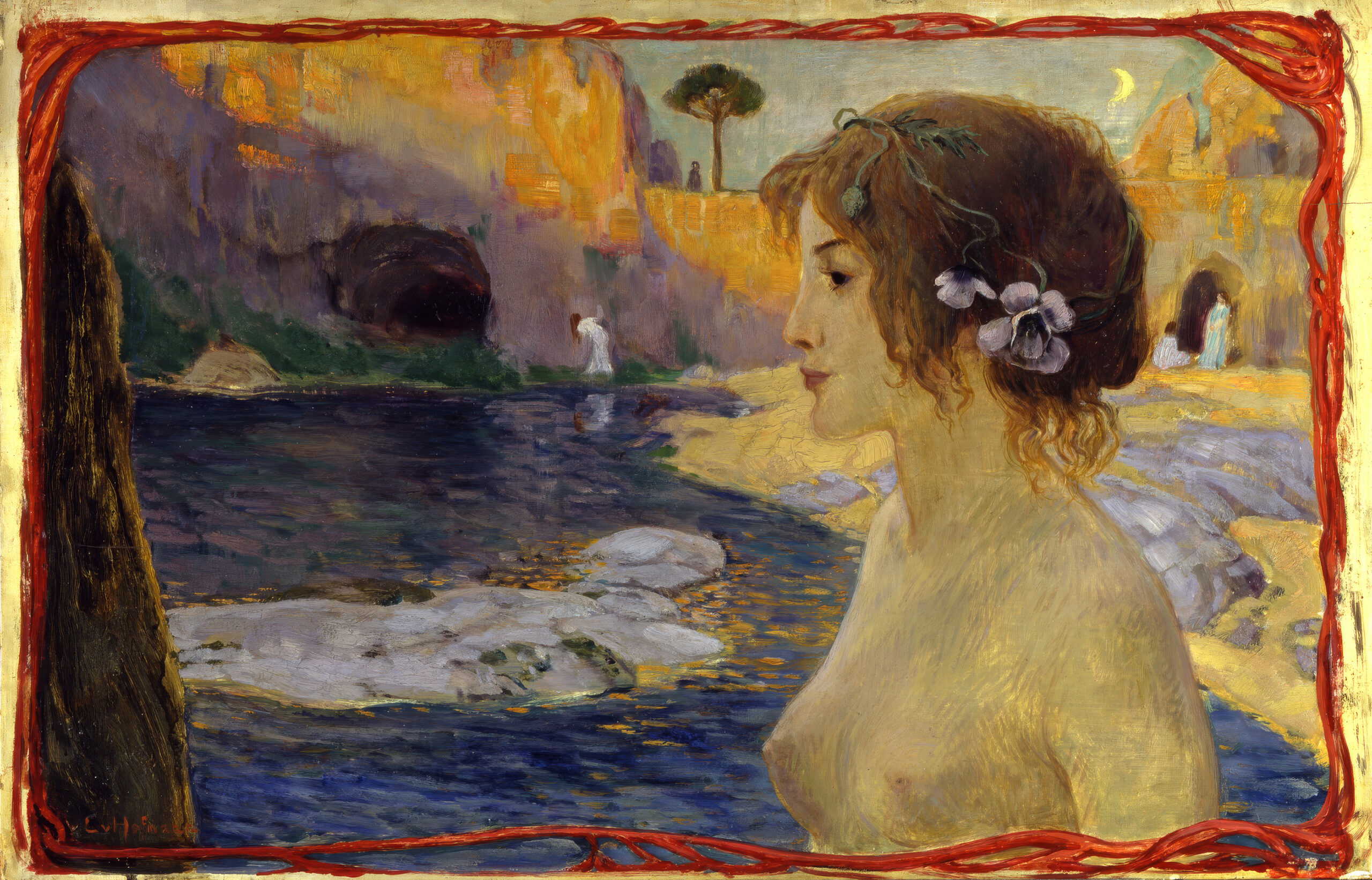
We stand before a dreamlike work whose title is itself perfectly evocative: Reverie (Träumerei in German). I love its warm, colourful character: the background scene rests peacefully under a soft evening light. The figure in the foreground gazes into the distance, lost in thought, absorbed in the very reverie that gives the painting its title. The curving lines and ornamental details, I find, create a sense of enchantment, an elegiac and symbolic atmosphere characteristic of Hofmann’s early work. The whole scene is reverie, as much for the viewer as for the figure depicted within it. And notably, the museum’s own record confirms this explicitly: the profile view deliberately echoes female portraiture of the Florentine Renaissance, much like the profile portrait of a young woman by Botticelli we featured recently on Vmuseum.
A green tendril winds through her brown hair, held by two mauve flowers barely open. Ludwig von Hofmann paints this detail with the same care he gives the face it frames, in 1898.
Reverie: the profile figure, the evening light
Her gaze drifts toward the horizon, her head turned in pure profile. Behind her, ochre cliffs glow under a low sun, pierced by a dark cave. A crescent moon already hangs in a pale, almost green sky. The water, dark and still, carries pale rocks like reflections of snow along the shore. Her skin, gilded by the evening light, stands out against the deep blue of the water behind her. A lone pine rises in the distance; white-robed figures linger by the water’s edge: everything seems suspended between day and night. Hofmann painted this in oil on a wood panel measuring 45 x 70.5 cm. A sinuous red vine motif frames the scene and runs onto the panel itself, like painted ivy. The signature, discreet, curls in the lower left corner.
A painting born of Ludwig von Hofmann’s engagement
Hofmann had already published a lithograph of the same title in the magazine Pan in 1896. Two years later, the face painted here echoes that of another portrait, Flora, said by family tradition to have been made for an engagement. The museum identifies the sitter as the painter’s fiancée, Eleonore Kekulé von Stradonitz, daughter of the archaeologist Reinhard Kekulé von Stradonitz, a professor in Darmstadt. She was also his cousin. The couple married in Berlin in 1899. The wood panel, cut to fit an antique Italian frame, echoes a gesture the sculptor Reinhold Begas had used for the portrait of his own bride: uniting the support and its frame into a single work.
A Symbolist of the Berlin Secession
Born in Darmstadt in 1861, Hofmann first studied law before turning to painting, training in Dresden and then at the Académie Julian in Paris, where he discovered the work of Puvis de Chavannes. He joined the Berlin Secession at its founding in 1898, alongside Max Liebermann. His travels in Italy, particularly time spent in Fiesole, would shape his pictorial world for years to come, poised between mythology and Mediterranean landscape. He later taught in Weimar and then in Dresden. The writer Gerhart Hauptmann and the novelist Thomas Mann counted among his admirers.
In the news: the Alte Nationalgalerie turns 150
In 2026, the Alte Nationalgalerie, home to Hofmann’s Reverie, marks the 150th anniversary of its building on Berlin’s Museum Island. To mark the occasion, the museum honours Paul Cassirer, the art dealer who played a decisive role in bringing French Impressionism to Germany, with an exhibition on view until 27 September 2026.
Source: Alte Nationalgalerie
A question for you
What if the painted frame, this red vine climbing across the panel, were not mere ornament, but a claim to a total work of art in which painting and frame become one?
About this work
- Reverie (Träumerei)
- Ludwig von Hofmann
- 1898
- Oil on wood
- 45 x 70.5 cm
- Alte Nationalgalerie, Berlin
- https://search.smb.museum/object/obj-961278