Key facts
Neptune and Amphitrite, painted by Jacob Jordaens around 1648, belongs to 17th-century Flemish Baroque painting. Held at the Rubenshuis in Antwerp, the canvas depicts the sea god alongside his wife Amphitrite, surrounded by tritons and sea horses, in a maritime allegory much prized by Antwerp patrons of the time. Jordaens painted it after the deaths of Rubens and Van Dyck, at the moment he became the leading figure of Antwerp painting. The work illustrates the dense, fleshy style that characterizes his mature output, marked by movement and colour contrast.
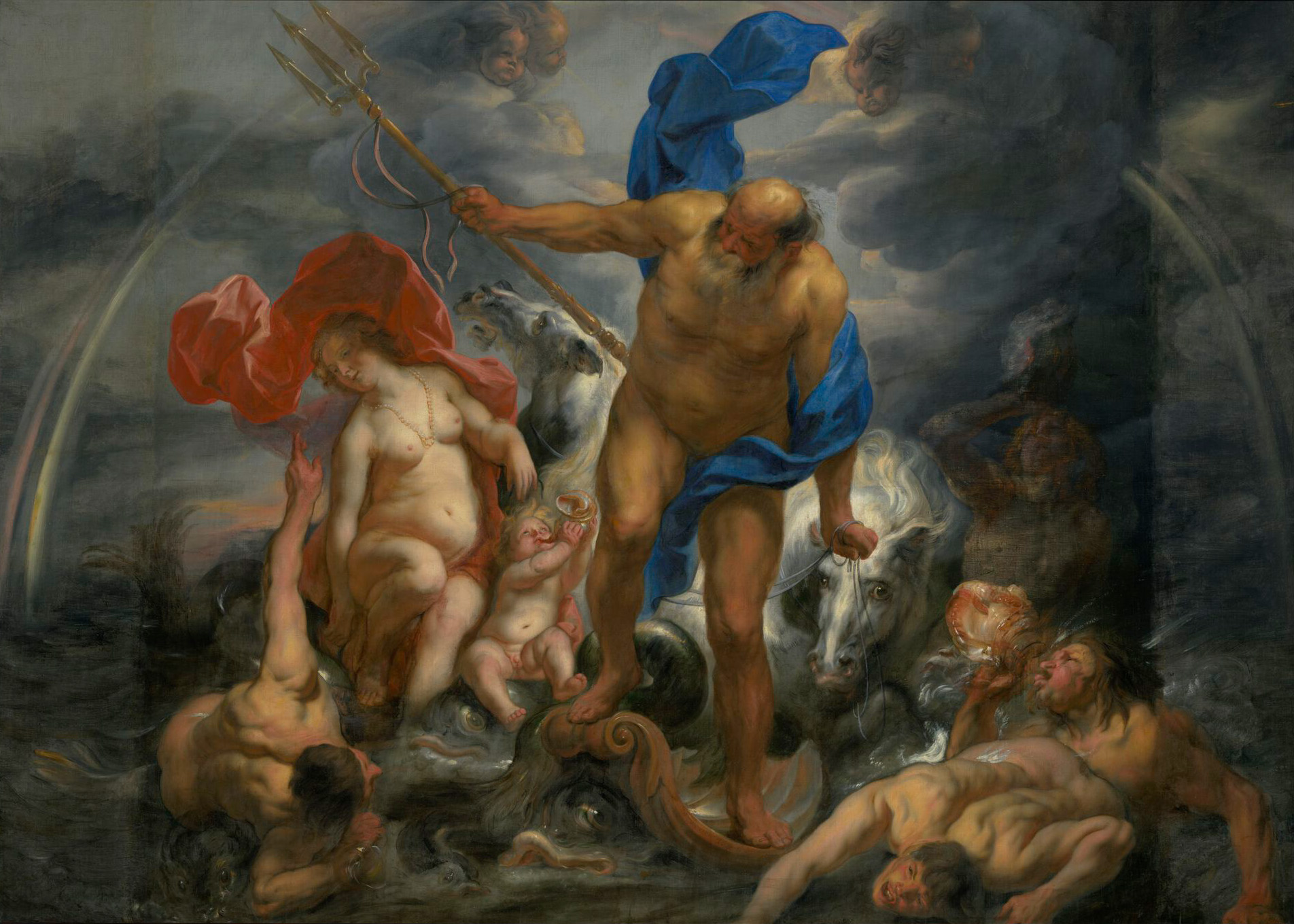
You recognise Neptune, god of the sea, at once by his trident. But I find myself wondering about Amphitrite, seated beside him. She is in fact a sea nymph, a Nereid, daughter of the sea god Nereus, with whom Neptune fell hopelessly in love. He struggled to win her hand, succeeding only through the intervention of the dolphin Delphinus. She became queen of the seas at his side and bore several children, among them Triton. What amuses me in this painting is that it isn’t actually Triton blowing the conch shell at their feet, but a little cupid, as if to underline the couple’s passion. The real Tritons are there too, in the foreground: less graceful, half-man, half-fish, escorting the tempestuous chariot.
I love the richness of Jordaens’s canvases, his rendering of figures full of force and form, movement and colour. The whole scene is in motion: the sky and sea churning, water spraying, bodies surging with power. And that little dolphin below, almost comical, who alone seems to be steering the entire chariot through the waves, a detail I adore. A rainbow timidly breaks through on the horizon: the storm is subsiding, as if Neptune himself were calming the very waters he had unleashed.
A fold of blue fabric lifts on Neptune’s shoulder. It seems swollen by a wind. This ripple of fabric bears the signature of the most prolific workshop in 17th-century Antwerp: that of Jacob Jordaens.
A composition reworked mid-execution
Neptune dominates the scene. White beard, torso bared to the storm’s cold light. He holds his trident at arm’s length. His other hand grips the reins of two white sea horses, their manes tangled with foam. Beneath his bare feet, a shell-shaped chariot cuts through churning water. The blue of Neptune’s drapery is laid down in deep glazes. The red of Amphitrite’s answers it, like two flashes against a stormy backdrop. To his left, Amphitrite wraps herself in that red drapery. A pearl necklace at her throat, she looks away into the distance. Between them, a little cupid blows into a conch shell. It is he, not Triton, who celebrates their union. In the foreground, muscular-torsoed tritons escort the chariot, less graceful than the couple they accompany. At the top of the sky, two cherub heads blow the wind that drives the clouds. A rainbow breaks through on the horizon, almost timid against the ongoing storm.
Recent varnish cleaning, documented by the Rubenshuis, revealed a fact about the painting’s construction. Jordaens painted on two canvases stitched together, then widened his composition on both sides while still working. The triton on the right, initially placed level with the horse, slid downward to echo the gesture of the trident: a visible pentimento revealed under technical examination. A preparatory drawing of the finished painting shows the scene without the rainbow. Jordaens seems to have added it as a final touch. The canvas now belongs to the Flemish Community Collection, on permanent loan to the Rubenshuis.
Antwerp, between mythology and maritime trade
The scene belongs to a genre then popular in Antwerp: the maritime allegory. It mirrors a city enriched by transoceanic trade. Jordaens’s signature bears a partly effaced date. It reads “164” followed by a missing digit. Art historian Arnout Balis places it in the second half of the 1640s. The Peace of Münster, signed in 1648, ended the Thirty Years’ War. It immediately revived maritime traffic toward the Antwerp region, a context that gives concrete meaning to this sea shown just beginning to calm. After the deaths of Rubens in 1640 and Van Dyck in 1641, Jordaens became Antwerp’s most sought-after painter. He inherited the grand commissions once reserved for his elders. His touch, more fleshy and dense, contrasts with Van Dyck’s elegance and Rubens’s fluidity.
Born in Antwerp in 1593, Jacob Jordaens trained under Adam van Noort, whose daughter he married. He collaborated occasionally with Rubens’s workshop. After 1640, he became the dominant figure of Flemish Baroque painting. His religious, mythological, and genre scenes are recognisable by their fleshy figures and contrasted lighting.
News: the Rubenshuis in the midst of transformation
The Rubenshuis in Antwerp, which holds this canvas by Jordaens, has been undergoing a major renovation since 2016, with a full reopening planned in stages through 2030. Part of the collection is meanwhile touring other museums, while an autograph sheet by Rubens dated 1607 joins the Rubens Experience space starting 19 May 2026.
Source: Rubenshuis
A question for you
Jordaens paints Neptune with the body of an old man rather than a triumphant god: simple fidelity to the myth, or a way of breaking from Rubens’s idealised style?
About this work
- Neptune and Amphitrite
- Jacob Jordaens
- c. 1648
- Oil on canvas
- Rubenshuis, Antwerp
- https://rubenshuis.be/en/jacques-jordaens-neptune-and-amphitrite