Key facts
Official painter to Louis XIV and heir to Charles Le Brun’s workshop, Jean Jouvenet (1644-1717) ranks among the leading masters of French Baroque religious painting. The Raising of Lazarus, held at the Los Angeles County Museum of Art, dates to about 1711 and relates to the monumental composition the artist painted in 1706 for the Parisian church of Saint-Martin-des-Champs, now at the Louvre. This smaller version is identified in sale records as a sketch tied to that royal commission, later reproduced as a Gobelins tapestry. It shows how Jouvenet built his large religious compositions in the years just before a stroke, in 1713, permanently paralysed his right hand.
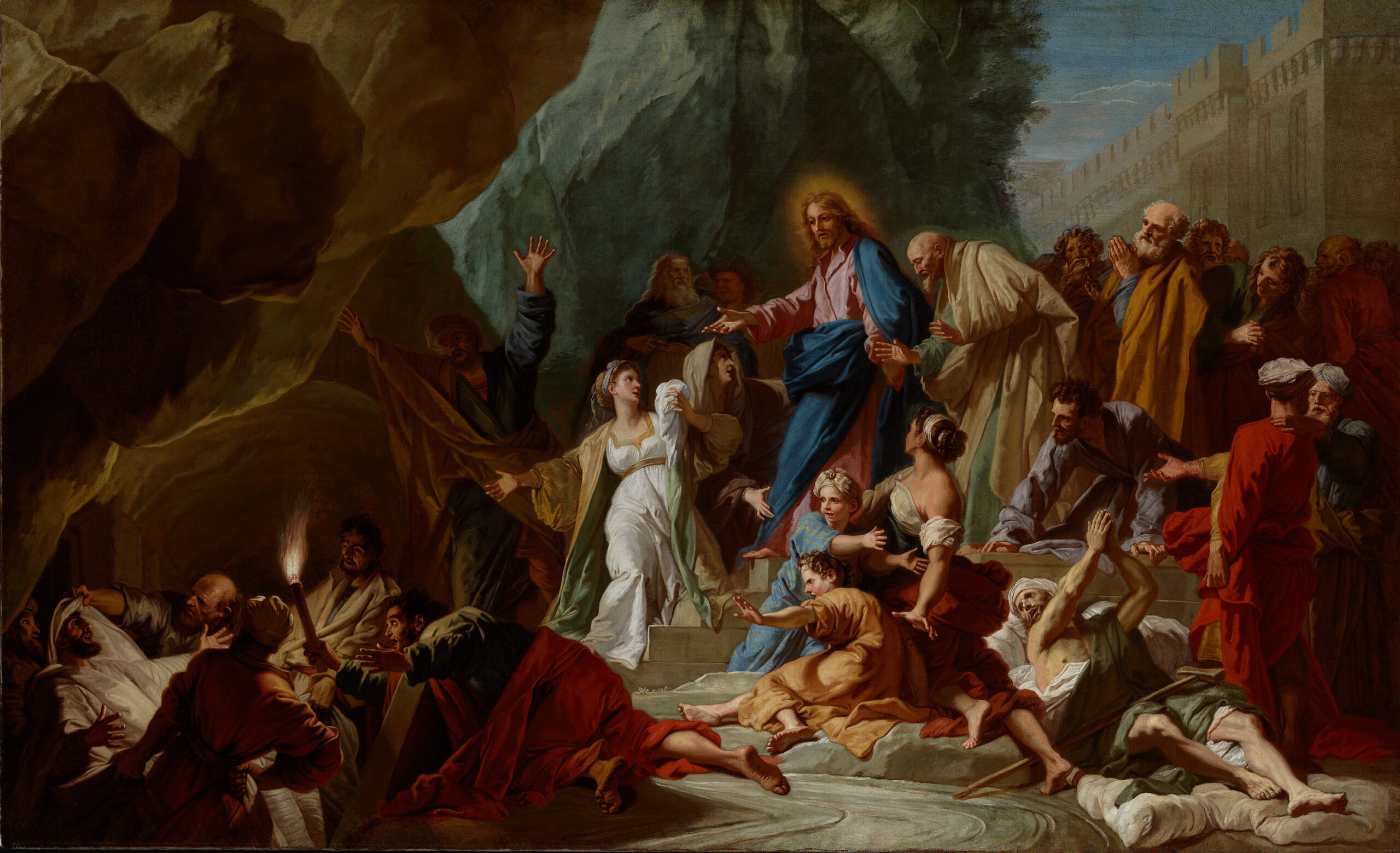
True to form, Jouvenet delivers a composition typical of the French Baroque, where emotion registers less in the faces than in the sweep of gesture. What strikes me first is how thoroughly theatrical the scene is: even the most minor figure seems caught mid-motion, arms or drapery thrown a little too wide, as though the whole canvas breathed to the rhythm of a single collective choreography.
The composition itself seems telling. Christ holds the centre and the light, the true dramatic pivot of the scene, while Lazarus, though the actual subject of the miracle, is pushed into the lower left corner, half-swallowed by the gloom of his tomb. Only a torch cuts through that darkness to outline his body, still wrapped in grave-cloths. This deliberate imbalance between the biblical subject and the pictorial one is, to my mind, what makes the composition work: Jouvenet is not painting a miracle. He is painting the shock it sends through everyone around it.
What holds my eye most is the sheer number of hands and arms, flung out in every direction. They trace a kind of gestural score across the whole canvas, and they draw the eye far more than any face does. This is Jouvenet’s signature at its clearest, the pupil of Le Brun and his theory that passion is expressed through the body rather than the face, and this canvas, in its unapologetic emphasis and theatricality, is one of his most complete demonstrations of it.
A torch burns low, tucked into the corner of the canvas. It lights a body still bound in cloth. Here, in Los Angeles, that modest flame carries the whole weight of Lazarus’s miracle.
A scene that spills past its own frame
Christ dominates the composition, draped in pink and blue, a golden halo ringing his face. His right hand reaches toward the tomb. Around him, dozens of arms rise, twist, grasp at the air. A young woman in white recoils, stunned. An old man raises his hands to heaven. On the ground, figures still crawl toward the light. Behind them, the walls of Jerusalem cut a pale band across the horizon. Jouvenet paints collective astonishment rather than the miracle itself. The faces matter less here than the hands, multiplied across the canvas, which hold the whole composition together.
A sketch for a religious “machine”
By around 1711, Jouvenet stood at the height of his reputation. Official painter under Louis XIV, he had just finished decorating the dome of Les Invalides and the tribune of the royal chapel at Versailles. This modestly sized canvas relates to a far larger work: the Raising of Lazarus Jouvenet painted in 1706 for the church of Saint-Martin-des-Champs in Paris, now held at the Louvre. Sale records in fact describe this very canvas as an advanced sketch for that composition, also known through Jean Audran’s engraving. Louis XIV later had it woven into a Gobelins tapestry, eventually given as a gift to Tsar Peter the Great.
Born in Rouen in 1644, Jouvenet joined Charles Le Brun’s Paris workshop while still young. He became one of Louis XIV’s favoured painters, a specialist in large-scale religious decoration. He died in 1717, four years after a stroke left his right hand paralysed. In this painting, dated two years before that turn, his right hand is still his own.
Current News
In 2026, LACMA opened the David Geffen Galleries, its new building devoted to the permanent collection, designed by Swiss architect Peter Zumthor. Built of architectural concrete and glass, the structure spans Wilshire Boulevard, forming a sculptural whole that embraces the neighbourhood, while its raised exhibition level frees up 3.5 acres of shaded public space below. Inside, visitors encounter a curatorial approach as diverse and open as Los Angeles itself, moving through terrace galleries flooded with natural light, courtyard-like galleries open to the sky, and more intimate interior spaces suited to quiet contemplation.
The inaugural installation explores networks of exchange built around major bodies of water, the Atlantic, the Mediterranean, and the Indian and Pacific Oceans, drawing unexpected visual and thematic links across eras and continents through more than eighty presentations comprising thousands of objects. A seventeenth-century Dutch painting might sit beside twentieth-century photography, or African textiles alongside American quilts. This new installation effectively reinvents the way LACMA presents its old master paintings.
Source: Los Angeles County Museum of Art (LACMA)
A Question for You
Is this painting a religious scene dressed as classical tragedy, or a classical tragedy dressed as a religious scene?
About This Work
- The Raising of Lazarus
- Jean Jouvenet
- circa 1711
- Oil on canvas
- 39 1/8 × 63 1/2 in. (99.4 × 161.29 cm)
- Los Angeles County Museum of Art (LACMA)
- https://collections.lacma.org/object/103873