Key facts
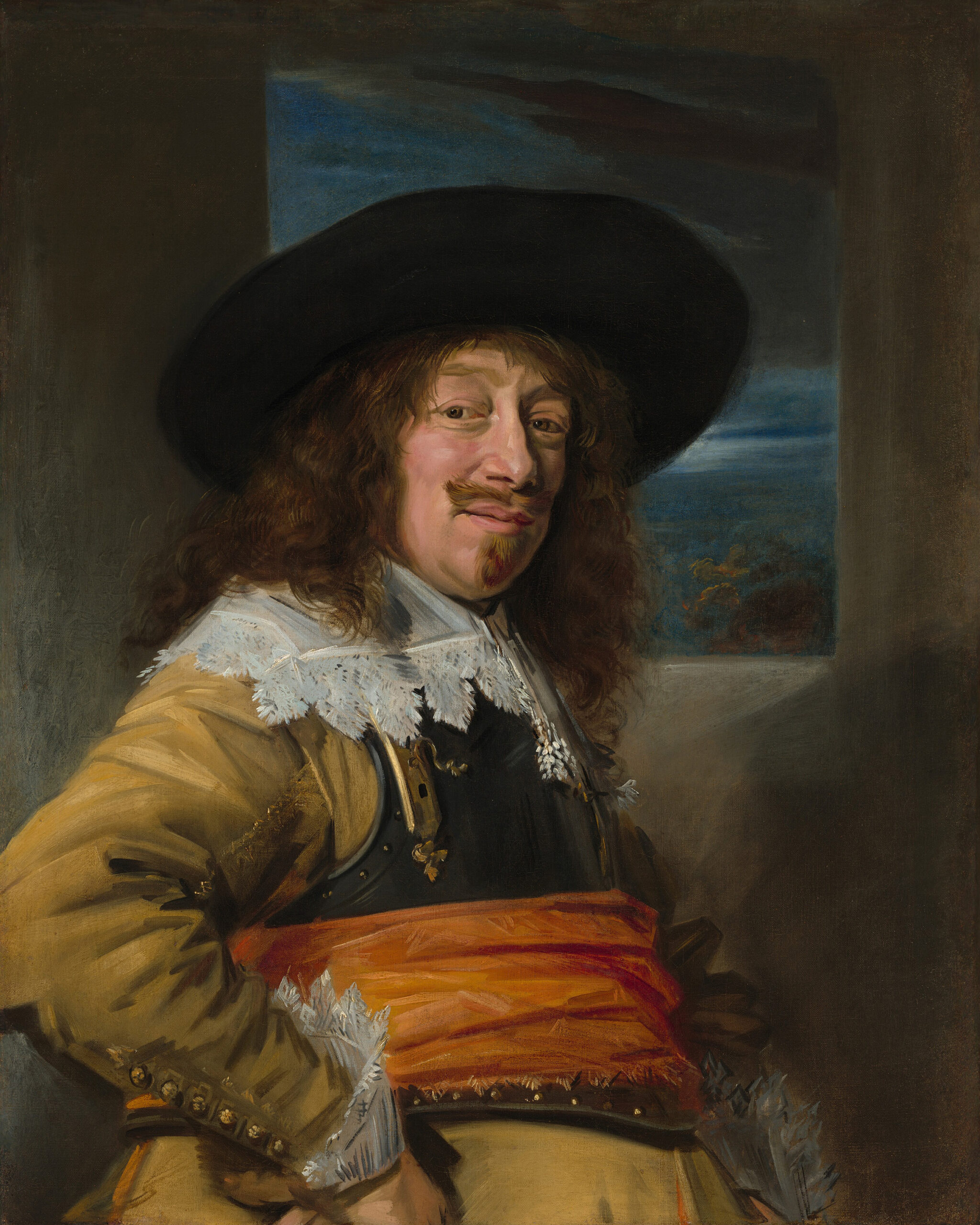
Painted around 1636-1638 by Frans Hals, the Portrait of a Member of the Haarlem Civic Guard belongs to the golden age of Dutch painting. It depicts a civic guardsman of the city, recognizable by his orange sash, the colour of his company. Hals, a master of the baroque portrait based in Haarlem, deploys here his rapid, free brushwork, a forerunner of Impressionism. The painting is one of only two known individual portraits of a civic guardsman by the artist, which explains its singular place within an œuvre dominated by large group portraits. It is held at the National Gallery of Art in Washington.
Frans Hals excels at cheerful, almost mischievous portraits, I think of the Portrait of Jan van de Poll or his merry Shrovetide revellers. This Portrait of a Member of the Haarlem Civic Guard stays in the same vein, and that is exactly what I love about it: that good humour, that liveliness which makes it feel as though the sitter has just turned towards us. You sense it in Hals’s very touch, quick and sure, laying in the collar and the highlights in a few deft strokes, a real freedom of execution. The interplay of colour completes the seduction: the vibrant orange sash cuts across the rest of the costume, while the window opens far off onto a bluish landscape that airs out the whole composition and lets the portrait breathe.
Haarlem, around 1637. A pale lace collar falls over a black iron cuirass. The man rests one hand on his hip. He smiles, sure of his rank. In the studio, Frans Hals fixes the moment.
What this Portrait of a Member of the Haarlem Civic Guard gives us to see
Look at the paint itself. The lace of the collar is not drawn, it is flung down in brisk, dry strokes, almost abstract up close. Beneath it, the iron breastplate swallows the light. The broad orange sash girds the waist, thick and crumpled, laden with layered reds and yellows. The pale buff of the doublet catches the day. The wide-brimmed black hat crowns a loose head of brown hair. To the right, a window opens onto a bluish distance. His gloved hand sinks into the shadow below. Hals works alla prima, in the fresh oil, with no visible pentimento. Each brushstroke stays legible. The costume speaks the soldier, the smile speaks the notable.
What Frans Hals’s era tells us
In 1568, seven provinces of the Netherlands rose against Spain. The war of independence would last until 1648. In the early years, the Haarlem militias fought bravely. By the time Hals paints this portrait, the front has moved south. The civic guard becomes more social than military. Hence the lace over the cuirass, and the openwork cuffs, signs of a peace almost returned. Each battalion counts three companies, in the colours of the rebel flag: orange, white, blue. Our man serves in an orange company. The broad sash gives him away. The orange leaps to the eye. These companies parade, banquet, keep watch over the city. Haarlem does not forget its sieges. Iron and lace share a single torso. War recedes, rank remains.
Frans Hals joins the Guard of Saint George as early as 1612. He paints several of its large group portraits, the glory of his career. This painting remains one of only two in which he shows a guardsman alone. Scholars date it to the late 1630s. They connect it to the Officers of the Saint George Civic Guard, around 1639, held at the Frans Hals Museum. In it, Hals slips into the background, on the left, his gaze towards us. This face, here, strangely resembles his own.
The work in the news
This portrait is not currently on view in Washington: the National Gallery of Art has lent it to the Figge Art Museum in Davenport (Iowa) as part of its Across the Nation initiative, launched in 2025 for the 250th anniversary of the United States. The work appears there within the exhibition The Golden Age: Featuring Northern European Works from the Collection of the National Gallery of Art, which brings together ten Northern European works (1537–1700) signed by, among others, Lucas Cranach the Elder, Anthony van Dyck and Frans Hals. In April 2026, this programme of loans to regional museums was made permanent thanks to a record gift of 116 million dollars from the Mitchell P. Rales Family Foundation.
Source: Figge Art Museum, Davenport (Iowa)
A question for you
💭 The iron of the cuirass speaks of war, the lace speaks of the salon: which of the two Haarlems did this portrait mean to keep?
About this work
- Portrait of a Member of the Haarlem Civic Guard
- Frans Hals
- around 1636-1638
- Oil on canvas
- 86 x 69 cm
- National Gallery of Art, Washington D.C.
- https://www.nga.gov/artworks/75-portrait-member-haarlem-civic-guard