Key facts
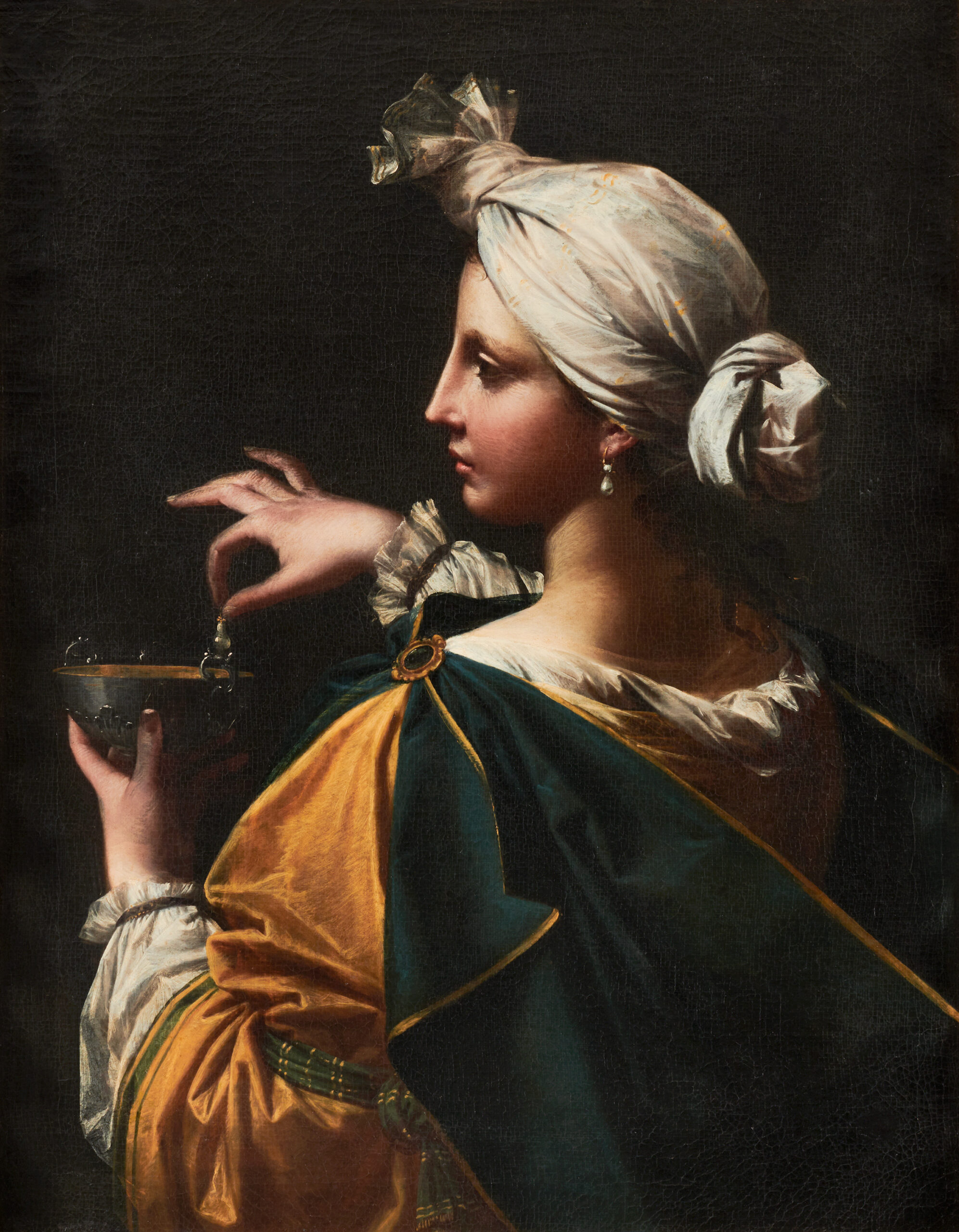
Painted around 1700–1705 by Donato Creti (1671–1749), Cleopatra Dissolving the Pearl illustrates an episode from Pliny the Elder’s Natural History. In it, the Queen of Egypt dissolves a pearl in vinegar to win a wager against Mark Antony. Creti depicts her half turned away, in profile, one pearl between her fingers and the other still hanging from her ear. The painting belongs to Bolognese classicism, of which the artist is considered the last great exponent. Nicknamed the “Bolognese Watteau” by the art historian Roberto Longhi, Creti is still rarely exhibited outside Bologna. The canvas belongs to the Clark Art Institute in Williamstown, which received it in 2025 as part of the gift from the Aso O. Tavitian Foundation.
I was immediately drawn to this work, which I discovered while browsing the Clark Art Institute’s recent acquisitions online. It is part of the gift from the Aso O. Tavitian Foundation, which entered the museum in 2025 (accession number 2025.1.118). What struck me first was the precision of the details and the dynamism of the figure, half turned away, as if caught just as she is about to act. The story is easy to read, even without knowing the anecdote. We clearly see Cleopatra about to dissolve a priceless pearl in vinegar. According to Pliny the Elder, she wagered Mark Antony that she could host the most expensive banquet in history, and this gesture won her the bet. Creti does not paint the triumph but the instant just before it, that suspended moment when everything hangs in the balance. This is probably what makes the scene so alive. I also greatly admire the rendering of the fabrics, almost sculpted, their folds seeming to have a volume of their own. You can sense the demanding draughtsman Creti was. The light focused on the face and the scene brings out the figure and draws the eye to what matters. For me, it is a wonderful way into the work of this Bolognese painter, who is still too little known in France.
A pearl hangs between thumb and forefinger. It sways above a metal cup, held by a gold mount. You can almost feel its weight. Then your eye drifts to Cleopatra’s ear. A second pearl gleams there, of the same shape. Everything suggests the queen has just unhooked the first.
The Second Pearl
This detail is no mere ornament. Creti follows Pliny the Elder closely. In the Natural History, the queen owns the two largest pearls ever known. She wears them as earrings. She drops one into vinegar, then drinks the mixture. Lucius Munatius Plancus, the judge of the wager, saves the second. Cut in two, it will later adorn the statue of Venus in the Pantheon in Rome. Yet the painter leaves out Antony, the table and the judge. A wager calls for a witness. Here, there is only you. Now look at the materials. The yellow satin of the sleeve catches the light in broad facets. The green velvet of the cloak, by contrast, drinks it in. The white turban is knotted in crisp folds, almost carved.
Donato Creti, the “Bolognese Watteau”
Donato Creti was born in Cremona in 1671 and died in Bologna in 1749. Trained in the workshop of Lorenzo Pasinelli, he absorbed the lessons of Reni and the Carracci. He is regarded as the last great exponent of Bolognese classicism. Yet his reputation long remained confined to specialists. Roberto Longhi likened him to Antoine Watteau, dubbing him the “Bolognese Watteau.” In 1935, Longhi co-edited the catalogue of the exhibition devoted to the Bolognese Settecento, held in Bologna. It was not until 1998 that a monographic exhibition introduced him to American audiences, at the Metropolitan Museum and then at LACMA. This Cleopatra entered the Clark in 2025, as the museum’s catalogue entry records.
News
Creti’s catalogue continues to grow. In 2024, the art historian Irene Graziani, of the University of Bologna, published a previously unknown painting, Achilles Dipped in the Styx, found in a private collection. Creti had already treated this subject several times, varying it with each version. This habit of returning to the same theme also applies to Cleopatra: the photo archive of the Federico Zeri Foundation in Bologna holds a record of another Cleopatra by the painter, already catalogued by Renato Roli in his 1967 monograph. The Clark canvas thus belongs to a long-standing meditation on the Queen of Egypt rather than standing as an isolated work.
Source: University of Bologna (IRIS).
A question for you
Many painters show the whole banquet, as Giambattista Tiepolo in The Banquet of Cleopatra with Antony and the judge at the table. Creti keeps only a woman and a cup. What did he gain by making the guests disappear?
About this work
- Cleopatra Dissolving the Pearl
- Donato Creti
- c. 1700–1705
- Oil on canvas
- 87.3 × 68.6 cm (34 3/8 × 27 in.)
- Clark Art Institute, Williamstown
- https://www.clarkart.edu/ArtPiece/Detail/Cleopatra-Dissolving-the-Pearl