
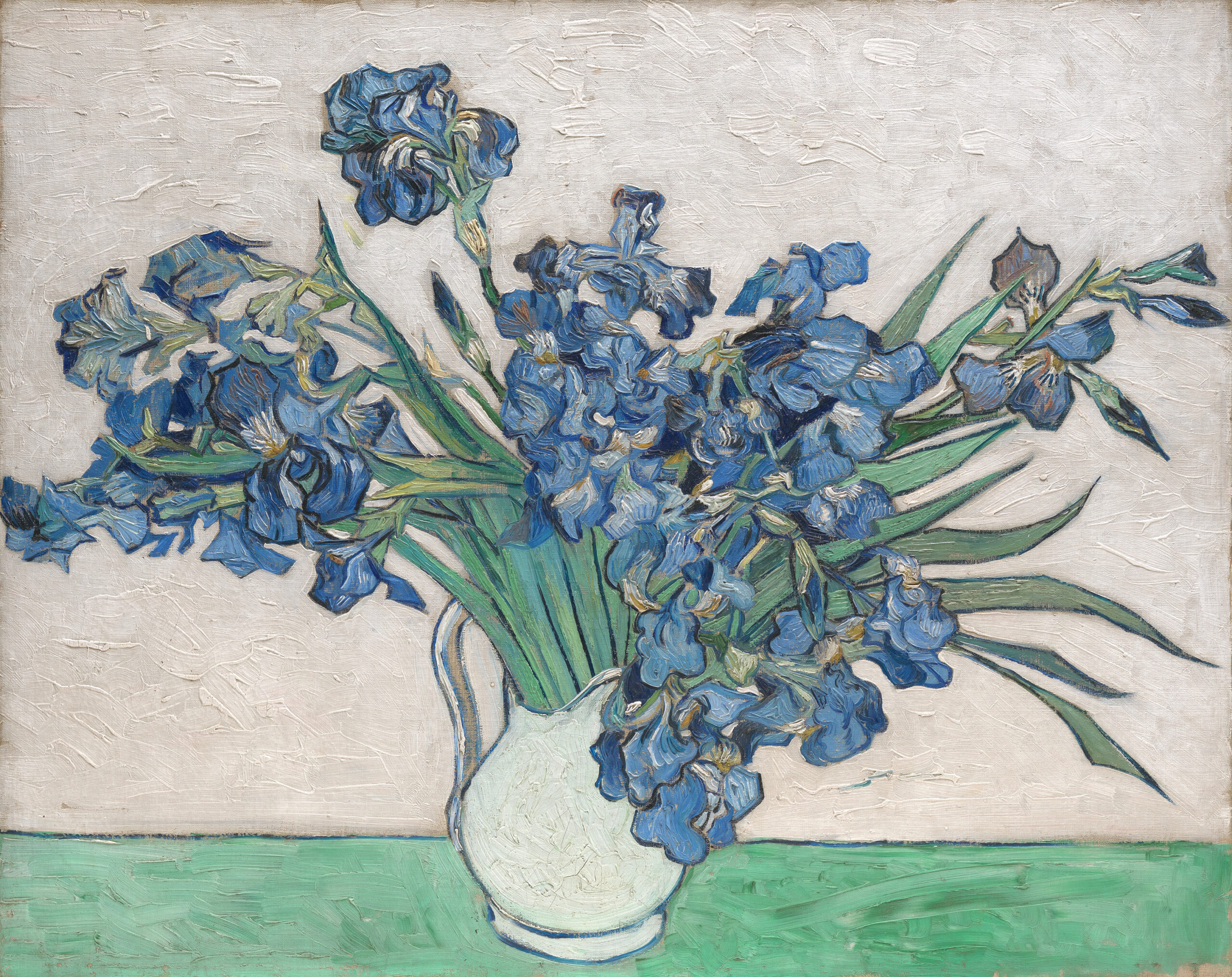
Standing before this canvas, what strikes me every time is the energy contained in each brushstroke. The stems bending under their own weight, the petals creasing in thick impasto, the background that has shifted to white when it was originally pink, everything signals urgency, a presence in the world that feels almost painful.
Like many, I did not come to Van Gogh immediately. His paintings first seemed too expressive, too charged. It was through sustained looking that something opened. I came to understand that the vibration one feels before his work is not a stylistic device: it is a truth of perception, the way light and movement genuinely impress themselves on the retina. Before the Irises in particular, what moves me is almost paradoxical: this is a work painted in a matter of days, inside an asylum, by a man seeking calm, and yet it overflows with life. Van Gogh himself wrote of wanting to achieve a “harmonious and soft” effect. Standing before the canvas, one measures how fully he succeeded, and at what cost.
Look
Consider this blue. Not a restrained blue. A blue that pushes outward, overflows, claims every available inch of the picture surface. The petals crease beneath heavy impasto. The stems cut across the composition in tight diagonals. Van Gogh’s mark does not describe the irises, it propels them. Now look at the ground: white today, pink at the time of painting. A fugitive red pigment has faded away. What you see is no longer quite what Van Gogh painted.
Understand
May 1890. Saint-Rémy-de-Provence. Van Gogh (1853–1890) prepares to discharge himself from the Saint-Paul-de-Mausole asylum after a year of voluntary confinement. He paints four exuberant bouquets of spring flowers, two of irises, two of roses. They are the only still lifes of any real ambition he undertakes during his entire stay. In the Irises held at The Metropolitan Museum of Art, New York, he sought a “harmonious and soft” effect: violet flowers set against a pink ground. Chemistry decided otherwise. The red pigments faded. The intended softness became cold tension. Post-Impressionism and Expressionism meet here, in a single canvas, in a single gesture. Both works from this series remained in the possession of the artist’s mother until her death in 1907.
Feel
Something resists in these irises. A man seeking stillness produces an explosion of blue. Van Gogh reaches for serenity; the canvas hums with barely contained energy. It is this contradiction one carries away. Not an answer. A sensation that lingers.
The work in the spotlight at The Met, 2026
The Irises are at the centre of an unexpected dialogue at The Metropolitan Museum of Art. In the Costume Institute’s new permanent installation, on view through 10 January 2027, the 1890 painting is placed in direct conversation with two haute couture ensembles : Yves Saint Laurent (spring/summer 1988) and Loewe by Jonathan Anderson (spring/summer 2025). Curator Andrew Bolton uses the juxtaposition to explore neurodivergence and mental health as connecting threads. Source: The Art Newspaper
A question for you
💭 Can a work still surprise us when we believe we know it by heart? Share your thoughts in the comments below.
About this work
- Irises
- Vincent van Gogh
- 1890
- Oil on canvas
- 73.7 × 92.1 cm
- The Metropolitan Museum of Art (MET), New York
- https://www.metmuseum.org/art/collection/search/436528


