Key facts
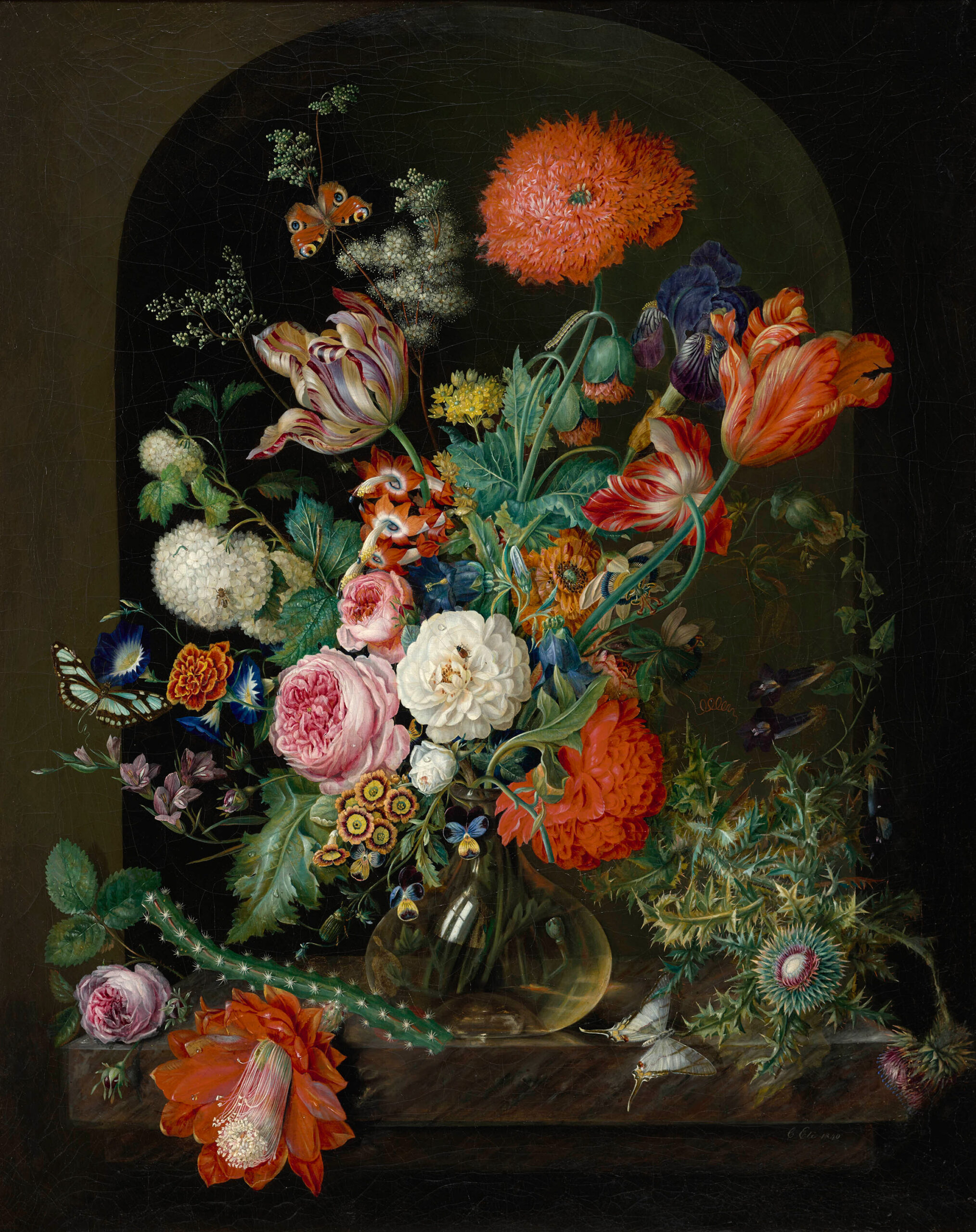
Painted in 1840 by Johann Heinrich Christian Eli, known as Christel Eli (1801-1881), Bouquet of Flowers in a Niche is a floral still life in oil on canvas. Trained as a porcelain painter at the Fürstenberg manufactory, Eli worked in Brunswick at the height of the Biedermeier period. The painting is based on a composition by Abraham Mignon, a flower painter of the Dutch Golden Age, now held at the Herzog Anton Ulrich-Museum in Brunswick. Eli added a Cereus flower, a cactus introduced to Europe around 1800, which anchors the canvas firmly in its own time. Signed and dated, the work has belonged to the LWL-Museum für Kunst und Kultur in Münster since 1989.
Here is a work in the manner of the great flower pieces of the Dutch Golden Age, the seventeenth century I am especially fond of, yet painted here in 1840. Christel Eli faithfully adopts all its conventions. First, there is an array of flowers that could never have bloomed at the same time, since they belong to different seasons. Among them, we can probably make out tulips, lilies, poppies, roses, passionflowers and thistles. Then there is the glass vase set in its niche, with its delicate reflections, and the butterflies fluttering around the bouquet as if to bring it to life. Yet one detail gives away the nineteenth century. In the lower left corner, the painter has slipped in what looks like a Cereus flower, a cactus introduced to Europe only around 1800. This detail sets his painting apart from the one that inspired it, Bouquet of Flowers with Thistle Leaves, painted around 1670 by Abraham Mignon and now held at the Herzog Anton Ulrich-Museum in Brunswick. I find this touch fascinating. Rather than slavishly copying his model, he adds a flower his predecessor could never have known, like a discreet signature of his own era. What I also love is the rendering so typical of the great seventeenth-century bouquets: the explosion of colour, the sheer variety of flowers and the care given to every petal. It is a pleasure to linger over the painting and keep discovering new details. With this large canvas, more than a metre tall, Eli offers us a truly remarkable floral concentrate, both a tribute to the old masters and a testament to the botanical curiosity of his time.
One white spine. Then ten, then a hundred. They bristle along a cactus stem lying on a marble ledge. A large orange flower tips over into the void. Its stamens hang like silk threads. Now raise your eyes. Christel Eli’s bouquet leaps out at you. Red, milky white, midnight blue, it rises against the shadow of an arched niche. You can almost feel the cold of the stone under your fingers.
An impossible bouquet, painted petal by petal
Look at the profusion. Purple-streaked tulips mingle with roses, poppies, lilies and passionflowers. A dark iris leans to the right. Blue morning glories open on the left. A silvery thistle spills over the ledge, ready to prick your hand. These flowers never bloom in the same season. So the bouquet never existed. And yet it looks as if it had been picked at dawn. Look at the glass vase. It catches the reflection of a window and lets you glimpse the stems in the water. A caterpillar climbs a poppy stem. A peacock butterfly hovers in the upper left. A second butterfly, turquoise and black, alights near the morning glories. A tiny insect forages in the heart of a white rose.
Come closer still. The surface is smooth, with almost no visible brushstrokes. The petals have the gloss of enamel. Every leaf vein is traced with the finest brush. Nothing smudges, nothing blurs. This is the hand of a porcelain painter. The craft demands fine, crisp colours, laid down without second thoughts. Eli learned it at the Fürstenberg manufactory, whose painting workshop was based in Brunswick. Copying a model is part of that discipline. A plate painted by Eli after a Sèvres design has been exhibited at Fürstenberg Castle.
The online collection of the LWL-Museum für Kunst und Kultur identifies the model for our canvas. It is a bouquet by Abraham Mignon, painted around 1670-1675. Eli keeps its structure and its light. But in the lower left, he adds a Cereus flower. This cactus did not reach Europe until around 1800. Faithful tribute or the signature of another century? The canvas does not say.
Christel Eli, from porcelain to canvas
Johann Heinrich Christian Eli, known as Christel, was born in 1801. He first trained with Johann Hilarius Krevel, a painter and engraver from Brunswick. In 1817, he joined the painting workshop of the Fürstenberg manufactory. The workshop closed in 1828. From 1830, Eli worked independently. In 1840, he signed and dated this large canvas on the marble ledge, lower right. Germany was then in the Biedermeier period. Eli’s eye for detail came from the workshop rather than the academy. His model came from an entirely different world. Born in Frankfurt in 1640, Abraham Mignon made his career in Utrecht, in the workshop of Jan Davidsz de Heem. He died in 1679. More than a century and a half thus separates the two bouquets. The title of court painter of flowers, fruit and insects would only come in 1857. Christel Eli died in 1881.
News from the LWL-Museum
Acquired by the Münster museum in 1989 (inv. 1916 LM), Bouquet of Flowers in a Niche is not currently on display in the galleries. It can, however, be viewed in the museum’s online collection. The institution is going through a particularly busy period. Until 17 January 2027, the RADAR series, run jointly with the Westfälischer Kunstverein, is presenting the artist Eda Aslan. She notably reuses material salvaged from the major exhibition “Kirchner. Picasso” of 2025-2026. From 23 January to 11 April 2027, the museum will then host the Museum of Broken Relationships from Zagreb, enriched with objects contributed by local residents. The highlight remains Skulptur Projekte, organised by the museum and held across the city of Münster from 13 June to 3 October 2027. That year, the exhibition will celebrate its 50th anniversary.
Source: Skulptur Projekte Münster.
A question for you
Which flower would you add today to sign your own era, as Eli did with his cactus?
About this work
- Bouquet of Flowers in a Niche
- Johann Heinrich Christian (known as Christel) Eli
- 1840
- Oil on canvas
- 116 x 97 cm
- LWL-Museum für Kunst und Kultur, Münster
- https://sammlung-online.lwl-museum-kunst-kultur.de/werke/39560