Key facts
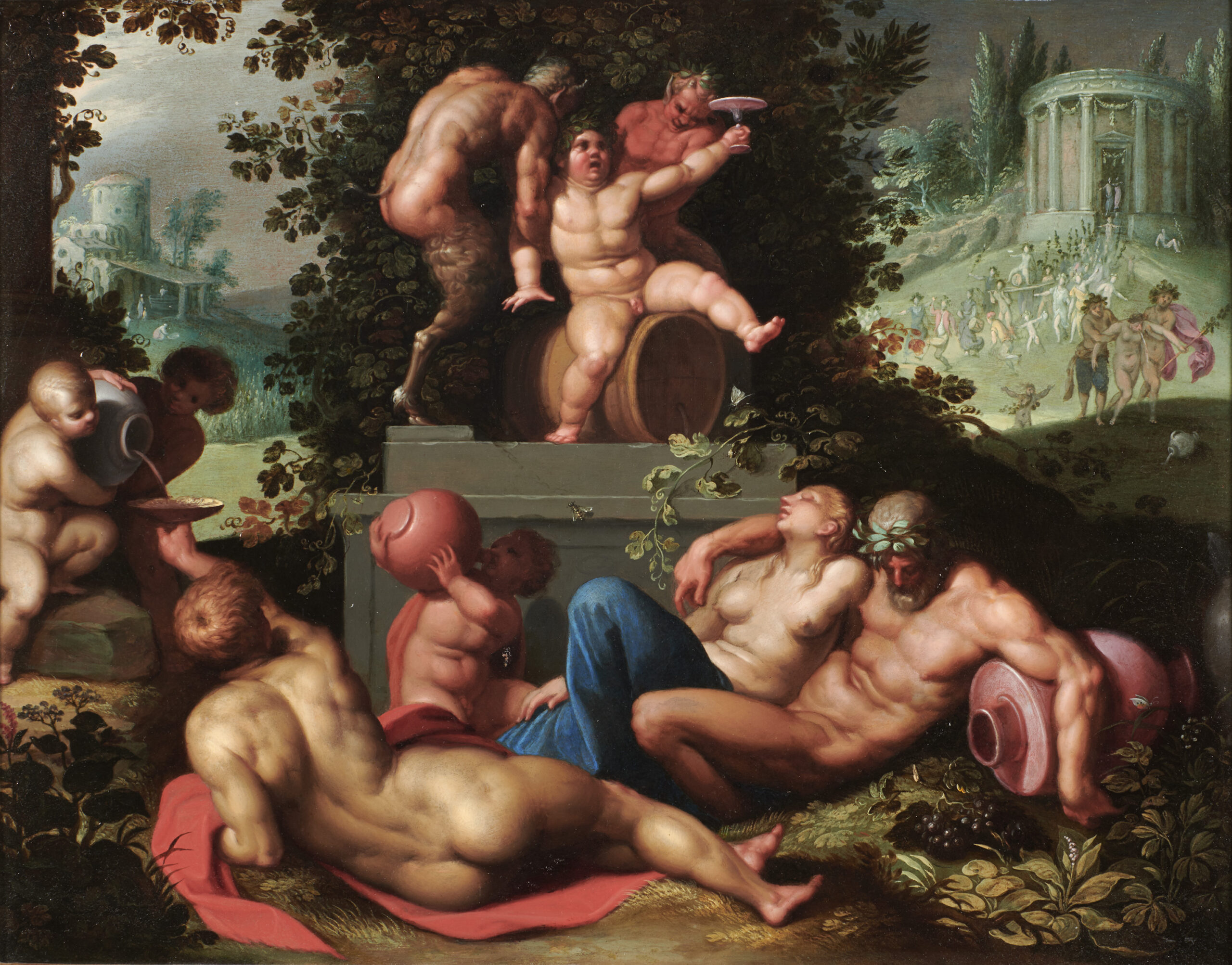
Painted in the 1590s, Pietro Mera’s Bacchanalia, by the artist known as Il Flammingo, depicts a mythological feast around the infant Bacchus. The god is surrounded by satyrs, sleeping drinkers and a dancing procession. Mera was a Flemish painter, born in Brussels and active in Italy, mainly in Venice. He belongs to the late Mannerism of the end of the sixteenth century. The painting combines the meticulous detail of Northern painters with the muscular nudes of the Italian tradition. Its copper support, prized by collectors for small and precious formats, gives the scene a particular brilliance. The painting is held at the Clark Art Institute in Williamstown, Massachusetts, thanks to a gift from the Aso O. Tavitian Foundation.
Here is a bacchanal by Pietro Mera, known as Il Flammingo (“the Fleming”), painted in the 1590s. I find it interesting because it stages mythological figures in this wine feast around Bacchus. The wine flows freely, and the figures have drunk their fill. In the background, the party is in full swing: the revellers set off in a joyful procession, and some are already feeling the ill effects of excess. It is this mix that I love: Mera does not only show cheerful drunkenness, he also slips in, with humour, its less glorious consequences. What also strikes me is the support. Painted on copper, a plate of only 35 × 45 cm, the work gains a smooth surface that allows a precision and a brilliance of colour that canvas could not achieve. This is a painting you need to look at closely, almost like a miniature, to discover all its details. The vine is very present and leaves no doubt about the nature of the drink pouring in abundance from the jars and barrels. You can also sense the path of this Flemish painter who settled in Italy, combining the Northern taste for meticulous detail and teeming scenes with the mythological subjects so dear to the Italians. For me, it is a wonderful discovery, and a good reason to take an interest in these late sixteenth-century masters, less famous than the great names but full of charm.
A bee. It rests on the grey stone of the pedestal, barely bigger than a grape. Come closer: its wings catch the light. Around it, everything overflows. The wine, the bodies, the vine. It alone does not drink.
What lies beneath the copper surface of this Bacchanalia
At the centre, a chubby child crowned with vine leaves sits enthroned on a barrel. Everything marks him out as Bacchus. Two satyrs hold him up. He raises a cup. The god of intoxication opens a baby’s mouth. Is he triumphing, or enduring his own feast?
The support explains the brilliance of the scene. Copper does not soak up paint the way canvas does. The paint layer stays on the surface, thin and taut. Light passes through the glazes, strikes the metal and comes back to you. Look at the back of the drinker lying on his red drapery: it gleams like warm marble. The blue of the sleeping woman’s drapery vibrates against the pink of the jars. The Museum of Fine Arts, Boston, holds a Pan and Syrinx by Mera, also painted on copper and of a similar size. These small and costly coppers called for close viewing. They found their way into the cabinets of learned collectors, who had a taste for mythological subjects.
Pietro Mera and his time
Pietro Mera was born in Brussels and built his career in Italy, mainly in Venice. The Italians simply called him “the Fleming”. He was one of those Northern painters who found success on the peninsula at the end of the sixteenth century. His style blends two worlds. On one side, Flemish precision: the vine painted leaf by leaf, the black bunch of grapes in the foreground, the detailed plants near the jar. On the other, the muscular, twisting nudes of Italian Mannerism. In the distance, a procession dances around a circular temple. There, two companions hold up a staggering bacchante.
A gift that brings Mera to the Clark
Pietro Mera’s Bacchanalia is part of an exceptional gift. The foundation of the philanthropist Aso O. Tavitian has given the Clark 331 works from his personal collection, along with more than $45 million to fund a curatorial position, the care of the collection, and the construction of a new Aso O. Tavitian Wing. The gift is one of the largest in the museum’s history. It includes 132 paintings, 130 sculptures, 39 drawings and 30 decorative arts objects, and more than doubles the Clark’s sculpture collection. The Tavitian Wing is due to open in 2028. In the meantime, visitors can get a first glimpse of the collection in the exhibition An Exquisite Eye: Introducing the Aso O. Tavitian Collection, on view in the Clark Center’s special exhibition galleries from June 13, 2026 to February 21, 2027. The exhibition is curated by Esther Bell and Lara Yeager-Crasselt, the curator whose position is funded by the Tavitian gift. The museum is also going through a change of leadership: Esther Bell became director of the Clark on July 1, 2026. She is the institution’s sixth director and the first woman to hold the post in its 70-year history.
Source: Clark Art Institute.
A question for you
Did you know that artists also painted on copper plates, not just on canvas or wood? Would you have guessed that this Bacchanalia is painted on metal?
About this work
- Bacchanalia
- Pietro Mera (Il Flammingo)
- 1590s
- Oil on copper
- 34.9 × 44.5 cm (13 3/4 × 17 1/2 in.)
- Clark Art Institute, Williamstown
- Gift of the Aso O. Tavitian Foundation, 2025.1.44
- https://www.clarkart.edu/ArtPiece/Detail/Bacchanalia