Key Facts
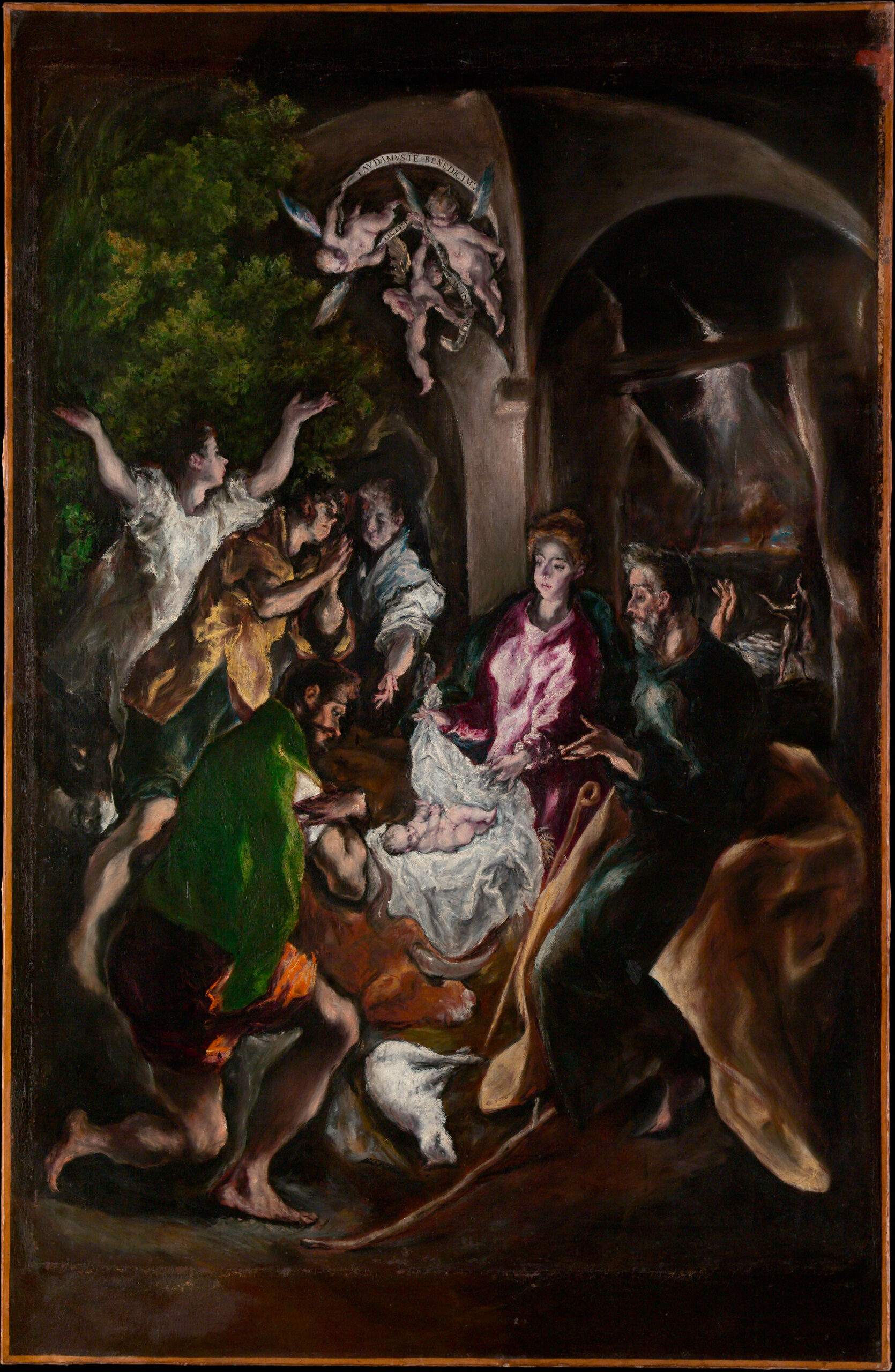
Adoration of the Shepherds, painted by El Greco (Domenikos Theotokopoulos) around 1605–1610, belongs to the artist’s late period, during his years in Toledo since the late 1570s. A leading figure of Spanish Mannerism, El Greco developed here a highly personal treatment of light and movement, departing from the naturalism still dominant in Italy at the time. The composition, in which the Christ Child himself becomes the source of light, reflects the formal freedom the painter achieved late in his career. The subject, frequently revisited in his workshop, underscores the importance of this scene within his religious output. The canvas is now held at The Metropolitan Museum of Art in New York, where it stands among the notable examples of Spanish Golden Age painting.
El Greco is an artist I admire deeply, and this Adoration of the Shepherds is a fine illustration of his work. What strikes me first is the vibration it gives off: the scene truly seems to unfold before our eyes, alive with movement, carried by the treatment of color and by El Greco’s singular manner of painting. Steeped in Mannerism, he elongates his figures, stretches them, and plays with sharp, acidic colors that flare against the darkness. Here, the Christ Child himself becomes the source of light, and the shepherds’ faces, caught in almost dance-like poses, seem to tremble with excitement before the scene. Everything is built to seize the eye and hold it, and I find that it works remarkably well.
A white cloth occupies the center of the canvas. Upon its folds lies a newborn, barely visible, barely born. Around him, hands reach out, faces lean in, bodies already jostle one another. Nothing is still: the night itself seems to breathe, suspended on the child’s first breath.
What Lies Beneath the Surface of the Adoration of the Shepherds
Look at the infant: he is the one who illuminates the entire composition. El Greco removes almost every other source of light, like a single candle in the night. The Child’s flesh becomes a living lamp. Around him, the shepherds rush forward, arms raised, bodies leaning in, nearly thrown off balance by their own momentum. Their gestures carry nothing of stillness: these are postures of dance rather than quiet prayer. An adoration implies silence. Here, nothing falls silent; everything vibrates, everything breathes. This is the hallmark of the painter’s late Mannerism. The figures stretch beyond any natural proportion. The colors, acid green, vivid pink, saffron yellow, flare against the dark background like sparks of flame. El Greco works in quick, almost nervous strokes. The paint surface remains visible, almost raw, under the lights of the New York galleries. This canvas is not a unique example. The painter produced several versions in his Toledo workshop, reworking the same scene time and again. At least eight variants of this Adoration of the Shepherds were recorded in his studio at his death in 1614. Visitors who pause before it experience the same vertigo El Greco sought in each of his variations.
El Greco and His Time
Domenikos Theotokopoulos was born in Crete in 1541, within the tradition of Byzantine icon painting, where gold and line took precedence over volume. He arrived in Venice around 1567, where he discovered Titian and Tintoretto, then reached Rome three years later. He finally settled in Toledo around 1577. Golden Age Spain offered him religious commissions and recognition. It was there that he received the name by which history remembers him: El Greco. He built a personal style there, distinct from the naturalism still fashionable in Rome. This Adoration of the Shepherds belongs to his late period, when his Mannerism reached a nearly abstract expression. He died in 1614, leaving behind a body of work that defied classification in his time.
News from The Met
The Metropolitan Museum of Art has once again put on view, in Gallery 162 devoted to Greek and Roman art, a papyrus fragment bearing lines from Homer’s Odyssey, the earliest known Ptolemaic-era example of this text. Dated to roughly 285–250 BCE and made in Egypt, this fragment was delicately inscribed with a mixture of charcoal and water applied by stylus to papyrus, one of the most widely used writing materials of antiquity, and preserves three lines absent from the standard text known today. The object returned to view on August 5, 2026, after a long period in storage, a resurfacing that coincides with renewed public interest in the Homeric epic sparked by Christopher Nolan’s film. It is a reminder that great museums, like The Met, continue to bring their ancient collections into dialogue with contemporary culture, a practice that, by extension, sheds light on how a museum continually values and recontextualizes its treasures, whether a Greek papyrus or a canvas by El Greco such as the Adoration of the Shepherds.
Source: The Metropolitan Museum of Art
A Question for You
If you could keep only one detail from this canvas, which would you choose?
About This Work
- Adoration of the Shepherds
- El Greco (Domenikos Theotokopoulos)
- c. 1605–1610
- Oil on canvas
- 144.5 x 101.3 cm (56 7/8 x 39 7/8 in.)
- The Metropolitan Museum of Art, New York