Key facts
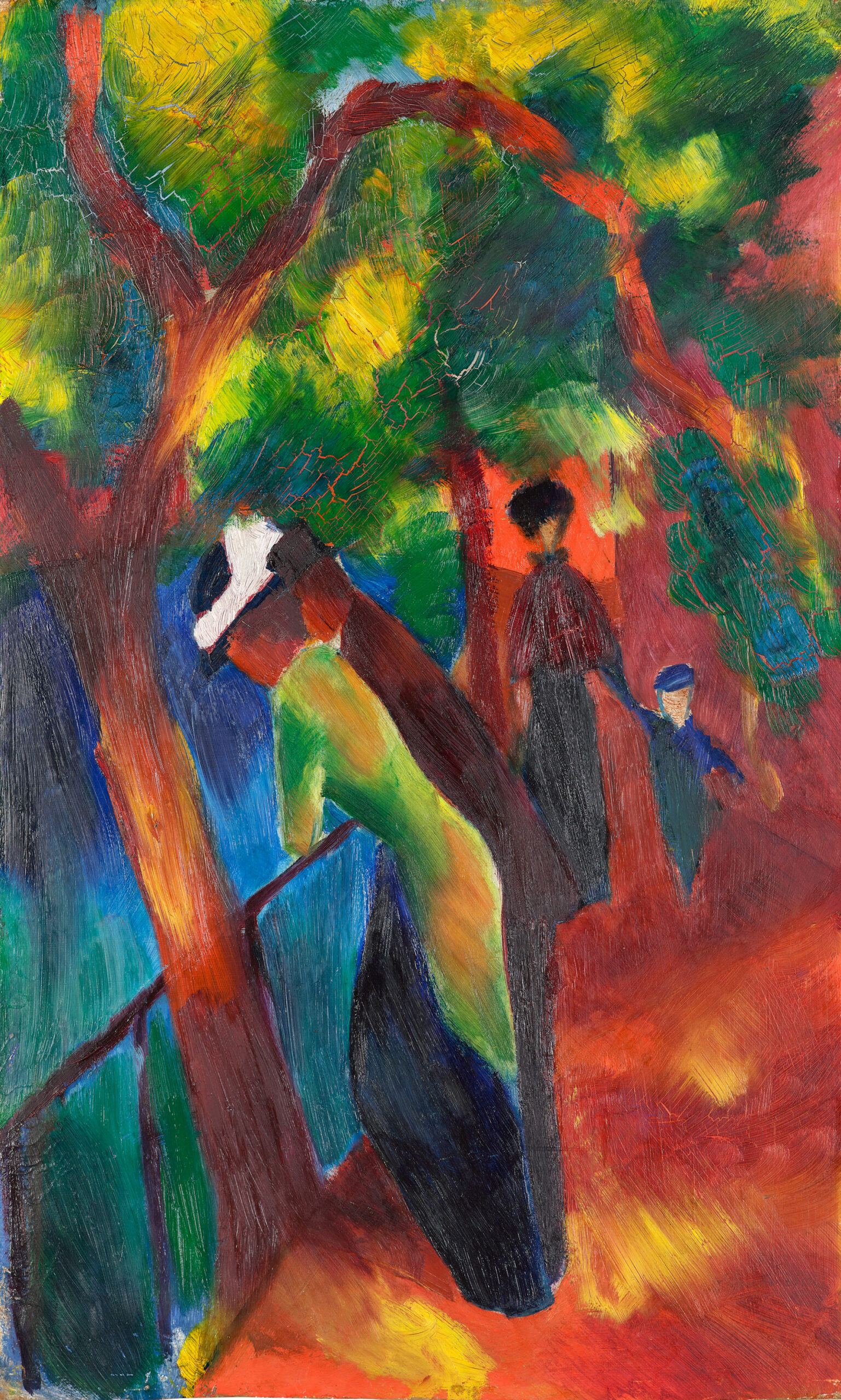
Sunny Path (Sonniger Weg) is an oil on cardboard painted in 1913 by August Macke (1887–1914), a leading figure of German Expressionism associated with Der Blaue Reiter. The painting is among the first works he produced in Hilterfingen, on the shores of Lake Thun, where he settled in October 1913. It depicts strollers with schematic silhouettes beneath trees pierced by autumn light. Shaped by the Orphism of Robert Delaunay, whom Macke discovered in Paris in 1912, the composition is built on contrasts of complementary colours. The LWL-Museum für Kunst und Kultur in Münster, which acquired it in 1986, ranks it among Macke’s major works. The painter was killed at the front on 26 September 1914.
Yet another artist who died too young. August Macke was killed on 26 September 1914, in the first weeks of the Great War, at just 27. Here he gives us one of his masterpieces, Sunny Path, painted in autumn 1913 in Hilterfingen, on the shores of Lake Thun in Switzerland, barely a few months before his death. A profusion of vivid colours, led by the sunny yellow of that beautiful autumn light piercing through the trees and settling on the deep blue of the lake. I love this work for its luminosity, for the simplicity of its forms, which nonetheless remain easy to recognise, and for the presence of these figures strolling along a path full of sunshine. A couple leans on the railing, gazing at the water, while a woman walks towards us, holding a little boy by the hand. Macke gives them almost no faces, and yet we immediately sense their elegance and their carefree ease. The very narrow, upright format heightens this feeling of calm and balance. What also moves me is the painter’s doubt. His wife Elisabeth recalled that he would place his paintings in the middle of the sunlit garden to see whether they held up against real light, and that he wondered himself whether he had painted a masterpiece or kitsch. More than a century later, the answer is beyond doubt. If you are ever in Münster, don’t miss the chance to see it in person: it hangs in room 1.31 of the LWL-Museum für Kunst und Kultur, which acquired it in 1986.
A patch of pure white, thick, almost in relief. Look to the left: it is the hat of a figure leaning on the railing. All around her, everything is ablaze. The path burns with orange and vermilion. The foliage crackles with yellow and green. Further on, a woman in a burgundy blouse walks forward, a child by the hand. You can almost feel on your skin the warmth of an October sun, filtered through the branches.
What Sunny Path conceals
Step closer to the foliage. A web of fine cracks runs across it, like the bark of an old tree. Macke paints here in oil on cardboard. This rigid, inexpensive support recurs often in his paintings of 1913. Notice the two gestures of the brush. In the trees, the strokes are crossed and nervous. On the path, they spread out in broad sweeps. The cracks bear the mark of the paint layer’s ageing. Time has written on the light.
Now look at the harmonies. The orange of the path answers the deep blue of the lake. The red of the trunks clashes against the green of the leaves. These are complementary colours, set side by side so that each heightens the other. The shadows are never grey: midnight blue, reddish brown, dark green. Macke learned this lesson in Paris in 1912, during a visit to Robert Delaunay with Franz Marc. There, the French painter was developing Orphism, in which colour alone builds space and rhythm.
The strollers, for their part, have almost no features. An oval of flesh, a blue cap, a dark skirt. The museum’s entry, available in the LWL-Museum’s online collection, speaks of schematic silhouettes, individualised just enough. The centre of the image remains empty of any event. The narrow format stretches the trunks like columns. The eye glides along the path without ever stopping.
That same year, Macke painted Lady in a Green Jacket, now in the Museum Ludwig in Cologne. It too was born on the shores of Lake Thun. We find the same green jacket and the same strollers with barely sketched features. The two paintings answer each other like two variations on the same tune.
Everything here breathes peace. The painting knows nothing of what is to come. You do.
August Macke and his time
Born in 1887 in Meschede, Westphalia, August Macke grew up in Cologne and then Bonn. He spent time in the studio of Lovis Corinth. Close to Franz Marc and Kandinsky, he took part in Der Blaue Reiter, one of the centres of German Expressionism. Yet he stood apart through his taste for everyday life: shop windows, gardens, strollers. From October 1913, he lived in Hilterfingen with Elisabeth and their children. Those months were among the most productive of his life. In April 1914, he travelled to Tunisia with Paul Klee and Louis Moilliet. Called up in August, he was killed on 26 September 1914 near Perthes-lès-Hurlus, in Champagne.
News: Macke between Münster and Bonn
At the LWL-Museum für Kunst und Kultur in Münster, home to Sunny Path, works by Macke feature in the family exhibition “Reiselustig. Unterwegs mit dem Hasen Felix” (Wanderlust: On the Road with Felix the Rabbit). Opened on 28 March 2026, it has been extended until 3 January 2027 due to its success. In Bonn, the Museum August Macke Haus, housed in the painter’s former home and studio, is showing “Chunqing Huang: Reflections” until 31 January 2027, a contemporary take on Macke and Expressionism. The museum is also preparing “TWENTY-SEVEN | Life. Art. Legend” (25 February – 5 September 2027). Starting from Macke’s death at 27 in 1914, the exhibition explores the myth of artists who died young. It will notably feature Abschied (Farewell), the last painting left on his easel. Finally, 3 January 2027 will mark the 140th anniversary of the painter’s birth.
Source: Museum August Macke Haus.
A question for you
💭 Macke wondered whether he had painted a masterpiece or kitsch. What would you have told him, in the place of his wife Elisabeth, who encouraged him?
About this work
- Sunny Path (Sonniger Weg)
- August Macke
- 1913
- Oil on cardboard
- 50 x 30 cm
- LWL-Museum für Kunst und Kultur, Münster
- https://sammlung-online.lwl-museum-kunst-kultur.de/werke/39242