Key facts
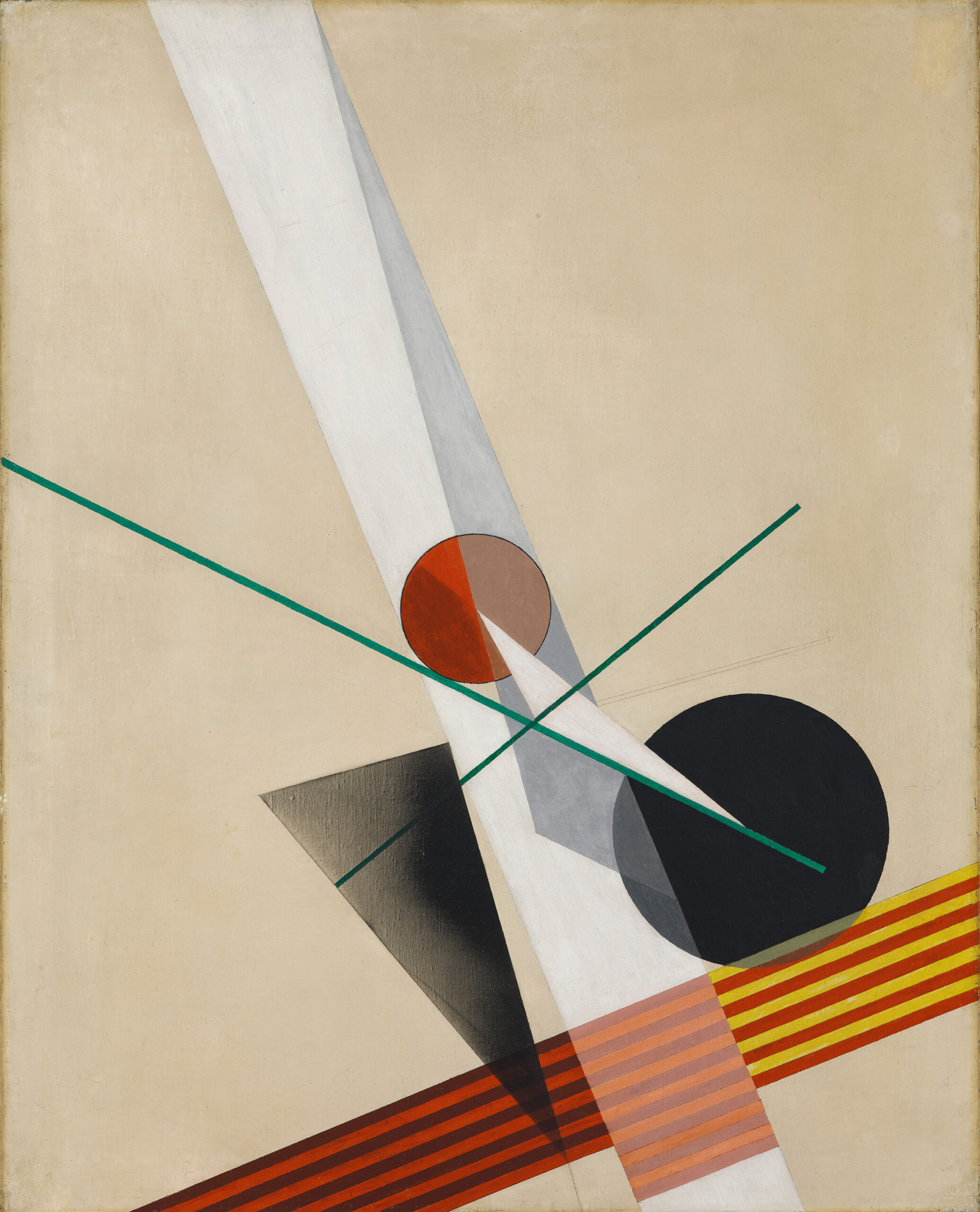
A XXI is an oil on canvas painted in 1925 by László Moholy-Nagy (1895–1946), a Hungarian artist and master at the Bauhaus from 1923 to 1928. Abstract and geometric, the composition brings together a white beam, two discs, a triangle and striped bands. Their overlaps simulate transparency. The painting dates from the year Moholy-Nagy published Malerei, Photographie, Film, the founding text of the “New Vision”. An inscription on the back allows the work to be hung either vertically or horizontally, a rare freedom granted to its owner. Acquired in 1962 from the Munich art dealer Hans Hellmuth Klihm, the canvas is held at the LWL-Museum für Kunst und Kultur in Münster.
Moholy-Nagy never ceases to amaze me with the radical nature of his abstraction. Here, there is no motif to recognise, no subject to hold on to: only planes, lines and colours answering one another. And this work strikes me even more, because the artist himself suggests hanging it vertically or horizontally. It is a rare freedom, left to the viewer, and it profoundly changes what we see. Hung vertically, the composition seems to rise or fall; hung horizontally, it slides, as if carried by a sideways movement. The painting no longer has a single direction, literally or figuratively. I also notice a tension in this canvas, heightened by the fine bright green lines and by the way the shapes are pushed to one side. The empty space is not a lack: it weighs as much as the forms and creates an imbalance the eye tries to resolve. My gaze gets lost in it, wanders, bounces off the lines, then always comes back to that edge where everything seems to gather. I find that few paintings make me look so actively.
Seeing A XXI
A green line, fine as a taut thread. It cuts across the canvas from edge to edge, and a second one crosses it. Around them, nothing is stable. A broad white beam plunges diagonally. A red disc clings to it, a black disc bumps against it. A grey triangle floats, modelled by a soft gradient. At the bottom, red and yellow bands stripe the beige ground. Look at the left half: it is almost empty. The weight lies elsewhere. And yet, everything holds.
Understanding Moholy-Nagy
Look closely at the intersections. Where the white beam passes over the red stripes, they turn salmon pink. On the black disc, the white becomes grey. The red disc splits into brick red and dusty pink. Moholy-Nagy does not stack opaque shapes. He paints transparency, as if each plane were a sheet of celluloid with light passing through it. Yet oil paint is an opaque medium. The illusion is therefore constructed from start to finish. To the right of the black disc, a fine pencil line is still visible. The construction does not hide itself.
In 1925, the artist had been a master at the Bauhaus for two years. That same year, his book Malerei, Photographie, Film came out as the eighth volume of the Bauhausbücher. In it he championed the “New Vision”: the lens sees what the eye overlooks. A XXI carries this thinking over into painting. Compare it with A II, painted in 1924 (New York, Guggenheim). The same neutral title, a letter and a number. No subject, only experiments in vision.
The painting’s history has its paradoxes. Moholy-Nagy refused to work through art dealers. Yet after his death in 1946, his widow Sibyl sold his works with the help of the Munich dealer Hans Hellmuth Klihm. The LWL-Museum acquired the canvas from him in 1962. The LWL-Museum’s online collection entry traces this history.
Feeling
On the back, Moholy-Nagy wrote that the canvas can be hung upright or on its side. The museum displays it vertically. A wall demands a direction. The artist, for his part, imposed none. Rotate the image in your mind. The beam no longer falls: it races. The stripes stand up. Nothing moves on the canvas, and yet everything tips over. This freedom gives the viewer power. It also takes away every certainty. The museum has made its choice. The work itself has not.
News: Münster, from sculpture to light
In Münster, the LWL-Museum is preparing a major event. Skulptur Projekte will run from 13 June to 3 October 2027, under the artistic direction of the Croatian curatorial collective WHW (Sabina Sabolović, Nataša Ilić and Ivet Ćurlin). With this sixth edition, the exhibition will celebrate its 50th anniversary. The LWL-Museum für Kunst und Kultur is its starting point and organises it. Further ahead, the museum is considering a large exhibition on light for 2028, from Caravaggio to James Turrell. It would span several centuries of art history and extend into the museum’s outdoor spaces. Stay tuned. The theme echoes the research of Moholy-Nagy, a pioneer of kinetic and light art.
Source: City of Münster
A question for you
If you were to hang A XXI at home, would you hang it upright or on its side?
About this work
- “A XXI”
- László Moholy-Nagy
- 1925
- Oil on canvas
- 96 x 77 cm
- LWL-Museum für Kunst und Kultur, Münster
- https://sammlung-online.lwl-museum-kunst-kultur.de/werke/38812