To understand Baroque art, one must look at how 17th-century artists used emotion, drama, and illusion to captivate the viewer. Emerging during the Counter-Reformation in response to the Protestant Reformation, the Baroque style broke away from Renaissance restraint through dramatic chiaroscuro, dynamic movement, and theatrical grandeur. From Caravaggio to Artemisia Gentileschi, here are 5 major artworks that embody the power and drama of the Baroque movement.
The Counter-Reformation as artistic revolution – when the Church commissioned Caravaggio
When people say Baroque, they usually think of Versailles.
Gold leaf. Painted ceilings. Gods tumbling through clouds. Excess as an aesthetic. This reduction obscures the central question: why, and for whom?
In 1563, the Council of Trent concluded after eighteen years of debate. Catholic bishops had just lost Germany, England, and the Netherlands to Protestantism. Luther had banished images from churches; Calvin had them smashed with hammers. The Catholic Church responded by deciding exactly the opposite: it would flood its faithful with images. Images everywhere. Images that moved, that told stories, that made people weep, that proved God had truly taken flesh. Images capable of countering a sermon.
Caravaggio was not a rebel defying the Church. He was its best employee.
Five works from the Vmuseum collections illuminate how this strategy operated, and which artists were recruited to carry it out.
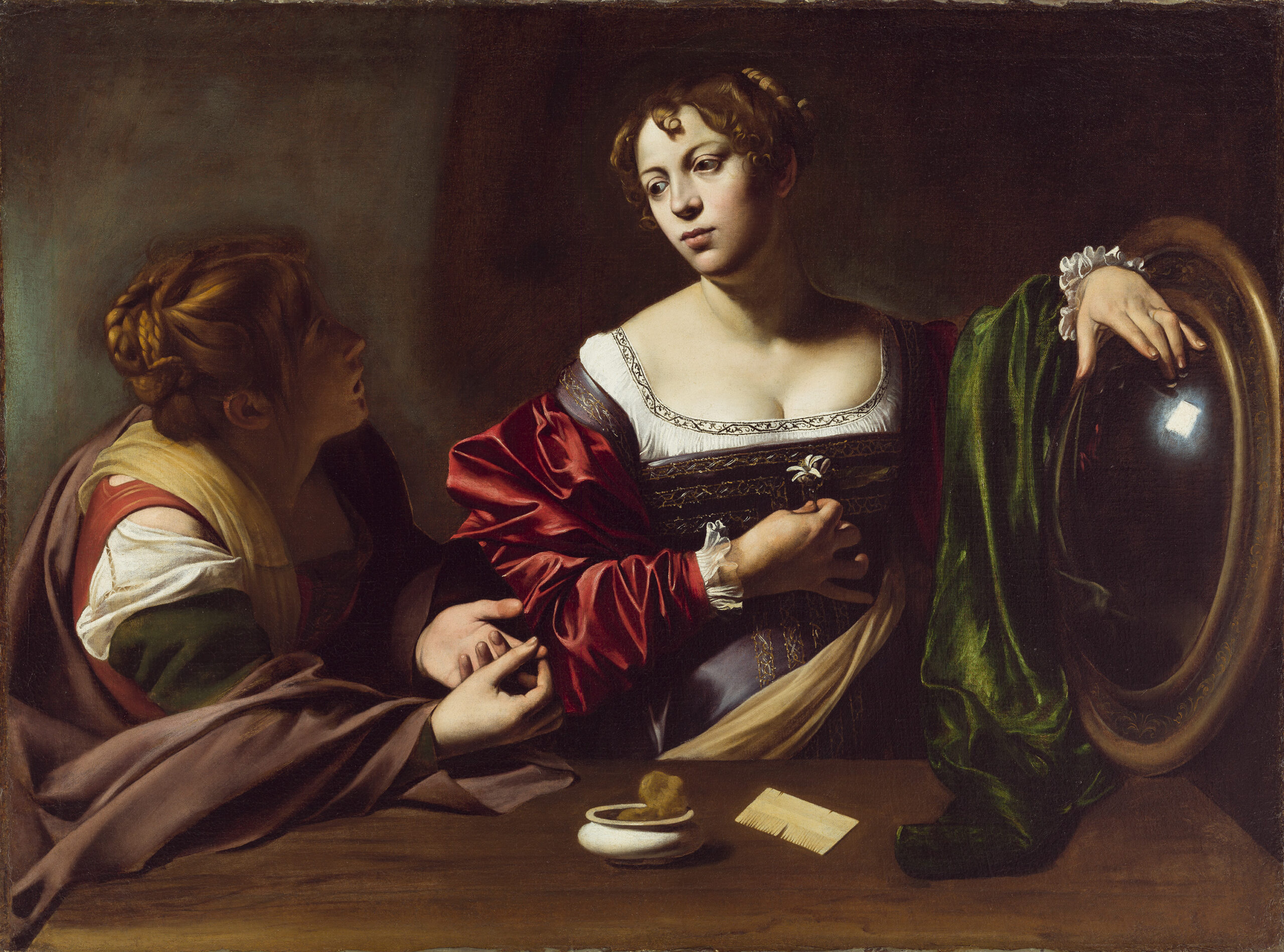
01 Caravaggio: Martha and Mary Magdalene, c. 1598
What this work reveals: The Church orders a conversion, live
In a simple room, two women are caught mid-conversation. On the left, Martha points at something, insisting. On the right, Mary Magdalene holds a mirror on which rest a white flower and a bracelet. Her fingers lightly touch the rim. She stares ahead, suspended between two states of being.
This is not the moment before the conversion, nor the moment after. It is the exact instant of the turning point.
Caravaggio painted this scene for Cardinal Francesco Maria Del Monte, his principal Roman patron. Del Monte was not a passive collector: he commissioned deliberately, guided subjects, knew precisely why he was paying. And the conversion of Mary Magdalene was a critical subject. Since Luther had reduced the sacraments to two, the Church of Rome was intent on reaffirming penance as a path to salvation, with Magdalene as the exemplary figure of redemption.
What Caravaggio brought that his predecessors lacked was physical presence. His figures genuinely occupy space. Light comes from somewhere. Fabrics have weight. The historian Roberto Longhi, who reconstructed Caravaggio’s nearly forgotten biography in the twentieth century, put it this way: Caravaggio does not imitate reality, he summons it. And that was precisely what Trent demanded: images that cannot be contemplated from a distance, but that seize you.
Cardinal Del Monte did not commission a masterpiece. He commissioned a conversion.
- Martha and Mary Magdalene, c. 1598, by Michelangelo Merisi da Caravaggio
- 39 3/8 × 52 15/16 inches (100 × 134.5 cm)
- Detroit Institute of Arts, European Paintings (not on display)
- https://dia.org/collection/martha-and-mary-magdalene-36204
02 Peter Paul Rubens: Christ Giving the Keys to Saint Peter, c. 1612–1616
What this work reveals: Painting doctrine as political program
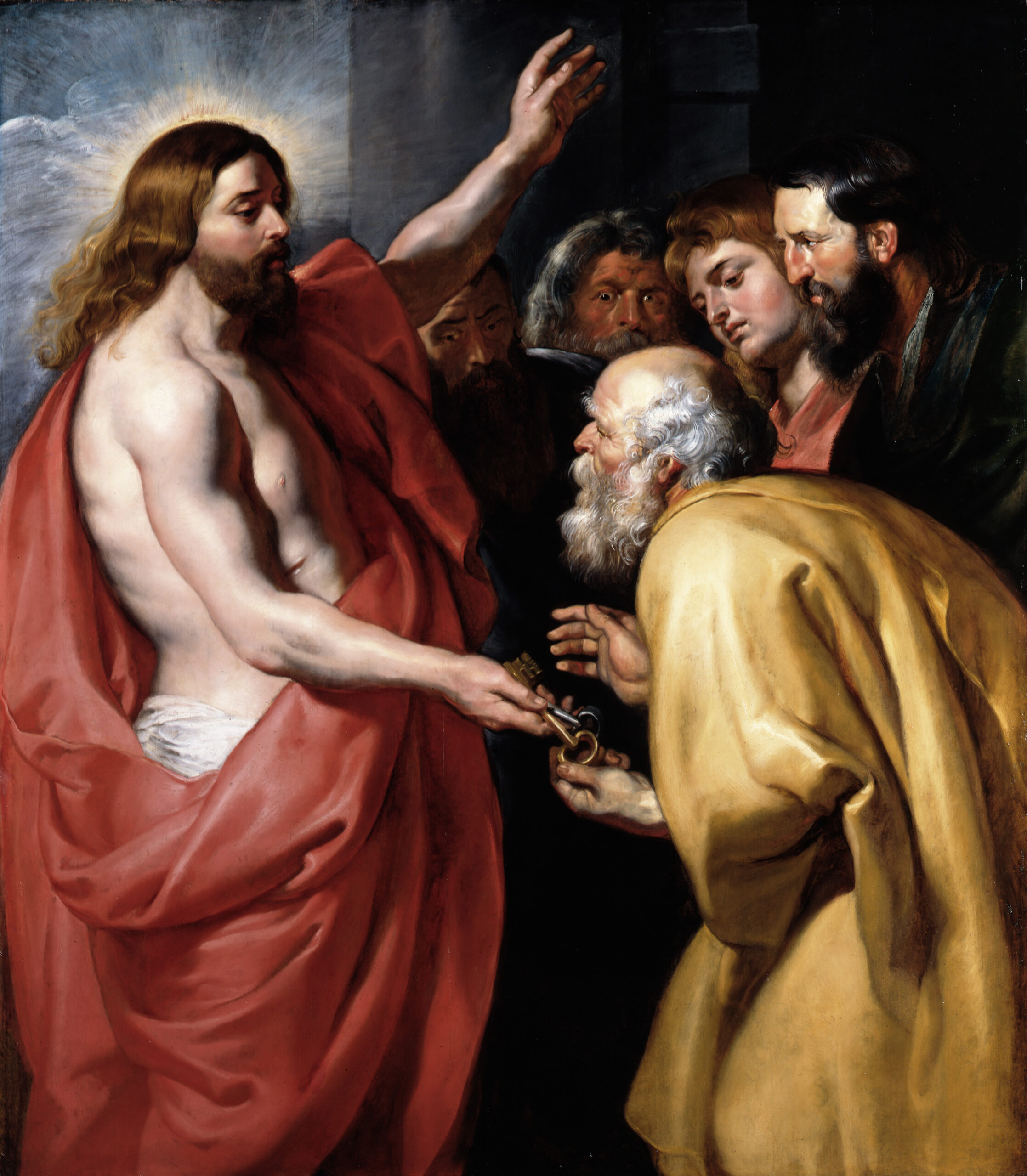
The scene is drawn from Matthew 16:18–19: “You are Peter, and on this rock I will build my Church. I will give you the keys of the Kingdom of Heaven.” Christ at the center, light descending upon him, Saint Peter kneeling to receive the keys, the apostles as witnesses. The composition is ordered, monumental, unambiguous.
This passage was perhaps the most contested in the entire New Testament in Rubens’ time. Protestants rejected any reading that established papal primacy over the universal Church. Catholics made it the cornerstone of their ecclesiology. Every painting that illustrated this moment was a statement of position.
Rubens was at this point the court painter of Spain and the Catholic archdukes of the Netherlands. He was not a craftsman executing instructions: he was a diplomat who traveled between royal courts, negotiated alliances, and carried sealed letters. His paintings traveled with him or ahead of him. They were arguments.
The historian Svetlana Alpers showed how the Rubens workshop functioned as a communications enterprise: dozens of collaborators, standardized exportable formats, a visual rhetoric calibrated to cross confessional borders. This painting is not a spiritual meditation. It is a manifesto.
When Rubens paints Saint Peter, he paints the papacy. This is not theology. It is foreign policy.
- Christ Giving the Keys of Heaven to Saint Peter, Peter Paul Rubens, circa 1613-1615
- Oil on oak panel, 182.5 × 159 cm
- Gemäldegalerie, Berlin
- https://recherche.smb.museum/detail/863360/christus-%C3%BCbergibt-dem-heiligen-petrus-die-himmelsschl%C3%BCssel
03 Valentin de Boulogne: A Musical Party, c. 1622–1625
What this work reveals: Music as argument, Caravaggism as viral network
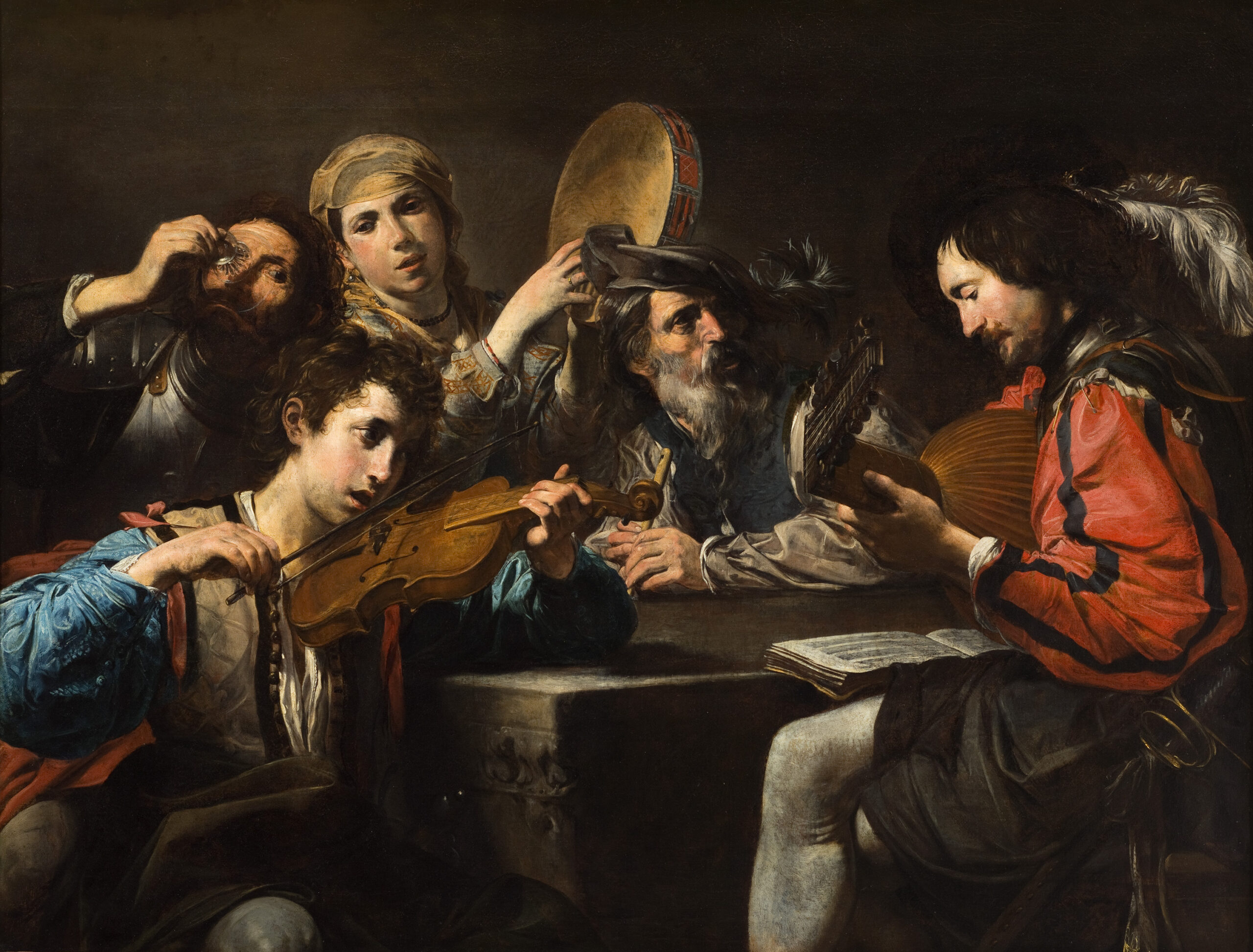
Around a cluttered table, musicians and drinkers. A lute player, a woman with a violin, a man singing, another laughing. Harsh light on the faces from a dark background. The scene seems improvised, but nothing is left to chance.
Valentin de Boulogne was born in Coulommiers, France. He spent his entire adult life in Rome, in the orbit of Caravaggio, who died in 1610. He was part of a group of artists from the north, Flemish, French, Dutch, who settled in Rome, absorbed Caravaggism, and brought it back to their countries of origin. This informal network of workshops, taverns, and commissions constituted the first international diffusion system for a pictorial style.
Music in this painting is not incidental. At the time of the Reformation, Protestants had simplified liturgical music; Calvin had reduced sacred song to the strict psalter. The Catholic Church responded at Trent by reaffirming polyphony, organs, and ornate music as a path toward God. Cardinal Barberini, in whose orbit Valentin moved, was at the heart of this debate: commissioning a painting of musicians, even one that appears secular, was also commissioning an image of sensory joy as divine gift.
The exhibition “Valentin de Boulogne: Beyond Caravaggio,” co-organized by the Louvre and the Metropolitan Museum in 2017, reconstituted his complete corpus for the first time and restored his central place in the diffusion of Caravaggism. Before 2017, Valentin remained a name for specialists.
Valentin painted a tavern. His patrons saw in it an apology for the human soul.
- A Musical Party, Valentin de Boulogne, c. 1623–1626
- Oil on canvas, 111.76 × 146.69 cm
- Los Angeles County Museum of Art (LACMA)
- https://collections.lacma.org/object/82630
04 Georges de La Tour: The Penitent Magdalene, c. 1635–1640
What this work reveals: The Counter-Reformation turns inward
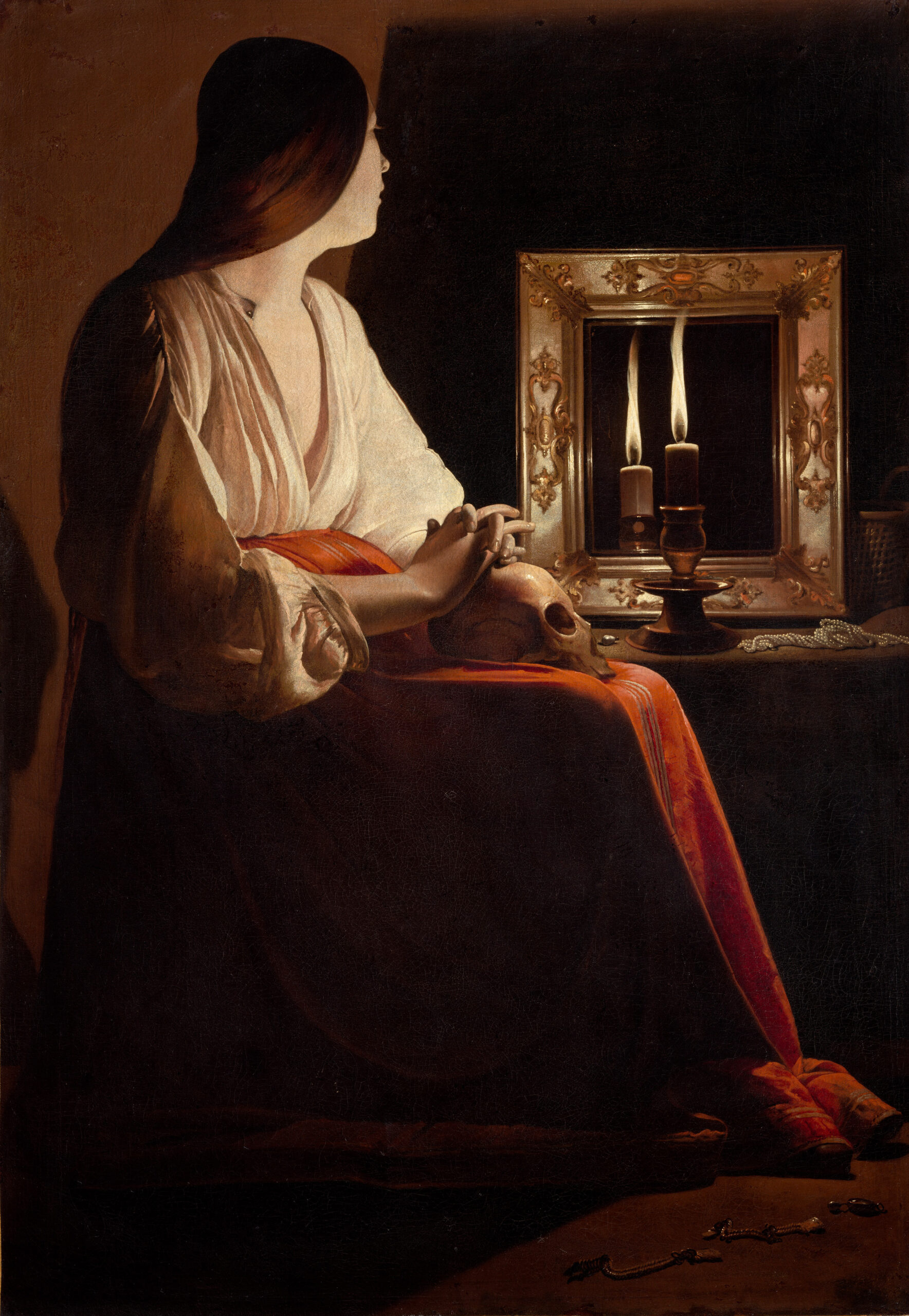
A woman alone in darkness. A candle on the table, its flame illuminating her left hand and the side of her face. On her lap, a skull. Before her, a mirror turned face down on the table. She is not looking at us. She is deep in thought.
There is no angel, no golden cloud, no rhetorical gesture. Just this woman and this candle.
La Tour painted in Lorraine, a territory devastated by the Thirty Years’ War. He worked for lay and religious patrons, including the dukes of Lorraine and King Louis XIII. His Mary Magdalenes are his most repeated, most requested works. Why this subject, in this format?
Because penance, since Trent, was the sacrament of interior reconquest. Not the spectacular penance of crowds in procession, but the individual and silent kind that suited the French aristocracy. La Tour translates Baroque emotion into introspective language. The theater remains in Rome. Here, light is reduced to a candle.
La Tour was almost entirely forgotten after his death. It was the German scholar Hermann Voss who, in the 1930s, recognized his hand in a series of canvases attributed to other painters and reconstituted his corpus. A painter whose works filled museums without anyone knowing his name.
La Tour needs no angelic choir. A candle is enough to build a cathedral of the interior.
- Title: “The Penitent Magdalene” by Georges de La Tour, circa 1640
- Dimensions: 133.4 x 102.2 cm (52 1/2 x 40 1/4 in.)
- Location: The Metropolitan Museum of Art, Fifth Avenue, New York, exhibited in Gallery 622
- https://www.metmuseum.org/art/collection/search/436839
05 Artemisia Gentileschi: Esther before Ahasuerus, c. 1628–1635
What this work reveals: A woman inside the machine, and what she slips in
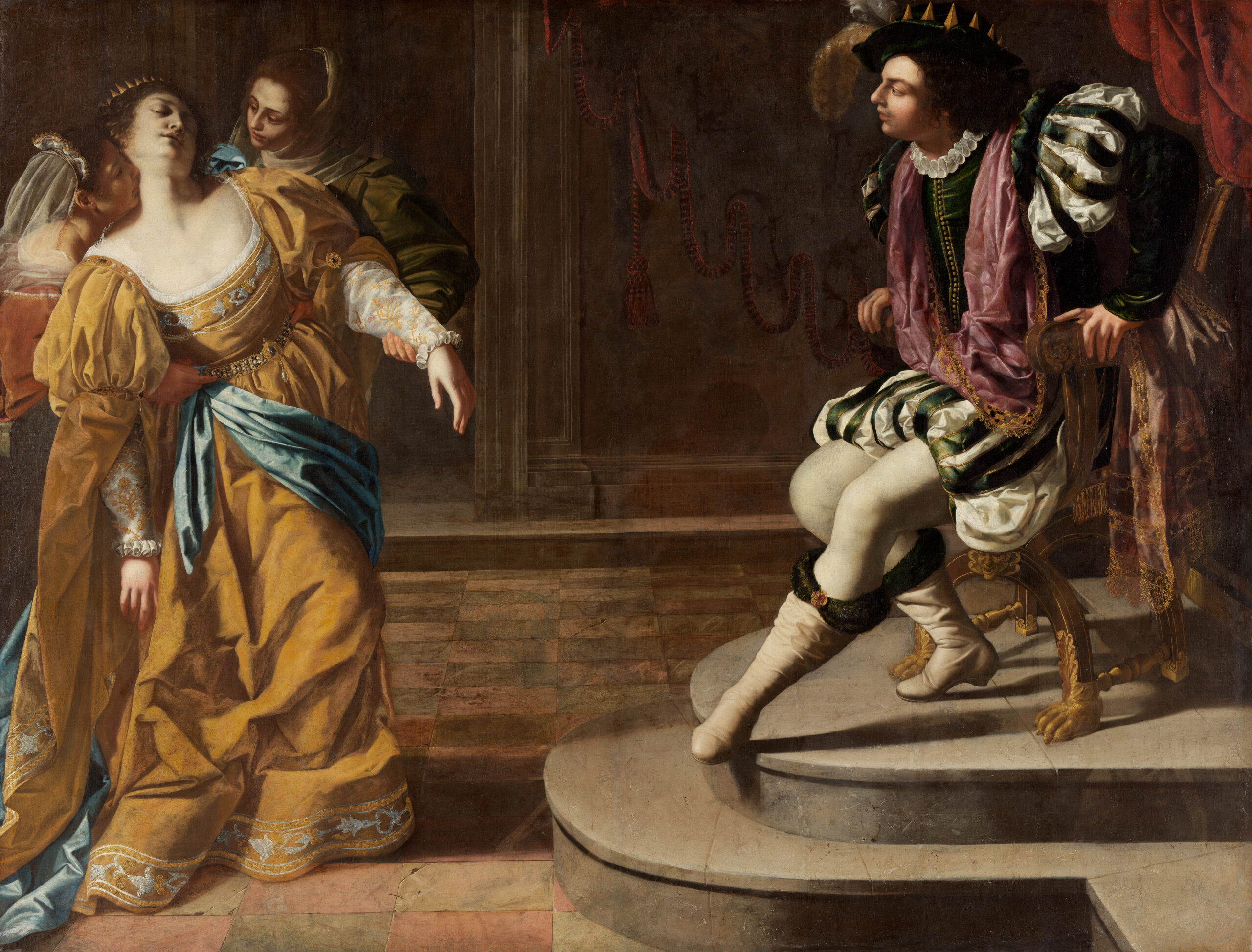
Esther, queen of a Persian king, steps forward to plead for her people. She is fainting. Her attendants support her. King Ahasuerus, to the right, watches from his throne.
The composition is conventional in its register: Esther is the biblical heroine who intercedes. Catholic typologists read it as a prefiguration of the Virgin interceding with Christ — a central subject of post-Tridentine devotion. The patron likely expected that reading.
Artemisia Gentileschi was the daughter of Orazio Gentileschi, a Caravaggesque painter. She was raped at seventeen by the painter Agostino Tassi. The trial that followed lasted seven months; she was tortured to “verify” the truthfulness of her testimony. She continued to paint, to travel, to sign contracts in her own name — in Florence, Rome, Naples, London. She was one of the rare professional women painters of her era to have had an international career.
The historian Mary Garrard, in 1989, was the first to systematically analyze the way Artemisia transforms conventional subjects. In this Esther, the fainting body is not weakness: it is the demonstration of a restrained power, of a being who chooses to efface herself to obtain what she wants. The psychology of the painting exceeds its typological subject.
Artemisia painted Esther. She may also have painted what it feels like to plead your case before a man who holds your life in his hands.
- Title: Esther before Ahasuerus
- Artist: Artemisia Gentileschi (1593-c. 1656)
- Date: 1620s
- Dimensions: 82 in. × 8 ft. 11 3/4 in. (208.3 × 273.7 cm)
- Location: The Metropolitan Museum of Art, Fifth Avenue, New York (not currently on display)
- https://www.metmuseum.org/art/collection/search/436453
What official history left out
We are generally taught that the Baroque was born in Italy and spread across Europe. We are told less clearly what it was built against.
The Bildersturm, “storms of images”, began in the Netherlands in 1566. Within weeks, thousands of religious works were torn from walls, broken, burned. Stained glass destroyed. Statues beheaded. In England, under Henry VIII, then Edward VI and Cromwell, the systematic destruction of images in churches lasted more than a century. Priceless medieval altarpieces disappeared. Frescoes were whitewashed.
Catholic Baroque art was, in part, a direct response to this destruction. The Church answered the bonfires of images with more images, larger, more emotional, more incarnate. It declared: our images are not idols, they are windows toward the divine. And it commissioned its finest artists to prove the point.
Art history almost never tells us what European museums no longer show: what was destroyed on the other side. Iconoclastic heritage has no museum.
Look first, read second
Return to Georges de La Tour’s The Penitent Magdalene (Metropolitan Museum of Art, New York). Before consulting the analysis, spend two minutes with the image alone.
Three points of observation:
- The mirror is placed face down on the table. Why can Magdalene no longer look at herself?
- The candle flame: what exactly does it illuminate, and what does it leave in shadow?
- Find three objects in the painting. For each one, ask yourself: does this belong to Magdalene’s past life, or to her new one?
There is no right answer, there is your gaze, before anyone tells you what to see. The art historian’s skill is built through this initial discomfort. Then compare with the full analysis on Vmuseum.
The Baroque lives around you
Emotional advertising
Catholic Baroque art invented a technique that contemporary advertising uses systematically: provoke an emotion before delivering a message. Baroque images do not inform you — they seize you. Harsh light on a face, a body caught in arrested motion, an expression of pain or ecstasy: devices Caravaggio developed in service of the Church that Nike, Apple, and Spotify deploy in their campaigns.
The museification of the sacred
Brian O’Doherty, in Inside the White Cube (1976), observes that the modern museum space reproduces the structure of a cathedral: silence, controlled light, slow processional movement, objects offered to contemplation. This is not a coincidence. Many of the first works displayed in the great nineteenth-century museums were Baroque altarpieces transferred from monasteries closed by revolutions. The museum inherited the cathedral without always realizing it.
The influence network as artistic diffusion
Caravaggism spread across Europe through nomadic artists circulating between Rome, Naples, Utrecht, Paris, and Madrid. This informal network preceded by four centuries the way artistic trends function on social media: a style that copies itself, adapts, and diffuses through mobile and connected individuals, without any central institution to control it.
Frequently asked questions
What was the Council of Trent, and why is it central to understanding the Baroque?
The Council of Trent (1545–1563) was the Catholic Church’s institutional response to the Protestant Reformation. Its decisions included: reaffirmation of the seven sacraments (against Luther, who recognized only two), defense of the veneration of saints and the Virgin, and an explicit directive on religious images. Bishops requested works that instructed the faithful, moved them, and encouraged devotion — without tipping into excess or confusion with the profane. This directive is directly responsible for the Baroque aesthetic: narrative clarity, visible emotion, physical incarnation of sacred subjects.
Was Caravaggio genuinely devout?
We do not know. Archival documents present a violent character involved in several brawls, one fatal, condemned to death in absentia and then a fugitive. But the question of religious sincerity is, for the art historian, secondary: what matters is that his patrons were Church officials who knew precisely what they wanted, and that Caravaggio delivered exactly that. The artist’s intention is not always determinative in the meaning of a work.
What is the difference between Roman, Flemish, and French Baroque?
Roman Baroque (Caravaggio, Annibale Carracci) is the most theatrical, most directly tied to ecclesiastical patronage. Flemish Baroque (Rubens, Van Dyck) is more colorful, more dynamic, heavily shaped by royal and aristocratic commissions — but still in service of the Counter-Reformation in the Catholic Netherlands. French Baroque (La Tour, Vouet, Poussin) is more restrained, more classicizing. Scholars often prefer the term “French Classicism” over Baroque, which reflects both an aesthetic judgment and a stylistic reality.
Why did Protestants destroy images?
Protestant iconoclasm rested on the Second Commandment (“You shall not make idols”) and the conviction that venerating images diverted the faithful from God toward material objects. Luther was relatively moderate on this point; Calvin was far more radical. The Bildersturm that devastated the Netherlands in 1566 was a popular expression of this conviction. The paradox is that this mass destruction pushed Catholic artists to produce even more images, even more convincing ones — directly accelerating the development of the Baroque.
Is Artemisia Gentileschi really a “feminist” artist, as is sometimes claimed?
The term is anachronistic: Artemisia had no feminist political program in the contemporary sense. But she navigated a professional world of men with a highly conscious strategy: she maintained correspondence with influential collectors, negotiated her own contracts, and claimed her status as a professional painter. Mary Garrard’s 1989 analysis remains the reference for understanding how her singular perspective transforms conventional subjects.
Further reading
Roberto Longhi, Caravaggio (various translations), The foundational monograph by the historian who reconstituted Caravaggio’s corpus in the twentieth century. Dense, uncompromising, indispensable.
Mary D. Garrard, Artemisia Gentileschi: The Image of the Female Hero in Italian Baroque Art (Princeton University Press, 1989), The academic reference on Artemisia. The first work to systematically analyze her singular perspective.
Exhibition catalogue: Valentin de Boulogne: Beyond Caravaggio (The Metropolitan Museum of Art / Musée du Louvre, 2017), The exhibition that restored Valentin to the center of the Caravaggism story. Richly illustrated, accessible texts.
John T. Spike, Caravaggio (Abbeville Press, 2010), The most complete English-language monograph, with a full catalogue raisonné and updated attributions.
Online resources
The Metropolitan Museum of Art (metmuseum.org) and the National Gallery (nationalgallery.org.uk) offer free, detailed analyses of Baroque works in their collections.
The Louvre online collection (collections.louvre.fr) provides access to French Baroque holdings with scholarly notes.