Key facts
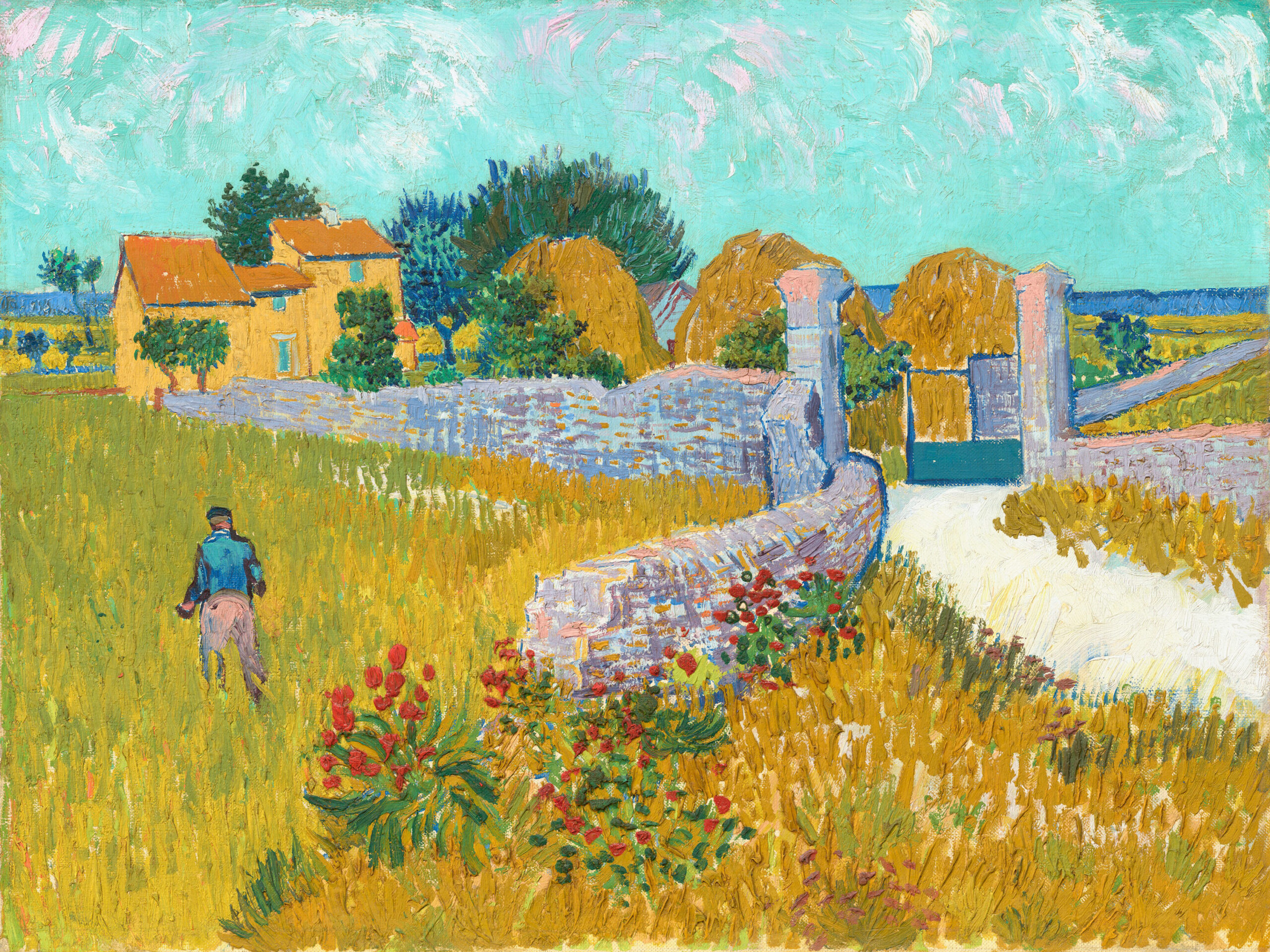
Farmhouse in Provence is an oil on canvas painted by Vincent van Gogh in 1888, during his stay in Arles, in the south of France. Held at the National Gallery of Art in Washington, D.C., the work belongs to the painter’s Arles period, marked by an intense output of more than 200 canvases in fifteen months. Part of the Post-Impressionist movement, it reflects Van Gogh’s exploration of Provençal light and complementary color pairings, a technique inherited from the Impressionists. This period remains decisive in his stylistic evolution, between the simplification of forms inspired by Japanese woodblock prints and heightened chromatic intensity.
What color in this Van Gogh painting! Here I find a variation of the yellow he loves so much, the one that reflects the light he rediscovers in this Provence he equally cherishes. Yellow floods the canvas: it appears in the crops rippling in the foreground, on the walls of the farm buildings, in the haystacks dotting the courtyard. And then that sky, an unexpected turquoise, streaked with pink clouds, a choice of complementary colors Van Gogh particularly favors during this period, which literally makes the canvas vibrate with light.
It’s a work that catches me the moment I see it, as I make my way through the collections of the National Gallery of Art. There’s something almost simple, earthbound, about this subject, a farm, fields, haystacks, a small figure that adds humanity. And yet everything is transfigured by the way Van Gogh looks at the light of the Midi. You can feel, in these bold strokes and this contrast of tones, his relentless search for a pictorial language able to convey the heat, the vibration of the air, the very substance of Provence. It’s this tension between a humble rural subject and an almost incandescent palette that, to my eyes, makes this canvas unforgettable.
Look at that small figure in the blue jacket, in the foreground on the left. His back is turned to you, almost swallowed by the golden wheat. The whole painting seems to converge on this tiny silhouette, before opening onto the farm, the haystacks, and that improbable sky.
What lies beneath the Farmhouse in Provence
Beneath this quiet scene, Van Gogh wages a real battle of color. The yellow of the wheat answers the blue of the sky, the red of the poppies opposes the green of the stems. According to the National Gallery of Art’s entry, the museum notes that these complementary pairs, drawn from the scientific research Pissarro passed on to Van Gogh, make the canvas nearly vibrate. Painted in Arles in 1888, this oil on canvas measuring 46.1 x 60.9 cm belongs to a dizzying period: fifteen months, 444 days exactly, during which the painter produces more than 200 canvases. A peaceful farm, born of an almost feverish pace. That is the tension running through this canvas: the calm of the subject contradicts the speed of its execution.
Vincent van Gogh and his time
Vincent Van Gogh arrives in Arles in February 1888. Snow still covers the fields. Yet it is the sun he seeks there, a light bright enough to flatten forms, as in the Japanese prints he admires. Arles becomes, in his eyes, “the Japan of the South.” This Post-Impressionist painter, still little recognized in his lifetime, first exhibited in 1901 at the Bernheim-Jeune gallery in Paris, enters the National Gallery of Art’s collection in 1978 through the bequest of Ailsa Mellon Bruce.
News: a reunion of Van Goghs unseen since 1984
In September 2026, it’s the Kröller-Müller Museum in Otterlo (the Netherlands) making headlines: from September 15, 2026, to January 3, 2027, the institution presents the exhibition “Van Gogh, All Our Paintings,” which brings together, for the first time since 1984, all 88 Vincent van Gogh paintings held in its collection. These works, mostly acquired between 1908 and 1930 by the museum’s founder, Helene Kröller-Müller, are presented around three central themes in the painter’s life and work: faith, hope, and love. The museum holds the world’s second-largest Van Gogh collection after Amsterdam’s, but since many of its canvases are usually on loan to other institutions, this complete gathering remains exceptional.
Source: Kröller-Müller Museum
A question for you
Can a painting be calm and feverish at once, or is it you who decides, as you look at it, which of the two you feel first?
About this work
- Farmhouse in Provence
- Vincent van Gogh (1853-1890)
- 1888
- Oil on canvas
- 46.1 x 60.9 cm
- National Gallery of Art, Washington, D.C.
- https://www.nga.gov/artworks/52178-farmhouse-provence