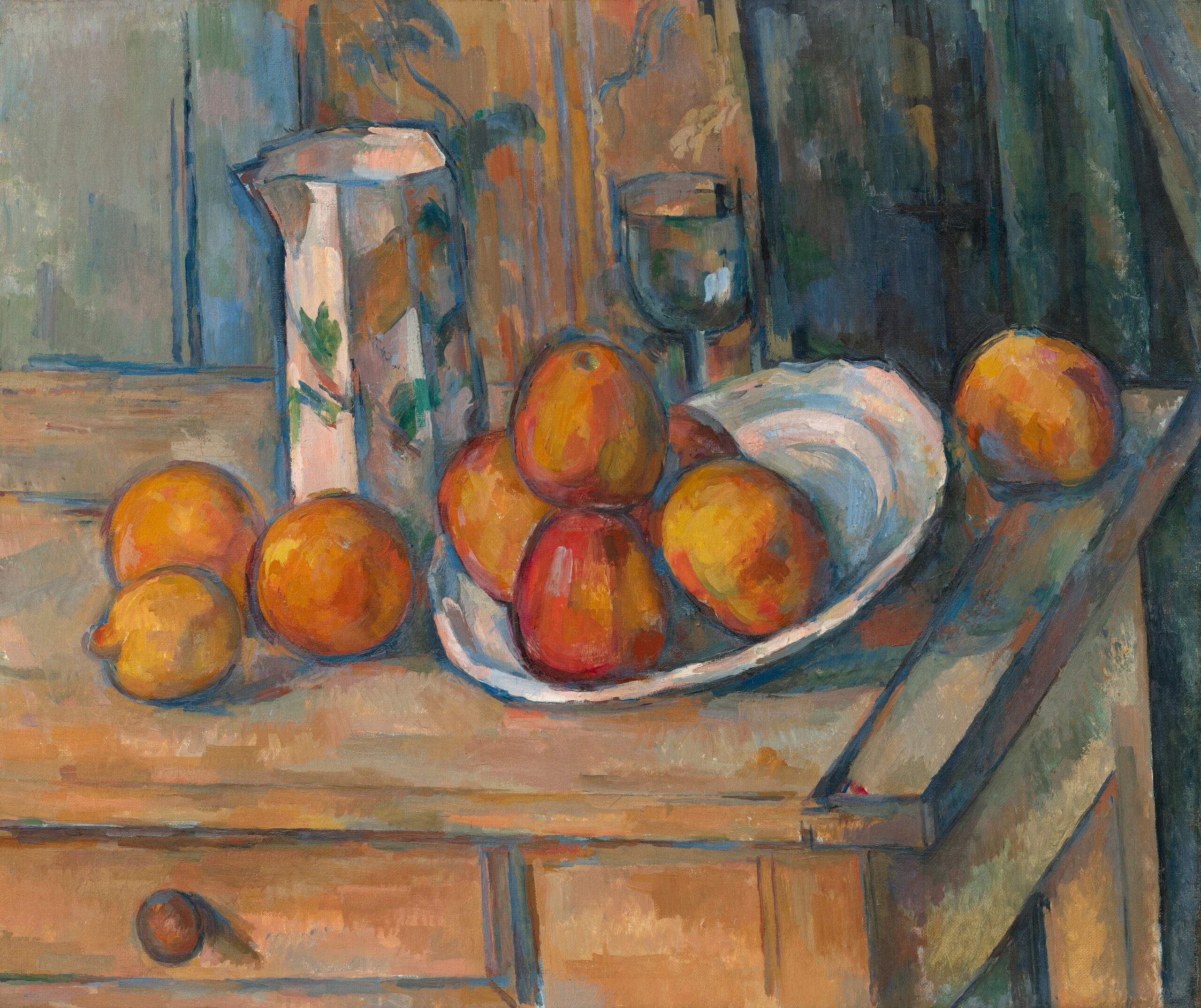
I have to say, what strikes me first before this canvas is the warmth of the colors. The yellows and oranges of the fruit, apples, pears, perhaps a lemon, seem to glow outward, their warmth reaching even into the shadows of the milk jug. Cézanne accustomed us to a great many still lifes, each quite different from the last, but this one carries something particularly gentle: one can almost feel the light of a summer afternoon passing through the room.
My eye never tires of moving from one object to the next: the stemmed glass, half in shadow, acts as a pivot between the substantial milk jug on the left and the gathered fruit beside it. In the small, oblique, slightly broken brushstrokes of the plate, one senses that celebrated Cézannian principle, modeling through color rather than line, so characteristic of this late period: volumes are not outlined, they emerge from shifts in tone itself. There is also a subtle instability in the perspective, the plate seems to tip gently toward us, lending the whole composition a quiet, almost living tension beneath its apparent domestic simplicity.
Set against the artist’s cooler, more austere still lifes, this one breathes a rare summer warmth, which is precisely why I keep returning to it, and why I wanted to share it with you.
Seeing
A green leaf, sketched hastily across the white porcelain of the milk jug. This small botanical motif catches the eye before anything else. Around it, fruit gathers on a white plate: red apples, oranges, a single lemon set apart on the pale wooden table. A stemmed glass, nearly empty, stands back in the green shadow of the background. Behind it, a dark green curtain closes off the space. The light does not fall from a single direction, it circulates, passing from one fruit to another, as though each object carried its own source of warmth.
Understanding
Cézanne painted this still life around 1900, in the final years of his life, dividing his time between Aix-en-Provence and Paris. By this period, he had largely set aside landscape in favor of studio compositions, reworked over weeks at a time. Unlike flowers, fruit does not wilt quickly, it became for him a subject of near-scientific study in color and volume. Here, modeling through color replaces classical draftsmanship: forms emerge from juxtaposed, oblique strokes rather than a closed contour. The dealer Ambroise Vollard, who gave Cézanne his first solo exhibition in 1895, helped bring this late body of work before the Parisian public. This method, refined over decades, would go on to shape the generation that followed, Matisse, and later Picasso.
Feeling
Before this canvas, the warmth is not only a matter of color. It comes from the restrained tension held in each object, the slightly tilted jug, the plate that seems to slide toward the viewer. Nothing is entirely stable, and yet nothing falls. Notice how your eye hesitates between the green of the leaf on the jug and the red of the apples: it is precisely that hesitation Cézanne sought to paint.
Currently – Cézanne et nous, at the Grand Palais
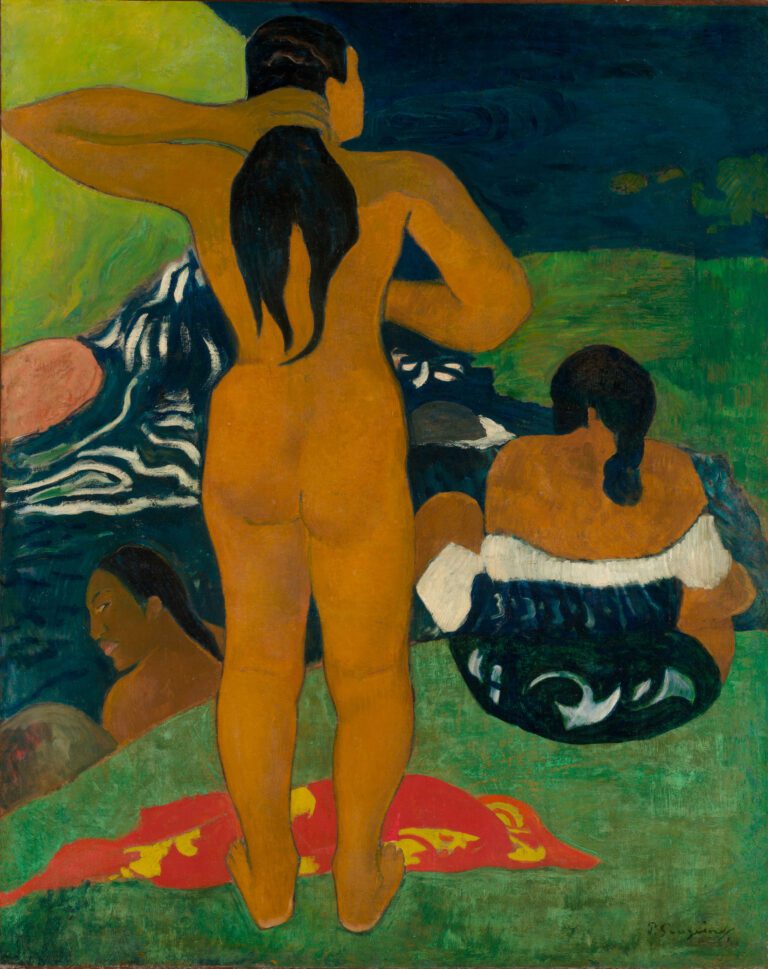
As this article goes to print, Cézanne is very much in the news: from 23 September 2026 to 17 January 2027, the Grand Palais in Paris presents a landmark exhibition, “Cézanne et nous,” co-produced with the Musée d’Orsay and the Centre Pompidou. Bringing together some 180 works, 70 by Cézanne himself, it traces his influence across generations of artists, from Gauguin to Picasso and on to contemporary figures such as Peter Doig. A timely occasion to place a work such as Still Life with Milk Jug and Fruit within the broader legacy of the painter from Aix-en-Provence.
Source: Centre Pompidou
A question for you
💭 Can a volume truly be painted without ever being drawn?
About this work
- Still Life with Milk Jug and Fruit
- Paul Cézanne
- c. 1900
- Oil on canvas
- 45.8 x 54.9 cm (18 x 21 5/8 in.)
- National Gallery of Art, Washington, D.C.
- https://www.nga.gov/artworks/53123-still-life-milk-jug-and-fruit