Key facts
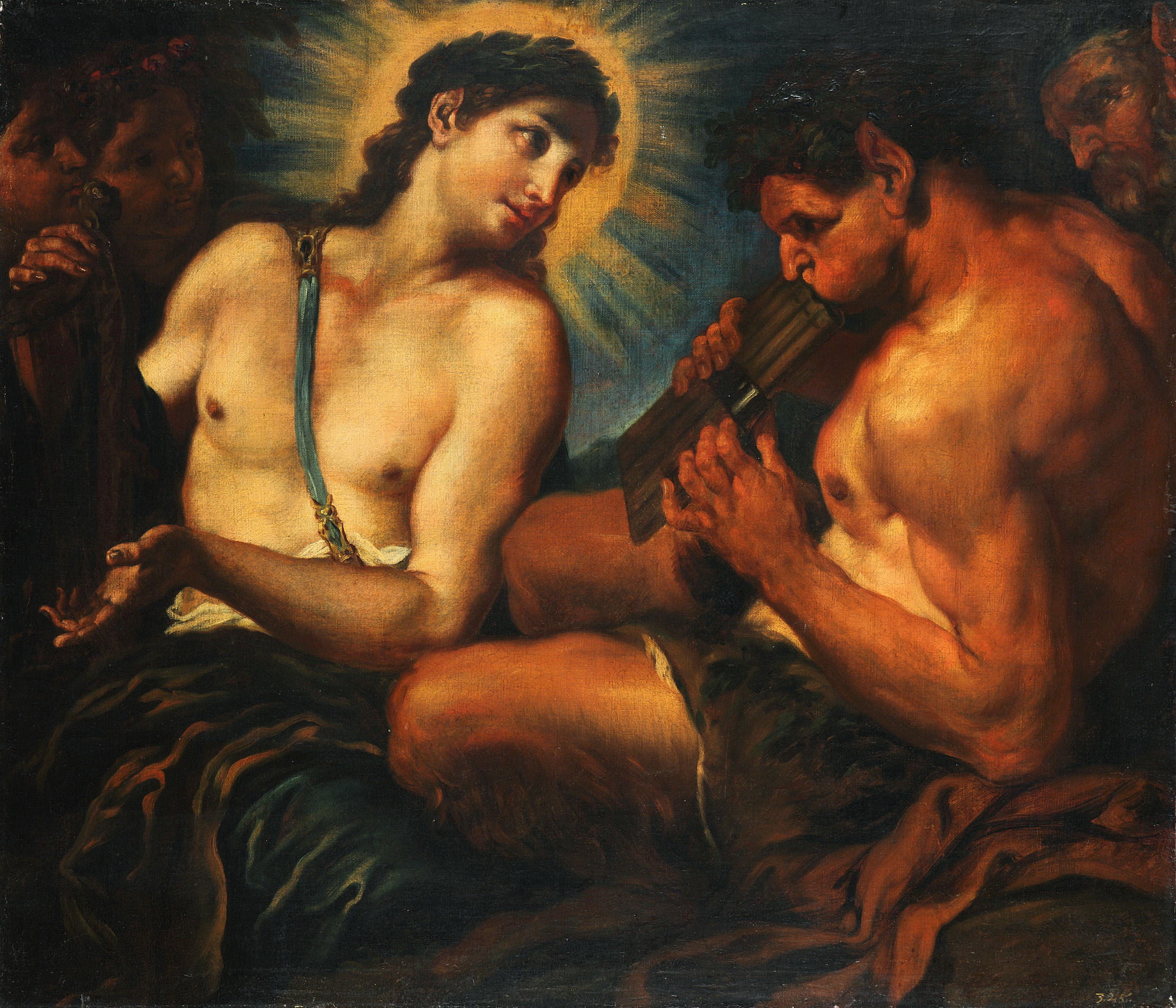
Painted around 1685 by Johann Carl Loth, The Musical Contest of Apollo is a Baroque oil on canvas that has been held by the Gemäldegalerie in Berlin since 1925. Born in Munich in 1632, Loth settled in Venice, where he died in 1698. Here he depicts an episode from Ovid’s Metamorphoses (VI, 381–399): the satyr Marsyas challenges Apollo to a musical contest and suffers a cruel punishment. The painting pairs a palette of glowing, incandescent colours with a precise reference to Antiquity. The figure of Marsyas is based on the Belvedere Torso, a marble in the Vatican that the painter most likely studied in Rome after 1653. The work shows the dialogue between ancient sculpture and Venetian painting in the 17th century.
Here is a work inspired by mythology, drawn from a passage in the Metamorphoses by the Roman poet Ovid (Book VI), an inexhaustible source of inspiration for artists. We see Apollo, god of the arts and leader of the Muses, challenged by Marsyas. This Phrygian nature spirit dares to pit himself against an Olympian god in a musical contest, and his boldness will earn him a cruel punishment: he will be flayed alive. What I find particularly interesting here is where the painter found his inspiration. For the body of Marsyas, Johann Carl Loth drew on the famous Belvedere Torso, the ancient marble fragment admired by Michelangelo and kept in the Vatican. He probably studied it during his stay in Rome, after 1653, before painting this canvas in Venice, where he spent most of his career. I love knowing that a German painter living in Italy turned to a two-thousand-year-old sculpture to bring his character to life. You can feel that sculptural power in Marsyas’s muscles, and it contrasts with the warm light and radiant colour that model the bodies. The figures are packed tightly into the frame, almost cramped, which heightens the tension of the face-off. In any case, I find it a magnificent example of Baroque painting. It entered the Gemäldegalerie in Berlin in 1925, a gift from the Berlin collector Henri Heilbronner.
A reddened knuckle presses on a reed pipe. Look closely at Marsyas’s hands. His fingers grip the panpipes, his cheeks puff out, his breath flows. Facing him, Apollo does not play. He listens, head tilted, crowned with laurel. Behind his dark curls, a golden light radiates like a rising sun. On the left, two youthful faces emerge from the shadows, one crowned with flowers. You can almost hear the music.
Apollo and Marsyas: two skins, one fire
Look at the flesh first. Apollo’s skin is pearly, almost milky, barely modelled. Marsyas burns in shades of brick and copper. Johann Carl Loth sets these two flesh tones side by side, almost touching. The light falls full on the god. Then it slides across the satyr’s shoulder and carves out every muscle. A blue strap fastened with gilded clasps crosses Apollo’s chest. It is the only cool note in a palette the museum’s label calls incandescent. The word fits. Look closer still. In the green drapery of the foreground, the brush leaves pale, quick, almost nervous flicks. The flesh, by contrast, is smoothly blended, with no visible brushstrokes. Two speeds of painting coexist on the same canvas.
Now look at Marsyas’s curved back. The leaning torso, the twisting trunk and the massive musculature all come from marble. The painter draws on the Belvedere Torso, a fragment signed by Apollonios of Athens in the 1st century BC. Now in the Vatican Museums, it shows a seated man, leaning forward, his body twisted. The statue has lost its head and arms. Loth gives them back. He grants the broken marble a face, hands and breath.
There is another, subtler departure from the text. In Ovid, Marsyas picks up the reed flute that Minerva threw away. Here, he blows into a syrinx with several pipes, the instrument of Pan. His pointed ear betrays his satyr nature. The loser has one of the most admired bodies of Antiquity. The winner keeps the smooth flesh of a young man. Ovid tells what comes next: Marsyas is flayed, then turned into a river. Loth shows none of this torment. He freezes the moment just before, while the music still rings out.
Johann Carl Loth, a Bavarian in Venice
Johann Carl Loth was born in Munich in 1632. He trained with his father, Johann Ulrich Loth, painter to the Bavarian court. After 1653, he left for Rome and studied the antiquities there. He then settled in Venice, where he worked until his death in 1698. The Italians called him Carlotto. Rome gave him the draughtsmanship of the ancients; Venice gave him colour. A specialist in history painting, he drew his subjects from mythology and the Old Testament. He favoured tightly packed group scenes, with figures cut off by the frame. He even received a commission from Emperor Leopold I in Vienna. His many pupils later spread his style through Bavaria and Austria. Painted around 1685, this picture entered the Gemäldegalerie in Berlin in 1925.
News from the Gemäldegalerie
If you go to Berlin to see The Musical Contest of Apollo, make time for the Gemäldegalerie’s temporary exhibition. Porträts! Überraschende Begegnungen von Botticelli bis Lempicka (Portraits! Surprising Encounters from Botticelli to Lempicka) runs until 14 March 2027. It brings together around 90 masterpieces, mostly from the museum’s own collection, alongside loans from other Berlin institutions: the Alte and Neue Nationalgalerie, the Egyptian Museum and the Sculpture Collection. The exhibition pairs portraits from different centuries and cultures, often for the first time, such as Botticelli’s Giuliano de’ Medici (1478) and a portrait by Tamara de Lempicka (c. 1931). It explores identity, beauty, status and power, with self-presentation in the age of the selfie as a common thread. The exhibition also includes works by Rembrandt, Rubens and Zurbarán, 17th-century masters like Loth.
Source: Gemäldegalerie, Staatliche Museen zu Berlin.
A question for you
Marble or paint: which do you think best conveys the strength of a body?
About this work
- The Musical Contest of Apollo
- Johann Carl Loth
- c. 1685
- Oil on canvas
- 98.5 × 115 cm
- Gemäldegalerie, Staatliche Museen zu Berlin
- https://search.smb.museum/object/obj-866151