Key facts
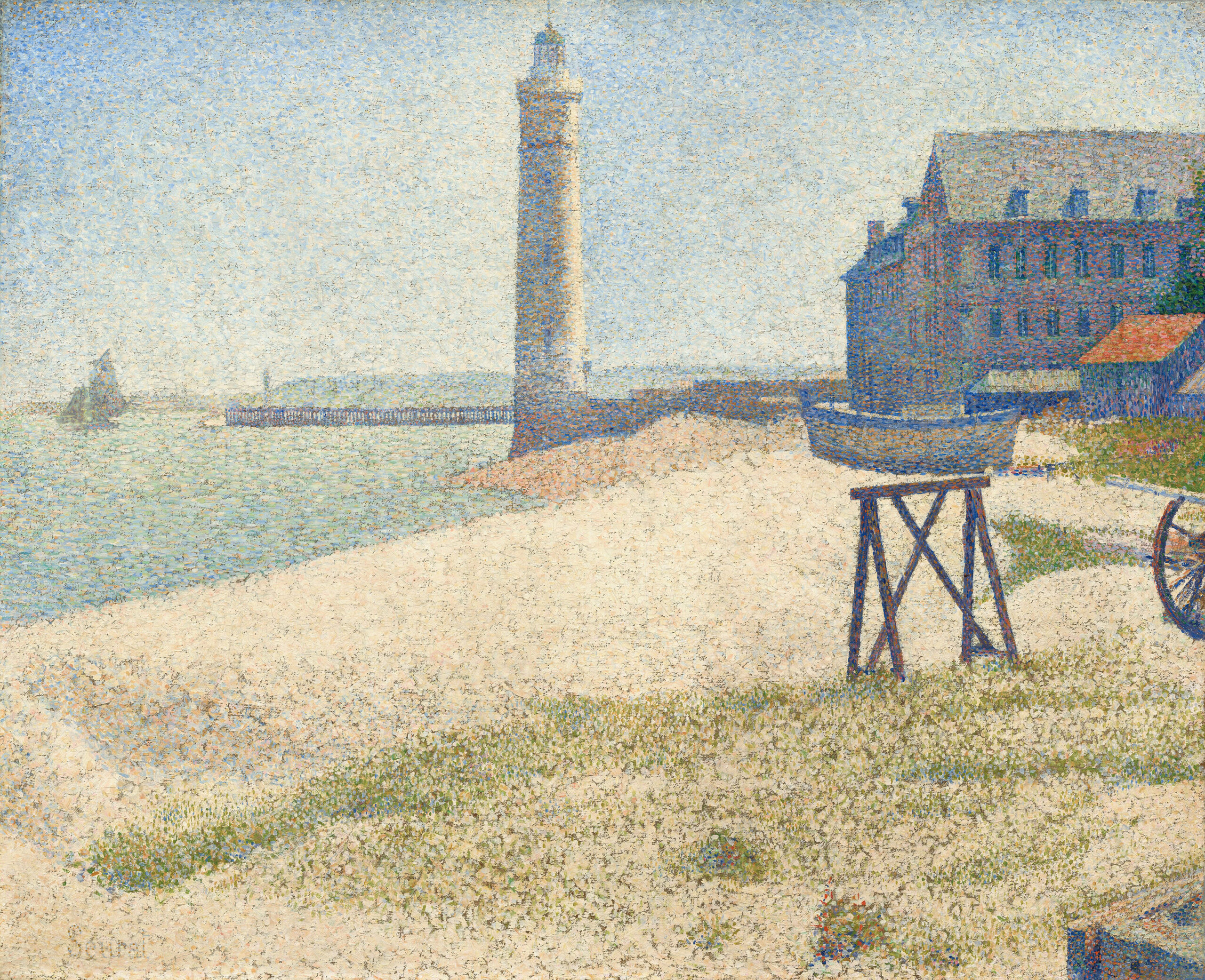
Painted by Georges Seurat in 1886, The Lighthouse at Honfleur depicts the lighthouse and hospice of this Norman port on the Seine estuary. The canvas belongs to Neo-Impressionism and uses pointillism, or divisionism: small touches of pure colour that the viewer’s eye blends from a distance. Seurat began it in Honfleur in the summer of 1886, just after showing A Sunday Afternoon on the Island of La Grande Jatte at the eighth and final Impressionist exhibition. It is one of the seven seascapes he started during that stay and later completed in his Paris studio. Held by the National Gallery of Art in Washington, the painting was shown in 2026 at the Courtauld Gallery in London, in the exhibition Seurat and the Sea.
Seurat and his pointillist technique never cease to amaze me. What an enormous amount of work this technique demands! Thousands of tiny touches of pure colour, laid down one by one, which the viewer’s eye blends on its own from a distance. And the result is stunning. You have to see The Lighthouse at Honfleur in person, up close and then from afar, to grasp the feat he achieved. Up close, you see nothing but dots; step back, and the light of the Norman port emerges, calm and almost silent. I also find it fascinating that this kind of painting grows directly out of Impressionism. Seurat showed his first pointillist works, including A Sunday Afternoon on the Island of La Grande Jatte, at the eighth and final Impressionist exhibition in 1886. That same year, he painted this lighthouse during his summer stay in Honfleur. He started from the observation of light so dear to the Impressionists, but gave it an almost scientific rigour. What I admire here is the way he renders colour, plays with shadow and handles the landscape: everything seems frozen in a motionless light, far from Monet’s spontaneity, and that is precisely what makes this seascape so unique.
Come closer to the sand at the bottom of the canvas. Between the cream, pink and soft green dots, tiny flecks of white remain. This is not paint. It is the canvas’s ground, left bare. Take a step back. These gaps become the glare of a sun-bleached shore. The lighthouse rises, pale, in still air. Not a breath of wind, not a figure. Only the light of the estuary, resting on Honfleur like warm dust.
The Lighthouse at Honfleur
Look at the tower. On the sunlit side, blond and orange dots. On the shaded side, mauve and blue take over. Seurat applies the rule of divisionism: shadow is built from the complementary of the local colour. The viewer’s eye does the mixing, at the right distance. Yet beneath this skin of dots lies another painting. According to the Courtauld Gallery, an X-ray of the canvas shows a first layer of criss-cross, hatched brushstrokes. Seurat waits for it to dry. Then he covers it with thick, irregular dots. Here, pointillism is not a single gesture. It is a layering, almost a masonry of colour.
The composition follows the same discipline. Tourist views of the site placed the lighthouse at the centre of a vast expanse of beach and sky. Seurat shifts it and pushes it up toward the top edge of the frame. The wooden jetty runs off to the left. The horizon stretches out. Only the vertical line of the tower cuts through these calm lines. On the right, the hospice with its midnight-blue windows closes off the view. In front of it, a beached boat, a cross-legged trestle, a cropped cartwheel. The sea shimmers with watery greens. In the distance, a grey sailboat never seems to move forward. The sky is not a flat blue: it mixes lilac, straw-yellow and azure dots. The National Gallery of Art’s catalogue entry notes the signature “Seurat” at lower left. It almost melts into the sand.
A “restful” summer
May 1886. Seurat shows A Sunday Afternoon on the Island of La Grande Jatte at the eighth and final Impressionist exhibition. The canvas divides opinion and establishes him in the Parisian avant-garde. Critics soon speak of Neo-Impressionism. Right afterwards, the painter leaves for Honfleur, near Le Havre. There he begins seven canvases, his most productive seascape campaign. All are completed in his Paris studio the following autumn and winter. Seurat tells the Belgian writer Émile Verhaeren, who buys the painting, that he worked on it for two and a half months. A holiday painting. Two and a half months of toil. By 1887, the canvas is on show at the Salon des Indépendants in Paris. In 1910, it already crosses the Channel for the exhibition Manet and the Post-Impressionists in London.
Linger a moment longer in front of the canvas. In the foreground, tufts of short grass dot the shore with green and ochre. At the very bottom, a small patch of red bursts out, alone. The eye travels up the beach, along the tower, and loses itself in a chalky sky. Nothing moves. And yet every inch of the surface crackles with clashing colours.
News
In 2026, Seurat’s seascapes received unprecedented attention. From 13 February to 17 May, the Courtauld Gallery in London devoted the first exhibition in history to them, Seurat and the Sea. It brought together 26 paintings, oil sketches and drawings made during the painter’s summer stays on the Channel coast. The Lighthouse at Honfleur was among them, on loan from the National Gallery of Art in Washington. The American museum is now preparing Souvenirs of the Gilded Age: French Landscapes from the Corcoran Collection (13 March 2027 to 17 January 2028).
Sources: Courtauld Gallery and National Gallery of Art.
A question for you
Seurat spent two and a half months painting this holiday landscape. Would you have had the patience, dot after dot?
About this work
- The Lighthouse at Honfleur
- Georges Seurat
- 1886
- Oil on canvas
- 66.7 × 81.9 cm (26 1/4 × 32 1/4 in.)
- National Gallery of Art, Washington D.C.
- Collection of Mr. and Mrs. Paul Mellon
- https://www.nga.gov/artworks/61383-lighthouse-honfleur