Paris, 1925. The Marne sparkles under the summer sun. Dufy sets up his easel facing the open-air cafés where working-class France comes to breathe. Boaters glide on the water, bathers rejoice, life bursts forth in quick, luminous strokes.
A Symphony of Greens
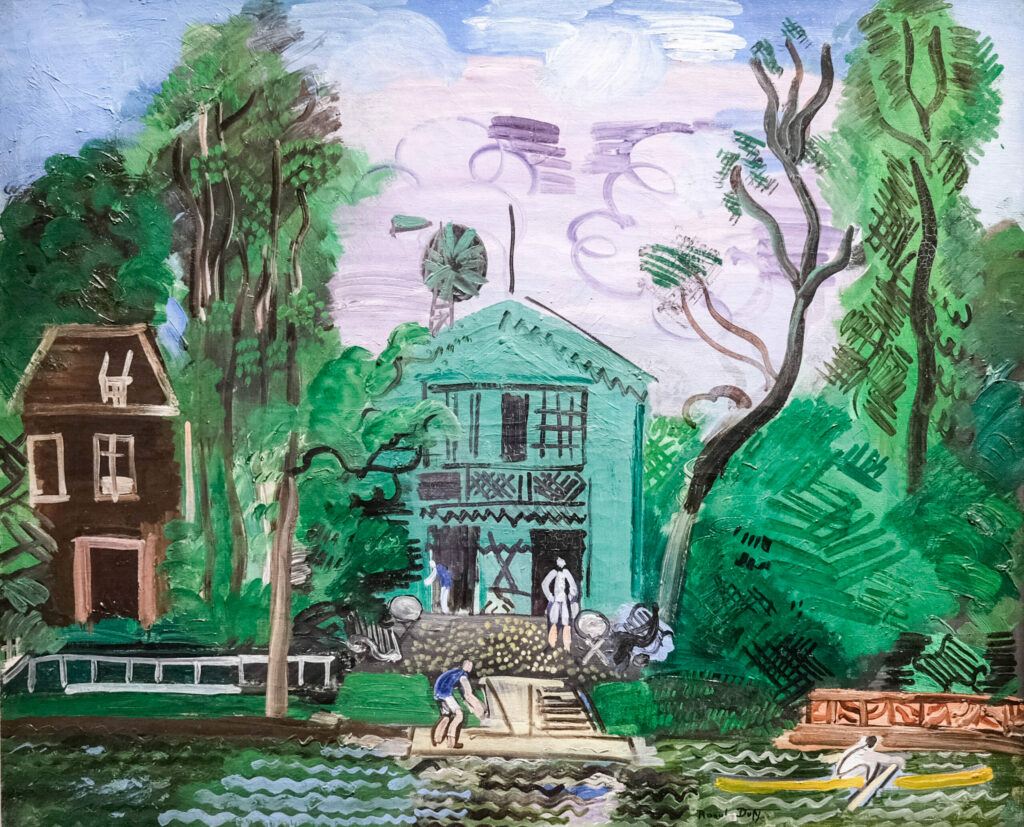
The work overflows with freshness. Dufy applies color in large vibrant flat areas. Houses rise on the left, one brown, the other turquoise with decorative ornaments. Trees soar in supple arabesques. In the foreground, silhouettes sketched in black ink stand out; one rows in a bright yellow canoe. The technique is spontaneous, almost calligraphic. Dufy traces contours with an independent line, then lays down color in flat areas that deliberately overflow. This dissociation between drawing and chromaticism creates a sensation of perpetual movement.
Leisure by the Water, a Modern Motif
The banks of the Marne embody leisure before its time. Already in the 1920s, Parisians fled the capital for these rustic open-air cafés. People danced, went boating, celebrated the modernity of leisure. Dufy captures this effervescence with tenderness. He follows in the lineage of the Impressionists who already celebrated Argenteuil and Bougival, but his pictorial vocabulary is resolutely Fauvist: pure colors, decorative compositions, immediate visual joy.
Raoul Dufy, Painter of Happiness
Born in Le Havre, Raoul Dufy (1877-1953) moved through Fauvism alongside Matisse. He developed a singular style of writing, light and musical, applied to horse races, regattas, and street scenes. His entire oeuvre celebrates French elegance and carefree spirit.
Think about it
💭 Twenty years after the Fauvism of Matisse and Derain, how does Dufy extend their chromatic revolution?
About This Work
- Banks of the Marne, the Boaters
- Raoul Dufy
- 1925
- Oil on canvas
- Musée d’Art moderne de Paris, Paris Musée
- https://www.parismuseescollections.paris.fr/en/node/205908
Celebration on the Water
Banks of the Marne, the Boaters belongs to the heart of Raoul Dufy’s production in the 1920s (Le Havre, 1877 – Forcalquier, 1953), when his style was fully formed and his pictorial language immediately recognizable. The composition depicts a leisure scene on the Marne: boaters in yellow canoes, swimmers, brown and turquoise architecture, and trees whose supple curves form a vibrant, joyful ensemble. Dufy organizes the space in broad areas of pure color whose outlines, drawn in ink or brush, appear independent of the colored fill, a technique that is his most personal invention and that gives his canvases their impression of lightness and calligraphic spontaneity.
Line Freed from Color
The great lesson Dufy drew from his Fauvist years (1906-1907) was the liberation of color from any descriptive role. In mature works like Banks of the Marne, the line draws the contours of bodies and objects while the color flows freely beyond those limits, creating an intentional gap between the two graphic systems. This procedure gives Dufy’s paintings an almost musical lightness, an analogy the artist himself invited, since he was a musician and often said that painting and music shared, in his view, the same freedom of improvisation over an underlying structure. The result is a body of work that reads simultaneously as observation and as celebration, never quite anchored to the specific and never purely abstract.
Dufy and Paris
The Musée d’Art moderne de la Ville de Paris holds one of the world’s most important collections of Dufy’s work, including the monumental La Fée Électricité (1937), a 600-square-meter panel commissioned for the Exposition universelle. The presence of Banks of the Marne in this collection reflects the particular relationship between Dufy and Paris, a city whose racetracks, regattas, flag-lined streets, and bourgeois interiors he painted with a consistency and warmth that make him one of the most faithful and personal chroniclers of Parisian life in the interwar years.