Key facts
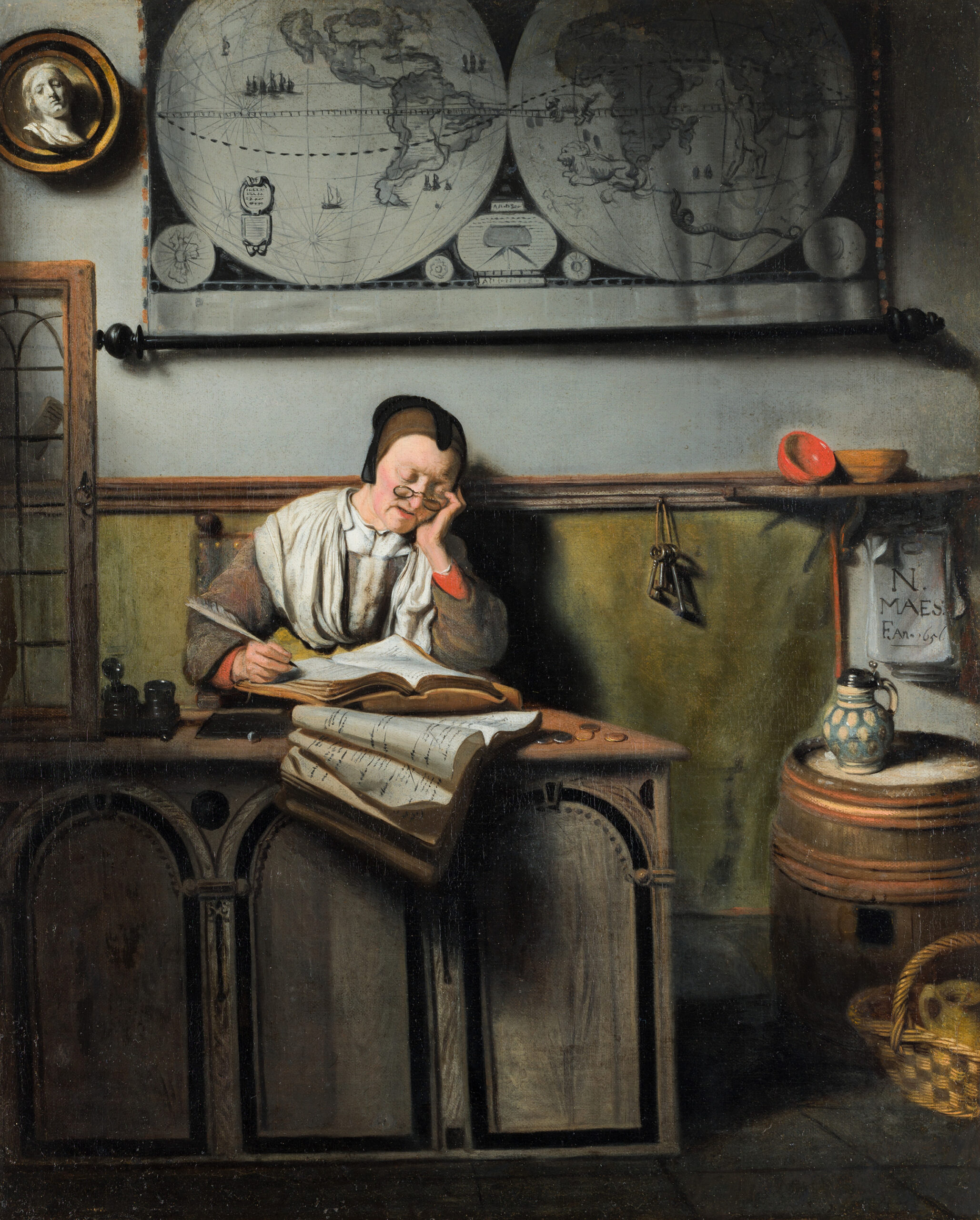
Painted in 1656 by Nicolaes Maes (1634–1693), The Account Keeper is a Dutch Golden Age genre scene in the collection of the Saint Louis Art Museum, Missouri. An elderly woman has dozed off over her account books, pen still in hand, beneath a large double-hemisphere world map. A former pupil of Rembrandt, Maes returned several times to the theme of the sleeping woman in the mid-1650s, notably in The Idle Servant (1655, National Gallery, London). His domestic scenes inspired Pieter de Hooch and Vermeer. The painting’s meaning remains open: the museum suggests a widow in financial difficulty, a woman reflecting on her life, or an allegory of idleness.
She has fallen asleep. That is what first drew me to this painting by Nicolaes Maes: a moment of dozing off at work, caught in paint. Her head has slipped, her hand has gone slack, and time seems to stand still. It is also the large world map on the wall. We are, it seems to me, in the office of a household involved in trade. It is 1656, at the height of the Dutch Golden Age, when the merchants of the United Provinces traded with the whole world. The horizon of this modest room is the entire planet. And yet everything stops here, on a sleeping woman. Heavy account books pile up on the desk, so high they look ready to fall. The whole scene is painted with great precision and care. We are caught by the vertical and horizontal lines of the composition, which give the scene an almost rigorous order. But that order is fragile: a single movement would send the ledgers tumbling. My eye travels through the painting, from detail to detail, then always returns to the sleeping face. I love paintings that show everyday life, with no heroes and no great events. Maes excels at this. He painted other dozing figures too, such as The Idle Servant (1655) at the National Gallery in London. I also love the readings suggested by the museum: she might be a widow in financial difficulty, an elderly woman reflecting on her life, or an allegory of idleness. What does this painting mean? Several paths open up, and nothing settles between them. Perhaps that is its strength: nearly four centuries later, it still leaves us free to invent its story.
You are standing before a pen that no longer writes. It rests on the page, held by a motionless hand. Behind her spectacles, her eyelids are closed. The ledger waits. The account keeper herself is somewhere else.
The Account Keeper
Look at her cheek resting on her left hand. The gesture speaks of fatigue, not surrender. Around her, though, everything seems held in place. Vertical uprights and a horizontal dado rail divide the space into a grid. Below, a cabinet with arched panels fills almost half the canvas. This massive furniture slightly overwhelms the figure. Near the inkwells, a few coins gleam. A bunch of keys hangs on the wall. A stoneware jug sits on top of a barrel. The order looks perfect. Yet it wavers. The heavy ledger spills over the edge of the desk, about to slide. Light enters through the leaded window on the left. It catches the whites of her kerchief and cap. The palette stays muted: grey wall, olive-green panelling, brown wood. Three reds bring it to life. Her cuffs, the bowl on the shelf, the edge of the map. The eye jumps from one to the next, then returns to her face. Now look at the medallion, top left. A face there has its eyes closed, too. A deliberate echo, or just a prop? The painting stays silent. On a sheet of paper pinned to the wall, Maes writes his name and the date. One more item for the inventory. The title calls her “The Account Keeper.” She isn’t counting anything. The name describes a role; the image shows a pause. Between the two, Maes does not decide.
In the Dutch Golden Age
Above her stretches a double-hemisphere world map, crossed by tiny ships. It is 1656, in the Dutch Golden Age. Merchants from the United Provinces trade on every sea. Amsterdam is printing maps for the whole world. The globe fits on this wall. The room itself stays modest, almost austere. Perhaps these ships tell us where the money counted on the desk comes from. Nothing proves it. Genre painting of these years likes to draw lessons from domestic life. Maes is twenty-two. He left Rembrandt’s studio only recently. From his master, he keeps the warm chiaroscuro and the attention to aged faces. He adds a sharper, more domestic geometry. He often returns to the theme of the dozing woman. In The Idle Servant (1655, National Gallery, London), the mistress of the house points disapprovingly at the sleeper. In Washington, an old woman falls asleep over her Bible. In Brussels, another nods off beside her lace pillow. Here, no one judges. And the book is no longer sacred: it is an account book. Morality seems to have left the scene. Unless it has shifted toward us.
Born in Dordrecht in 1634, Nicolaes Maes trained with Rembrandt in Amsterdam. Back in his hometown, he painted everyday life with a new freedom. Pieter de Hooch and Vermeer would draw inspiration from him. Maes later turned to portraiture, with great success.
News
The Account Keeper belongs to the permanent collection of the Saint Louis Art Museum. The museum purchased it in 1950 (object number 72:1950), and the painting is currently on view in Gallery 238. The museum offers an open reading: the woman dozing over her account books could be a widow in financial difficulty, an elderly woman reflecting on her life, or an allegory of idleness. If you are in St. Louis this winter, you can see it alongside the temporary exhibition “Women Impressionists and the Land.” The show runs in the East Building galleries from October 17, 2026, to January 10, 2027. The museum describes it as the first exhibition devoted to landscapes as a body of work essential to understanding the women artists of Impressionism.
Source: SLAM.
A Question for You
Rembrandt was Maes’s teacher, and Vermeer would draw inspiration from him. Which of the two does this painting remind you of most?
About this work
- The Account Keeper
- Nicolaes Maes
- 1656
- Oil on canvas
- 66 × 53.7 cm (26 × 21 1/8 in.)
- Saint Louis Art Museum, Missouri
- https://www.slam.org/collection/objects/38142/