Key Facts
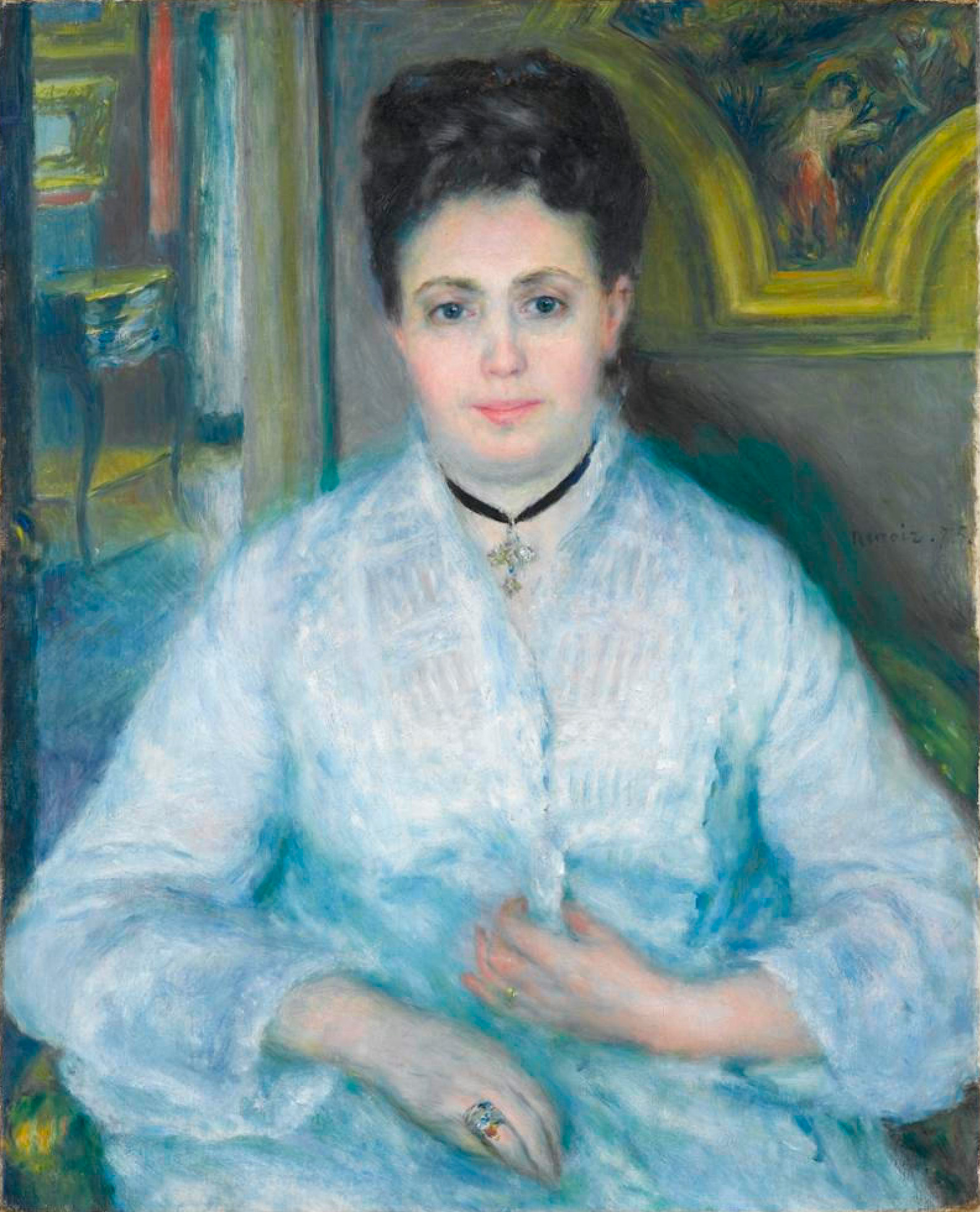
Painted in 1875 by Pierre-Auguste Renoir, Madame Victor Chocquet is an oil-on-canvas portrait held at the Staatsgalerie Stuttgart. It depicts Augustine Marie Caroline Chocquet, née Buisson, wife of the collector Victor Chocquet, one of the earliest supporters of Impressionism. Renoir combines an Impressionist brushstroke with pastel tones inspired by eighteenth-century painting. Behind the sitter hangs a sketch by Eugène Delacroix, a painter Chocquet admired and collected. The painting marks the beginning of the relationship between Renoir and this patron, who also commissioned his own portrait, now in the Harvard Art Museums. It sheds light on the decisive role early collectors played in the recognition of the Impressionist movement.
Here is a portrait by Renoir that I find rather classical. The sitter, Madame Victor Chocquet, is shown facing us, her gaze direct, in a blue dress. In the background is a richly decorated interior, with a painting and a fine piece of furniture. The painting behind the sitter reproduces a sketch by Delacroix. This detail is far from trivial. Victor Chocquet, the sitter’s husband, was indeed a great collector of eighteenth- and nineteenth-century paintings and a passionate admirer of Delacroix: he would come to own as many as 89 works by the painter. This modest customs official discovered Renoir in 1875, at the Impressionist sale at the Hôtel Drouot. He saw in his colors the legacy of Delacroix and immediately commissioned portraits of his wife and himself. It is said that he wanted to bring together on the same canvas the painter he had just discovered and the one he revered. I love the idea of a painting that also tells the story of an encounter: thanks to this commission, Chocquet became one of the first supporters of the Impressionists, and it was Renoir who introduced him to Cézanne. I particularly appreciate the classical handling of this portrait, quite different from other portraits by Renoir, which often bear a stronger mark of his personal touch. One senses a young painter paying tribute to his elder and to his patron, with a restraint that moves me.
A black velvet ribbon encircles the neck. A small cross glitters just below it. Then your eyes move down to the ring, heavy, resting on the pale fabric. You can almost feel the coolness of the stones. The face looks straight at you, calm, without a forced smile. Madame Chocquet is watching you. There is no escaping that gaze.
What the Portrait of Madame Victor Chocquet Conceals
Look closely at the dress. It is not white. Renoir builds it from blues, pearly greys and touches of pink. The brushstrokes are short, broken, almost nervous. You can almost feel the muslin quiver in the light. The face, by contrast, is smoothly and soberly modeled. Two styles coexist on the same oil on canvas. The Impressionist brushwork stirs in the fabric. Tradition rules the features.
These pastel tones are no accident. According to the Staatsgalerie Stuttgart’s catalogue entry, they look back to eighteenth-century painting. Chocquet’s collection included several canvases by Watteau.
On the left, a small table with curved legs gleams in the half-light. A strip of red vibrates beside it. Chocquet was also fond of antique furniture and porcelain. The setting speaks of him as much as of her. On the right, the signature takes just a few strokes: “Renoir. 75”.
Now look at the wall, top right. A gilded frame encloses an arched composition, shaped like a lunette. A figure dressed in red stands out within it. It is a sketch by Eugène Delacroix, Victor Chocquet’s hero. The collector had once asked him, in vain, to paint his wife’s portrait. Renoir fulfills the wish, but under the master’s eye.
The gesture recurs. Look at the portrait of Victor Chocquet in the Harvard Art Museums. A study by Delacroix also floats behind his head. It was made for a lunette in the Hôtel de Ville in Paris, destroyed in 1871. Husband and wife each pose under the protection of the same master. The two canvases read like a scattered diptych. Is the living painter stepping aside for the departed master? Or quietly taking his place?
Pierre-Auguste Renoir and His Time
In 1875, Pierre-Auguste Renoir is in his thirties. The year before, he exhibited with his friends at the first Impressionist exhibition. The public remains wary. Buyers are few. A loyal patron is worth his weight in gold. Chocquet becomes that supporter. By the second exhibition, in 1876, he openly champions the movement. Renoir even takes him to the color merchant Père Tanguy to show him works by Cézanne.
The canvas itself has kept on traveling. In 2015, the Oskar Reinhart Collection in Winterthur reassembled the works Chocquet had gathered. The Stuttgart portrait appeared there under the title Portrait de Madame Chocquet, en blanc. For the length of an exhibition, the couple found their paintings again, their Delacroix, their Renoir. The lost walls of their apartment were rebuilt elsewhere, in other hands.
Today, this Impressionist portrait greets visitors to the Stuttgart museum. The cool light of the dress has lost none of its brilliance. The sitter still seems to be waiting for the painter to set down his brush.
News from the Staatsgalerie
Until 31 January 2027, the Staatsgalerie is showing BÄNG! Radikale Künstlerinnen aus dem Archiv Sohm (Radical Women Artists from the Sohm Archive). The exhibition is devoted to five artists: Yoko Ono, Yvonne Rainer, VALIE EXPORT, Carolee Schneemann and Charlotte Moorman. From 4 December 2026, Alles surreal?! will present around 250 Surrealist photographs from the Dietmar Siegert collection, acquired by the Staatsgalerie in summer 2025. It will run until 11 April 2027. This autumn, the museum also unveiled THIS IS TOMORROW, a new display of its twentieth- and twenty-first-century collection.
Source: Staatsgalerie.
A Question for You
If you could buy just one Impressionist painting, which would you choose?
About this work
- Madame Victor Chocquet
- Auguste Renoir
- 1875
- Oil on canvas
- 75 x 60 cm
- Staatsgalerie, Stuttgart
- https://www.staatsgalerie.de/de/sammlung-digital/madame-victor-chocquet