Key facts
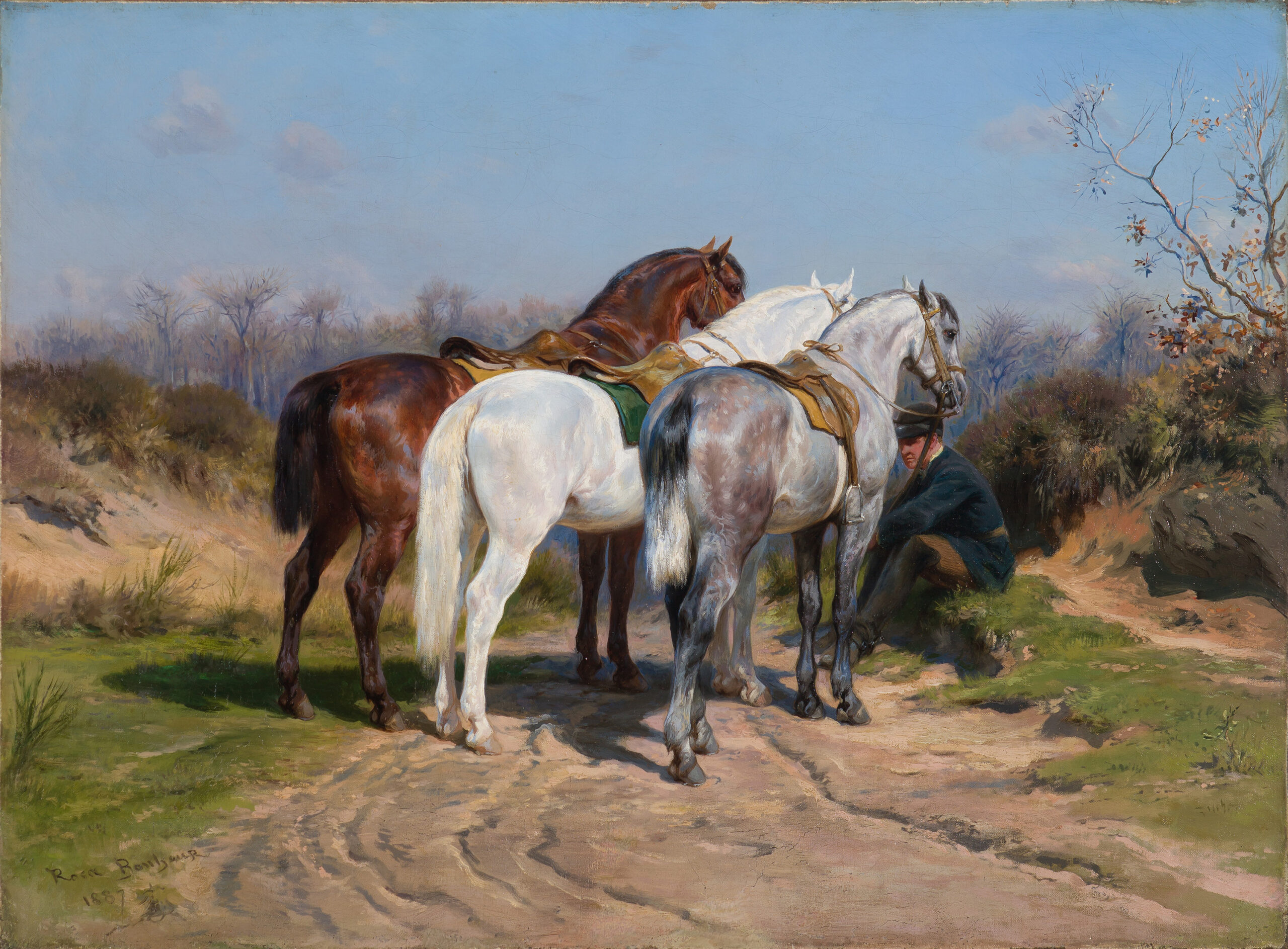
Painted in 1887 by Rosa Bonheur (1822–1899), Relay Hunting is an oil on canvas held by the Saint Louis Art Museum in Missouri. The painting shows three saddled horses waiting on a forest track, ready to replace mounts exhausted during a hunt with hounds. A seated man, barely sketched, stays in the background. A major figure of animal painting and French Realism, Rosa Bonheur owed her international fame to The Horse Fair, shown at the Salon of 1853. This small late canvas reflects her precise study of horses’ anatomy and coats, and her taste for scenes of everyday life rather than heroic subjects.
Three horses wait for their riders, ready to relieve the mounts worn out by the hunt. That is what Rosa Bonheur shows us in this painting. No pack of hounds in full cry, no stag at bay: the action happens elsewhere, outside the frame. What is told here is an episode from the everyday life of the hunt, a quiet moment we often forget. And that is exactly what interests me. We are in the 19th century. Hunting is a particular pastime, reserved for an elite, especially hunting with hounds, with its codes, its vocabulary and a whole organisation we never see. This painting takes us behind the scenes.
I also find this work interesting because it was made by an extraordinary woman. An animal painter celebrated in her lifetime and the first woman artist awarded the Legion of Honour, Rosa Bonheur had to apply for official permission to wear trousers so she could study animals at horse fairs and slaughterhouses. She stood up for her art, her freedom and her approach to nature with great flair. Settled in By, near Thomery, on the edge of the Fontainebleau forest, she knew these landscapes and these horses intimately.
I love the freshness of this canvas. I love the way she captures the animals: the white horse in the centre catching the light, framed by its two darker companions, each with its own bearing. The bare trees and the dirt track disappearing into the forest all make us watch for the riders’ arrival. Rosa Bonheur manages to paint what is almost never painted: waiting. A moment held in suspense, just before the hunt resumes.
You are looking at a taut rein. It runs from the head of the dapple-grey horse. It slopes down to a man sitting by the side of the path. His head is bowed. He waits. Three saddled horses wait with him. Nothing moves.
What Relay Hunting Tells Us
The format is modest: 45.7 by 66 centimetres. Nothing is spectacular. Everything is exact. Look at the coats first. The bay gleams like polished leather. The white horse, in the centre, catches all the sunlight. The dapple grey, on the right, mixes patches of slate and snow. Rosa Bonheur builds up these volumes in oil, in subtly shaded layers. The tail hairs fall in fine strokes, almost one by one. Look at the saddles. Tan leather, a green saddlecloth under the white horse, a stirrup dangling in mid-air. Then the ground. The sandy track is scored with deep ruts. Other horses have passed this way. In the background, bare trees. A branch with russet leaves reaches in from the right. Late autumn, or early winter. The hunt is far away, outside the frame. No hounds, no stag. Only what is left behind.
Now look for the man. He is half hidden behind the grey horse. His dark jacket melts into the bushes. The Saint Louis Art Museum notes that this figure is roughly sketched, almost as an afterthought. The horses are modelled muscle by muscle. The man is barely drawn. The painting is called Relay Hunting. No one is hunting.
What the Era Tells Us
Hunting with hounds remains a ritual of the elite. A day of pursuit exhausts a horse. So fresh horses are posted along the route: this is the relay. The subject is modest, everyday. It suits the taste of the time. By the mid-19th century, painting is gradually turning away from history and mythology. Contemporary scenes appeal to a rising middle class. Realism seeks the truth, not the grandiose. Interest in animal anatomy is growing too. Held by the Saint Louis Art Museum, this small canvas ticks every box.
Compare it with The Horse Fair. Begun in 1852, that canvas caused a sensation at the Salon of 1853. It is more than five metres wide. Its horses rear and jostle in the dust. Here, on 66 centimetres, three horses stand still. Same passion, different scale, different tempo. The first painting shows the crowd. The second shows the silence. A coincidence: in 1887, the year of Relay Hunting, The Horse Fair entered the Metropolitan Museum of Art in New York.
Born in Bordeaux in 1822, Rosa Bonheur became the leading animal painter of French Realism. In 1865, Empress Eugénie presented her with the Legion of Honour. At By, near Fontainebleau, her château housed horses, deer, wild boar, sheep, dogs and even lions. In the 1880s, she worked there mainly on commissions, far from the bustle of Paris.
News: Rosa Bonheur and the Horse at Chantilly
The horses of Relay Hunting strike a particular chord this autumn. Until 3 January 2027, the Château de Chantilly is devoting an exhibition, “Rosa Bonheur and the Horse”, to the artist’s passion for the animal that was the favourite subject of so many of her canvases. Shown at the Musée Condé and the Living Museum of the Horse, in partnership with the Château de Rosa Bonheur in Thomery, it recalls the painter’s ties with the Duke of Aumale, who commissioned a painting from her. Across the Atlantic, the Saint Louis Art Museum, home to Relay Hunting, is also celebrating women artists: its exhibition “Women Impressionists and the Land”, on view until 10 January 2027, is the first devoted to landscapes painted by women Impressionists.
Source: Château de Chantilly.
A Question for You
Why was Rosa Bonheur, so famous in 1887, almost forgotten in the following century?
About This Work
- Relay Hunting
- Rosa Bonheur
- 1887
- Oil on canvas
- 45.7 x 66 cm (18 x 26 in.)
- Saint Louis Art Museum, Missouri
- https://www.slam.org/collection/objects/10558/