Key facts
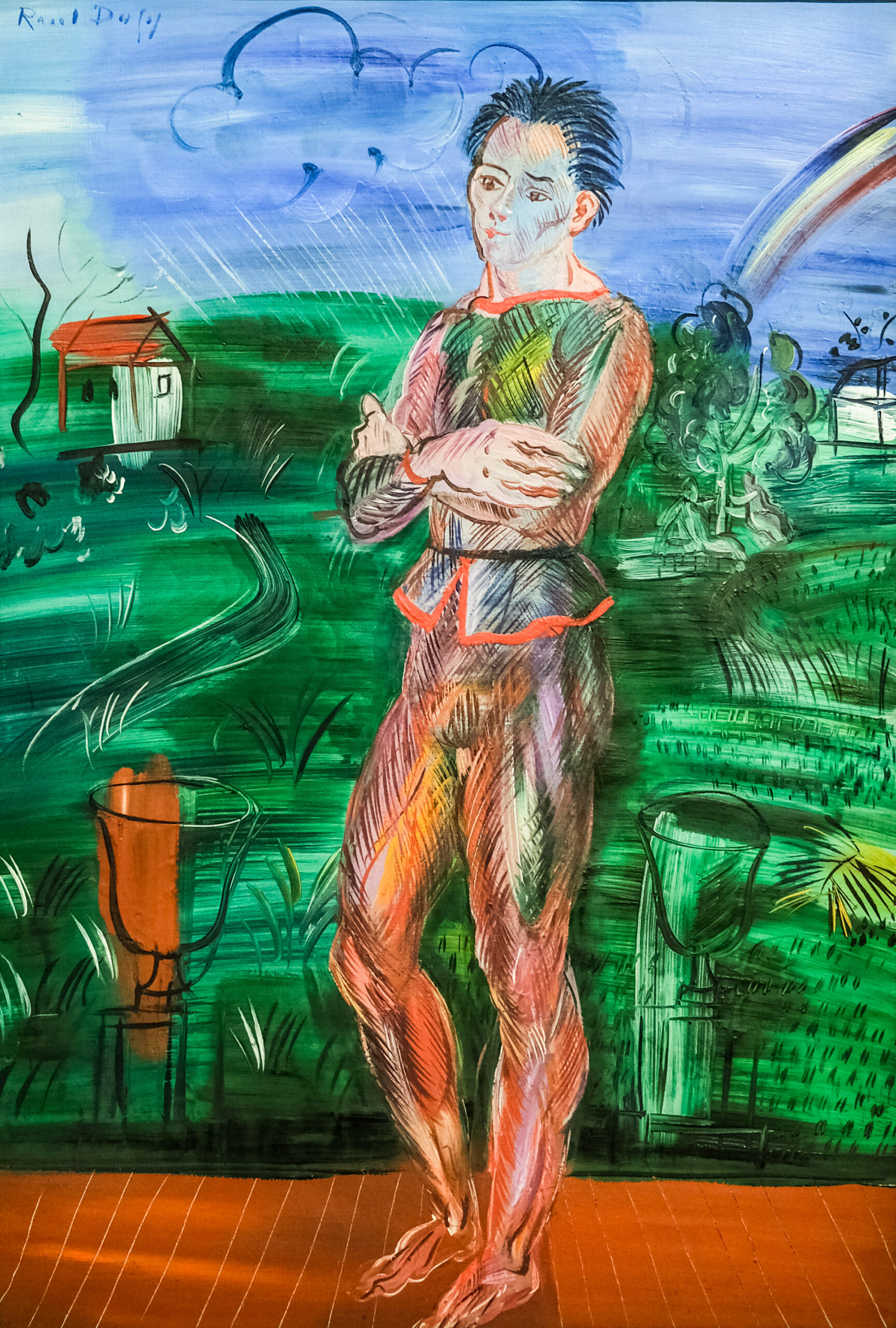
Painted by Raoul Dufy in 1943, The Harlequin depicts a commedia dell’arte figure in a vividly colored landscape, the color deliberately spilling beyond the black outline drawing. The oil on canvas belongs to the collections of the Musée d’Art Moderne de Paris, part of Paris Musées. Dufy, born in Le Havre in 1877 and died in Forcalquier in 1953, was first associated with Fauvism before developing a personal style in which rapid drawing and flat areas of color operate independently of one another. In 1943, in the midst of the Occupation, he lived in retreat in the south of France, where severe polyarthritis was already affecting his hands after several years.
What still fascinates me about Raoul Dufy is this marriage between drawing and color. Here, in The Harlequin, the black line runs freely across the canvas, almost independent of the color fields it never really tries to contain, this is the famous “color spilling beyond the drawing” so dear to Dufy, and it leaps out at you in this painting. The figure, arms crossed, planted at the center in his costume of green, yellow, pink and blue, has a surprisingly lively presence despite the apparent simplicity of the forms. I also love the depth of the landscape behind him: the small house with the red roof on the left, the rain shower, the figures sketched beneath the trees on the right, the orange ground stretching across the foreground… everything is suggested in a few strokes, yet nothing is missing. And then there’s this detail I find wonderful: a blue, white and red rainbow unfurls across the sky, almost like a discreet tricolor wink slipped into the composition. A painting that looks joyful and light at first glance, but which, once you linger on it, reveals real pictorial density.
Look first at those crossed arms, right at the center of the canvas. The hands close together, while the rest of the body seems to dance within the green, pink and blue stripes of the costume. A face framed by spiky black locks looks off to the side, somewhere between gravity and a held-back smile.
What lies beneath the surface of Harlequin
The black line dominates, dry, quick, almost calligraphic. Dufy theorized this dissociation between drawing and color as early as the 1920s: in his view, the eye registers color faster than outline. Hence this freedom of the brush, which slips outside the line without ever aligning to it precisely. Look at the green of the torso spilling onto the pink of the sleeve. Look at the orange ground biting into the fabric of the trousers. Nothing is fitted together exactly, and that’s deliberate. Around the figure, the setting is built up in a few bold strokes: a house with a red roof, a tricolor rainbow slipped into a sky streaked with rain. This taste for decorative pattern is no accident. Dufy worked for nearly twenty years with the silk manufacturers Bianchini and Férier, designing for the textile industry.
Raoul Dufy and his era
Raoul Dufy was born in Le Havre in 1877. In 1943, France was under occupation. The painter lived in retreat in the unoccupied south, where a doctor was attempting to treat the arthritis that had been deforming his hands since the mid-1930s. Yet he kept painting, despite the pain, these scenes of festivity and color that built his reputation from his Fauvist years onward. He died in Forcalquier in 1953, after seeking a milder climate to ease his joints.
News from the Musée d’Art Moderne de Paris
The Musée d’Art Moderne de Paris, which holds Raoul Dufy’s The Harlequin in its permanent collection, is hosting the Prix Marcel Duchamp from October 2, 2026 to February 7, 2027, for the second year running. Created in 2000 by the ADIAF and organized from the outset in partnership with the Centre Pompidou, the prize ranks among the leading awards on the French contemporary art scene; past laureates include artists such as Kader Attia and Dominique Gonzalez-Foerster. For this 26th edition, four artists are shortlisted: Joël Andrianomearisoa, the duo Brognon Rollin, Laura Henno and Josèfa Ntjam. Their work is on view free of charge within the museum’s own collections. The laureate’s name will be announced on October 22, 2026, during Art Week, by an international jury chaired by Xavier Rey, director of the Musée National d’Art Moderne. This program is part of the “Constellation” initiative, under which the MAM hosts the Prix Marcel Duchamp exhibitions until 2029, for the duration of renovation works on the Centre Pompidou’s historic building, confirming the museum’s role as a leading exhibition venue for modern and contemporary art in Paris, alongside its permanent collection, which includes works by Picasso, Matisse and Dufy himself.
Source: Musée d’Art Moderne de Paris
A question for you
Between the tapestry of verdure, the theatrical backdrop, and the painted studio background of portrait painters, where does this suspended landscape behind the Harlequin truly find its origin?
About this work
- Harlequin
- Raoul Dufy
- 1943
- Oil on canvas
- Paris Musées, Musée d’Art Moderne de Paris
- https://www.parismuseescollections.paris.fr/fr/musee-d-art-moderne/oeuvres/l-arlequin