Key facts
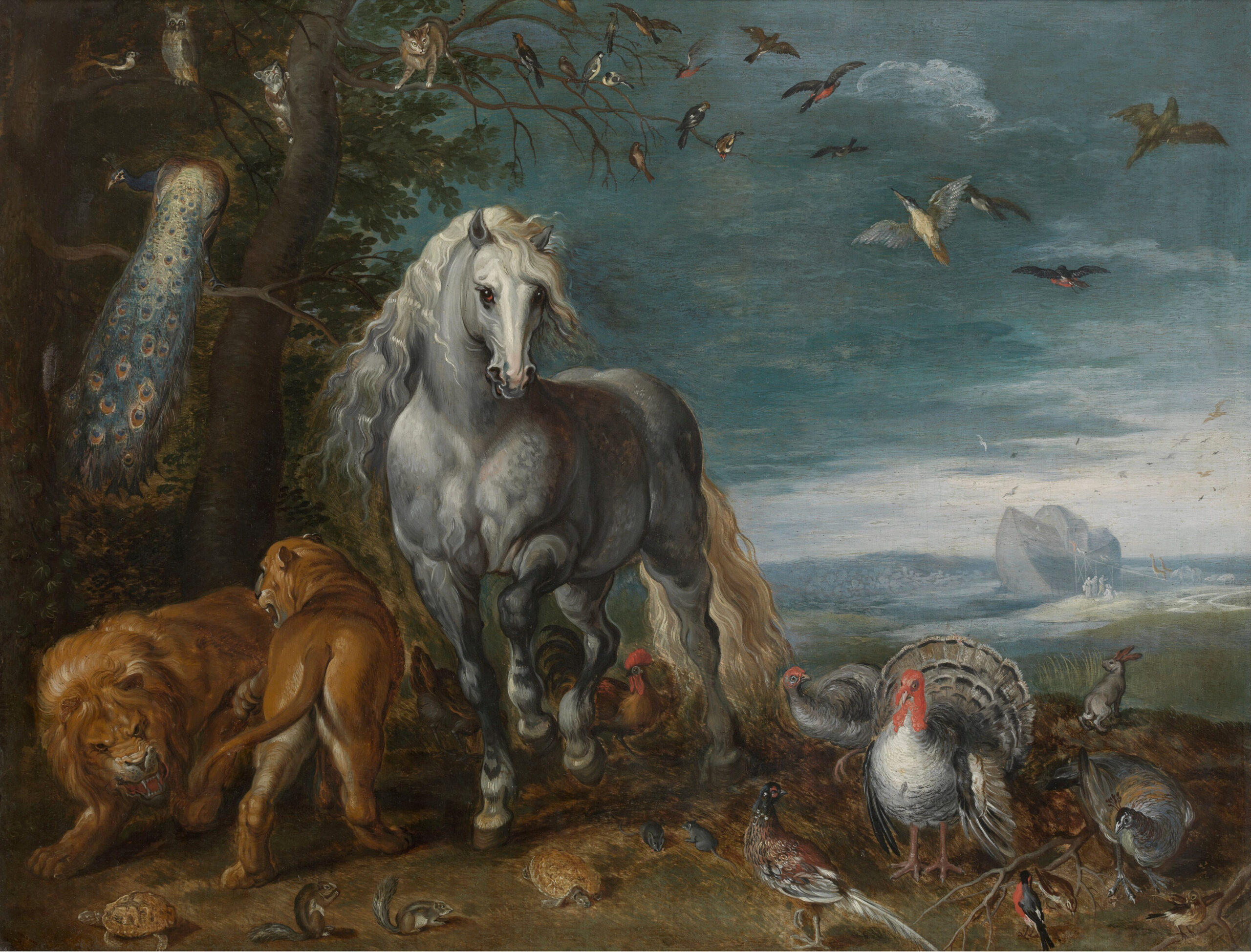
Painted in the 17th century by the Flemish artist Jan van Kessel I (1626–1679), Noah’s Ark is a small oil on panel. It is held by the Royal Museum of Fine Arts Antwerp (KMSKA) and belongs to the Collection of the Flemish Community. A dapple-grey horse stands at the centre of this Flemish Baroque panel. Around it gathers a menagerie of familiar and exotic animals, many of them in pairs, while the ark appears in the distance. The composition takes up motifs from The Entry of the Animals into Noah’s Ark (1613, Getty Museum), a painting by his grandfather Jan Brueghel the Elder. It shows how models were handed down within the Brueghel dynasty, and Antwerp’s taste for meticulous animal painting.
Here we are, back in the heart of the 17th century and Flemish Baroque art, with this work by Jan van Kessel I (1626–1679), grandson of Jan Brueghel the Elder on his mother’s side. Trained in Antwerp in the studio of his uncle Jan Brueghel the Younger, he inherited the family taste for nature observed up close: flowers, insects, shells and animals painted with a miniaturist’s precision. The subject is a classic one: Noah’s Ark. But above all it is a pretext for a stylistic exercise, depicting a great number of animals in a single painting, just as his grandfather had done in his Earthly Paradise landscapes. In the distance we see the ark at its mooring, while in the foreground a true menagerie unfolds, where familiar species and exotic animals rub shoulders. The small size of the panel (28 × 36 cm) draws you in close, almost as if with a magnifying glass, the way collectors of the time looked at the paintings in their cabinets of curiosities. I love this kind of decorative painting, which uses a biblical subject as a pretext for a delightful spectacle, somewhere between natural science and wonder. Here the animals live together without a care, predators and prey side by side. To me it speaks of the harmony of Creation, a reconciled world that is a pleasure to contemplate at length.
A brown eye, rimmed with pink, is fixed on you. Then the mane unfurls, long, almost liquid, the colour of milk. The dapple-grey horse steps towards you, one hoof raised. Its grey coat catches a cold light. All around, the panel teems with feathers, claws and scales.
Noah’s Ark, a menagerie painted under the magnifying glass
Come closer. The oil is laid on a wooden panel measuring 28 × 36 cm. That is barely larger than a sheet of notebook paper. On this smooth wood, Jan van Kessel applies fine, tight brushstrokes. The white of the mane forms small commas of paint. The sky, brushed in muted blues and stormy greens, weighs on the scene. Look at the turkey with its tail fanned out. Every feather of the fan is outlined with a light stroke. Its red wattle stands out sharply against the grey sky. Beside it, the hen lowers her head. At the horse’s feet, two mice scurry past. Further down are two tortoises and two squirrels. In the branches, two cats are eyeing the birds. The animals go two by two, as the Book of Genesis tells it.
The turkey comes from the Americas, the peacock from Asia, the parrot from the tropics. In 17th-century Antwerp, these faraway creatures fascinate art lovers. The biblical subject offers the perfect setting to bring them together. The ark itself shrinks to a pale silhouette resting on the plain. A few tiny figures bustle in front of it. The title promises a ship; the painting delivers a zoo.
A family model
You may have seen this horse before. It comes from a famous painting by Jan Brueghel the Elder, The Entry of the Animals into Noah’s Ark. Painted in 1613, it is now in the Getty Museum in Los Angeles. Brueghel had already borrowed the horse and the lions from his friend Rubens. Van Kessel takes up these motifs a generation later. The Walters Art Museum in Baltimore holds another of his variations, painted around 1660. In Antwerp’s workshops, a successful model is passed down like an heirloom. To copy one’s grandfather is to declare that one belongs to the dynasty.
Yet something resists the promised harmony. Look at the lion, fangs bared, with a menacing glare. The lioness turns her back on him. A few steps away, a tortoise plods along unhurried. Further on, a rabbit pricks up its ears. Is this the peace of the beginning, or a threat held in suspense? The panel does not decide.
Jan van Kessel I and his times
Jan van Kessel I is baptised in Antwerp on 5 April 1626. His mother, Paschasia, is the daughter of Jan Brueghel the Elder. He is apprenticed to a history painter at a very young age. In the mid-1640s, the Guild of Saint Luke registers him as a blomschilder, a flower painter. He specialises in small formats, often on copper. Insects, shells, birds and garlands become his signature. These meticulous images are made for collectors with a keen interest in natural history. He dies in his native city in 1679. His Noah’s Ark belongs to the Collection of the Flemish Community, held at the KMSKA in Antwerp.
KMSKA news
The Antwerp museum that holds Noah’s Ark remains very active around the 17th-century Flemish masters. In its Rubens Gallery, the open studio “Studio Rubens” is currently restoring the monumental altarpiece The Adoration of the Magi. Visitors can watch the restorers at work. The project reached an important milestone in late summer 2026: the wooden boards on the back of the panel were replaced with an aluminium frame. The restoration is due to be completed in spring or summer 2027, in time for the 450th anniversary of Rubens’s birth. Antwerp will celebrate a “Rubens Year”, and the KMSKA will present the exhibition Rubens and the World together with the Rubenshuis. Rubens often collaborated with Jan Brueghel the Elder, Jan van Kessel’s grandfather. The anniversary is therefore a good opportunity to rediscover this whole line of Antwerp painters. For now, the KMSKA is devoting an exhibition to the sculptor Ossip Zadkine (Ossip Zadkine and Belgium, until 18 April 2027). Two more are on view until 17 January 2027: Philip Aguirre y Otegui and Guy Vandenbranden in the European Avant-Garde.
Sources: VRT News and KMSKA.
A question for you
This small painting is meant to be viewed up close. Do you prefer works that reveal themselves under a magnifying glass, or large paintings that command attention from afar?
About this work
- Noah’s Ark
- Jan van Kessel I
- 17th century
- Oil on panel
- 28 × 36 cm
- Koninklijk Museum voor Schone Kunsten Antwerpen (KMSKA), Collection of the Flemish Community
- https://artinflanders.be/en/artwork/noahs-ark