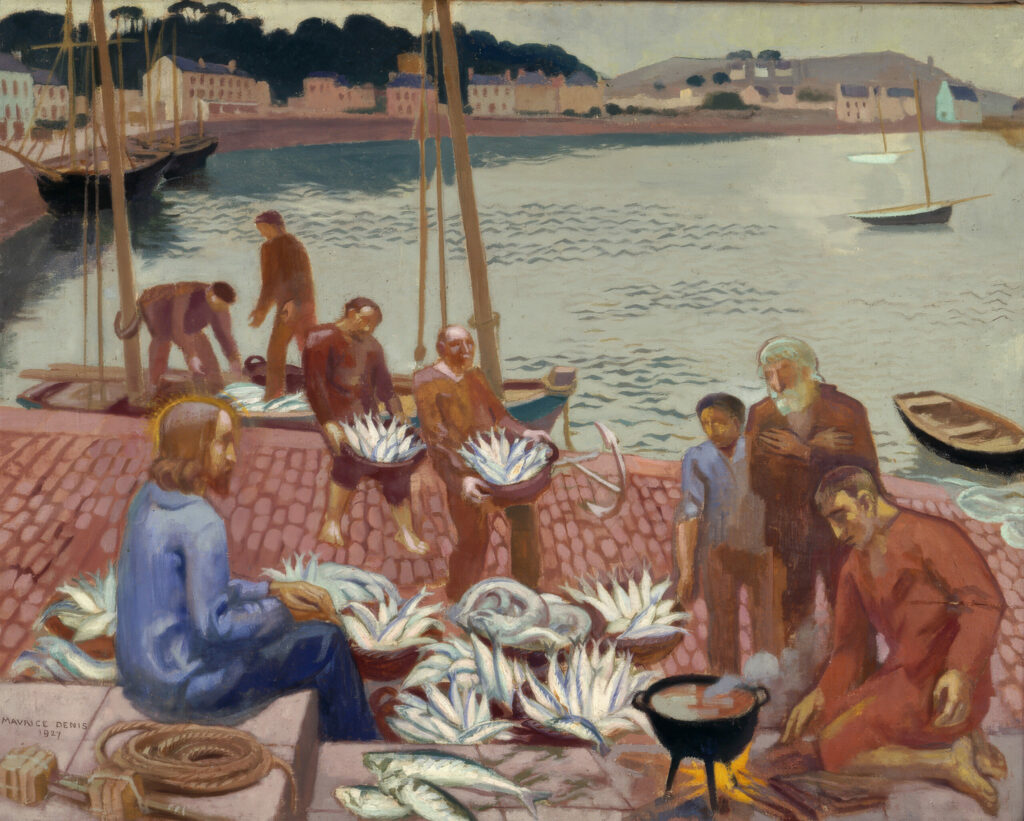
Key takeaway: The Miraculous Draught of Fishes is an oil on canvas painted by Maurice Denis in 1927, held at the Musée d’arts de Nantes. This composition transposes a biblical episode into a Breton fishing port contemporary to the artist, blending a religious scene with a naturalistic observation of everyday life. Maurice Denis, a major figure of the Nabis movement trained alongside Paul Gauguin and Paul Sérusier, developed during this later period of his career a personal, non-doctrinal approach to religious art, far removed from grand theatrical gesture. The work reflects the way traditional Christian iconography, in Denis’s hands, merges into the landscapes and ordinary gestures of early twentieth-century Brittany.
I recognise here the full colouristic world so characteristic of Maurice Denis. But what strikes me most in this canvas is its naturalism. Remove the gilded halo above Christ’s head, and what remains is a perfectly ordinary fishing-port scene. If a miracle occurs, it lies entirely in the simplicity of the scene and the sudden abundance of fish.
Saint Peter registers his astonishment with restraint, arms crossed over his chest, without theatrical gesture. The rest of the landscape is that of an unremarkable harbour, firmly rooted in Denis’s own time. The sea is calm, as is the composition as a whole: the scene remains simple, almost silent, as though the sacred were quietly insinuating itself into the everyday.
Look at this gilded circle, scarcely wider than a crown of bread, hovering above a fair-haired head. We are on a Breton quayside, one morning in 1927. Without it, nothing would set this seated man apart from the fishermen gathered around him amid their baskets of sardines.
What the Surface Conceals
Executed in oil on canvas, the composition arranges its figures in a frieze-like manner, recalling an antique bas-relief. Denis renders the reds and pinks of the rooftops, the faded blue of the sky, the muted ochre of the garments. This pictorial vocabulary owes much to his travels in Italy, which drew him away from Nabi audacity toward a more classical manner. The subject is drawn from the Gospel of Luke: the miraculous draught of fishes. Yet Denis sets it within a contemporary setting, a Breton harbour animated by the sardine trade. This transposition is no mere decorative conceit; it reflects his broader project for sacred art, anchoring religious mystery within the fabric of everyday life, baskets of fish included. The painting is now held in the collection of the Musée d’arts de Nantes.
The Artist and His Era
Maurice Denis (1870–1943) was among the founders of the Nabi group, and became a deeply Catholic painter and decorator. He articulated, early in his career, a theory of painting built on flat surfaces and organised colour. He subsequently evolved toward a classicism nourished by Italian art. As founder of the Ateliers d’art sacré, he devoted his later career to biblical subjects, which he transposed into his own time, between Brittany and the South of France.
Current Exhibition: Maurice Denis, the Lesser-Known Collector
Interest in Maurice Denis remains lively in 2026. The Musée départemental Maurice Denis, in Saint-Germain-en-Laye, presents, through 31 January 2027, the exhibition “Maurice Denis, Collector: Bonnard, Gauguin, Sérusier…” Nearly 150 works reveal the intimate world of his house-studio and the artists who shaped his practice.
Source: Musée départemental Maurice Denis
A Question for You
💭 Can we still speak of sacred painting when the sacred conceals itself so thoroughly within the real?
📌 About This Work
- The Miraculous Draught of Fishes
- Maurice Denis
- 1927
- Oil on canvas
- 89 x 111.5 cm
- Musée d’arts de Nantes