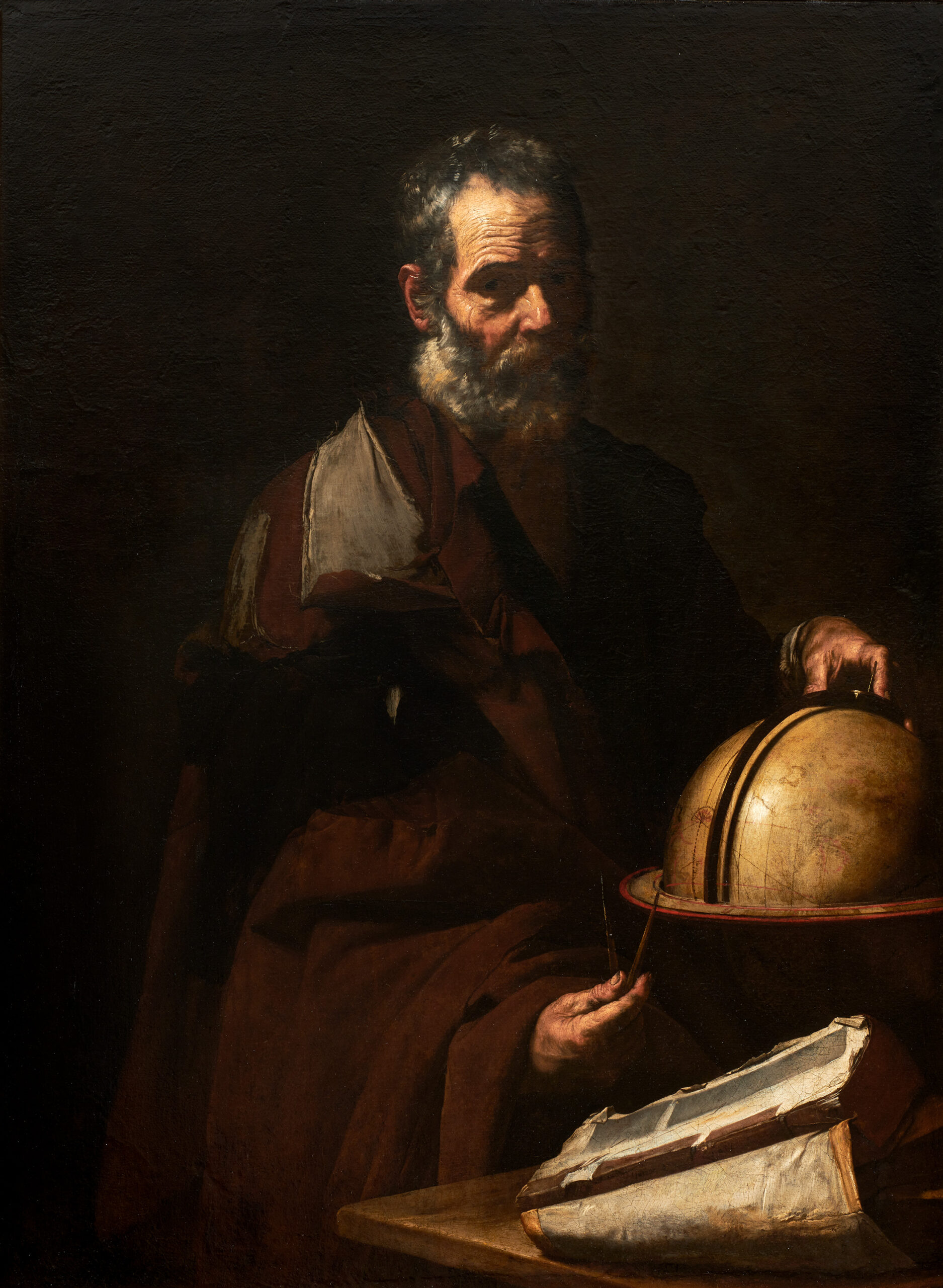
Ribera is one of those painters who leaves no one indifferent. His canvases possess an immediacy that can feel almost uncomfortable, a deliberate choice to place flesh, aging, and the human condition at the very center of the composition without ever romanticizing them. What I admire most is his absolute refusal of decorum. Where other painters of his era sought to idealize, Ribera looked at the world with uncompromising honesty. His series of philosophers stands as a striking testament to this approach. These figures bear no resemblance to the pristine statues of Antiquity. Whether depicting Democritus, Heraclitus, Diogenes, or Anaxagoras, Ribera reimagines them as men from the streets of seventeenth-century Naples. With weathered hands, worn garments, and gazes that drift between vacancy and irony, he restores a raw humanity that history had flattened into abstraction. Philosopher with a Globe is no exception. This elderly man holding an armillary sphere is far from a serene, detached sage. His expression remains enigmatic, heavily tinged with melancholy, as though a profound knowledge of the cosmos had not dispelled the mystery of existence, but rather deepened it. This is Ribera’s greatest triumph: bringing into the light what would have otherwise remained in the shadows.
A brooding gaze fixes you from the shadows. This elderly man, with deeply etched features and a graying beard, commands your immediate attention. His right hand rests lightly upon a terrestrial globe, while his left holds a pair of dividers over a large, open volume.
Beneath the Surface
Observe the striking economy of means deployed by Jusepe de Ribera. The artist employs a radical chiaroscuro inherited from the Caravaggesque tradition. A harsh, directional light strikes the furrowed brow, the threadbare drapery, and the paper sphere. This oil-on-canvas technique effectively isolates the sitter against a pitch-black background, heightening the tactile reality of his flesh. The heavy folds of the brown cloak and the frayed white fabric reveal a stark, surprising poverty. As an adoptive Neapolitan, the painter rejects the classical idealization typically reserved for ancient sages, opting instead for a vernacular model to embody scientific inquiry. While the dividers and globe identify the figure as the astronomer Anaxagoras, the psychological ambiguity of his expression remains entirely unresolved.
The Artist and His Era
By 1630, Jusepe de Ribera dominated the artistic landscape of Spanish-ruled Naples. The master’s rigorous naturalism captivated collectors across Europe, and his series of philosopher portraits fundamentally subverted the conventions of history painting. By transforming street beggars into universal thinkers, he conferred a novel dignity upon the human condition. Moving away from academic notions of ideal beauty, Ribera favored a raw, deeply psychological observation of reality.
Current Exhibition and Provenance
Philosopher with a Globe (Anaxagoras?) has entered the permanent collection of the Clark Art Institute as part of an exceptional gift from the Aso O. Tavitian Foundation. The painting will be featured in the upcoming exhibition An Exquisite Eye: Introducing the Aso O. Tavitian Collection, on view from June 13, 2026, through February 21, 2027. This presentation offers a rare public encounter with an extraordinary North American private collection, exploring a singular curatorial vision of European masterworks spanning from the Renaissance to the nineteenth century.
Source : clarkart.edu
A Question for the Viewer
By transforming an ancient sage into a common man with such gritty realism, was Jusepe de Ribera seeking to humanize philosophy, or was he playing into the seventeenth-century European vogue for the “beggar-philosopher” as a deliberate challenge to the idealized traditions of the Renaissance?
Object File
- Philosopher with a Globe (Anaxagoras?)
- Jusepe de Ribera
- 1630
- Oil on canvas
- 129.9 × 106 cm
- Clark Art Institute, Williamstown
- Gift of the Aso O. Tavitian Foundation, 2025.1.51
- https://www.clarkart.edu/ArtPiece/Detail/Philosopher-with-a-Globe-(Anaxagoras-)