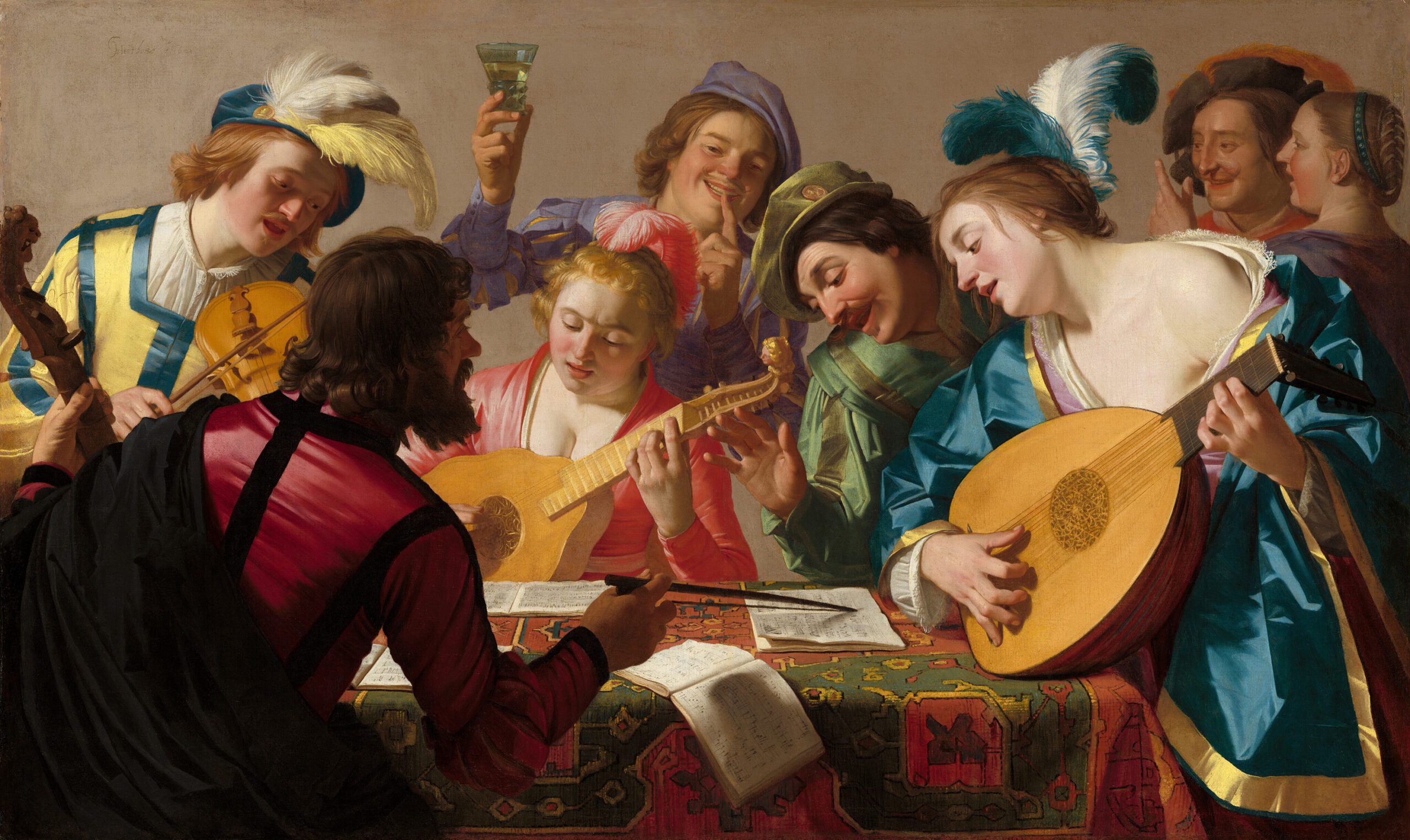
What strikes me first about The Concert is that the colours seem to follow the same logic as music itself: varied, fresh, tuned to one another without ever clashing. The luminous blue, the warm ochres, the off-white of the shirts, each hue plays its part in a perfectly controlled overall harmony.
But it is the figures who truly hold my attention. Honthorst gives each one a singular presence, a distinct emotion. The conductor, directing from the back, commands with quiet authority. The musicians, lost in their playing, wear that particular expression of happy concentration, almost meditative, that belongs to those doing exactly what they love. And then there is the drinker, laughing, slightly apart, a reminder that this is no solemn recital but a celebration, a shared moment of life.
That duality is what stays with me: the rigour of art and the lightness of pleasure, side by side, without friction. Honthorst does not paint music. He paints what music does to people.
The deep blue silk on the right catches the light before the eye has decided where to go. The Concert by Gerrit van Honthorst first appears in a 1632 inventory of the Prince of Orange’s palace in The Hague. Oil on canvas, large format, nine figures.
Formal and Technical Analysis
Honthorst paints in full, diffused light. No candle, no dramatic nocturnal scene: the Caravaggesque chiaroscuro is here restrained, northern in spirit. The figures, rendered life-size, are compressed within the frame. They press forward, physically present. The conductor sits with his back to the viewer, a deep red coat, open sheet music before him. Around him: a lutenist in dark blue, a guitarist in pink, a violinist in yellow and shadow. The instruments, lute, viol, Baroque guitar, are depicted with tactile precision. The Persian carpet in the foreground anchors the composition in the sensory world. Look at the hands: every finger is a decision. The brushwork is broad and assured. The colours ring together like chords.
Historical and Artistic Significance
Utrecht, 1623. Honthorst has been back from Italy for three years. He studied alongside the Giustiniani, received commissions from cardinals, absorbed the lesson of Caravaggio. On his return, he adapts Caravaggism to the tastes of the Dutch court. The Concert may have been a diplomatic gift from the exiled King of Bohemia, Frederick I, to the Prince of Orange, who supported him financially. Musical harmony doubles as political allegory: to play together is to acknowledge the authority of the one who leads. The tension between popular festivity and allegory of power is never resolved. It remains suspended, like an unfinished chord.
Gerrit van Honthorst (1592–1656), a central figure of the Utrecht Caravaggists alongside Ter Brugghen and Van Baburen. The Concert is held at the National Gallery of Art, Washington D.C.
Gerrit van Honthorst in 2026
Interest in Gerrit van Honthorst is enjoying a significant revival this year. The Centraal Museum in Utrecht is devoting its first major retrospective to the artist: Gerard van Honthorst – Different to Rembrandt, on view from 25 April to 13 September 2026. The exhibition brings together over 60 paintings and some 30 drawings from public and private collections across Europe and the United States, including the Louvre, the British Royal Collection and the Galleria Borghese. A recent acquisition enriches the show: The Ecstasy of Mary Magdalene, an early Roman work painted between 1618 and 1620, previewed at TEFAF Maastricht.
Source: centraalmuseum.nl
A question for you
💭 If you were to place The Concert within a lineage, would you align it with Caravaggio, who inspired it, or with Vermeer, who would paint music as an art of living some twenty years later?
About this work
- The Concert
- Gerrit van Honthorst
- 1623
- Oil on canvas
- 123.5 × 205 cm
- National Gallery of Art, Washington D.C.
- https://www.nga.gov/artworks/163184-concert