Key facts
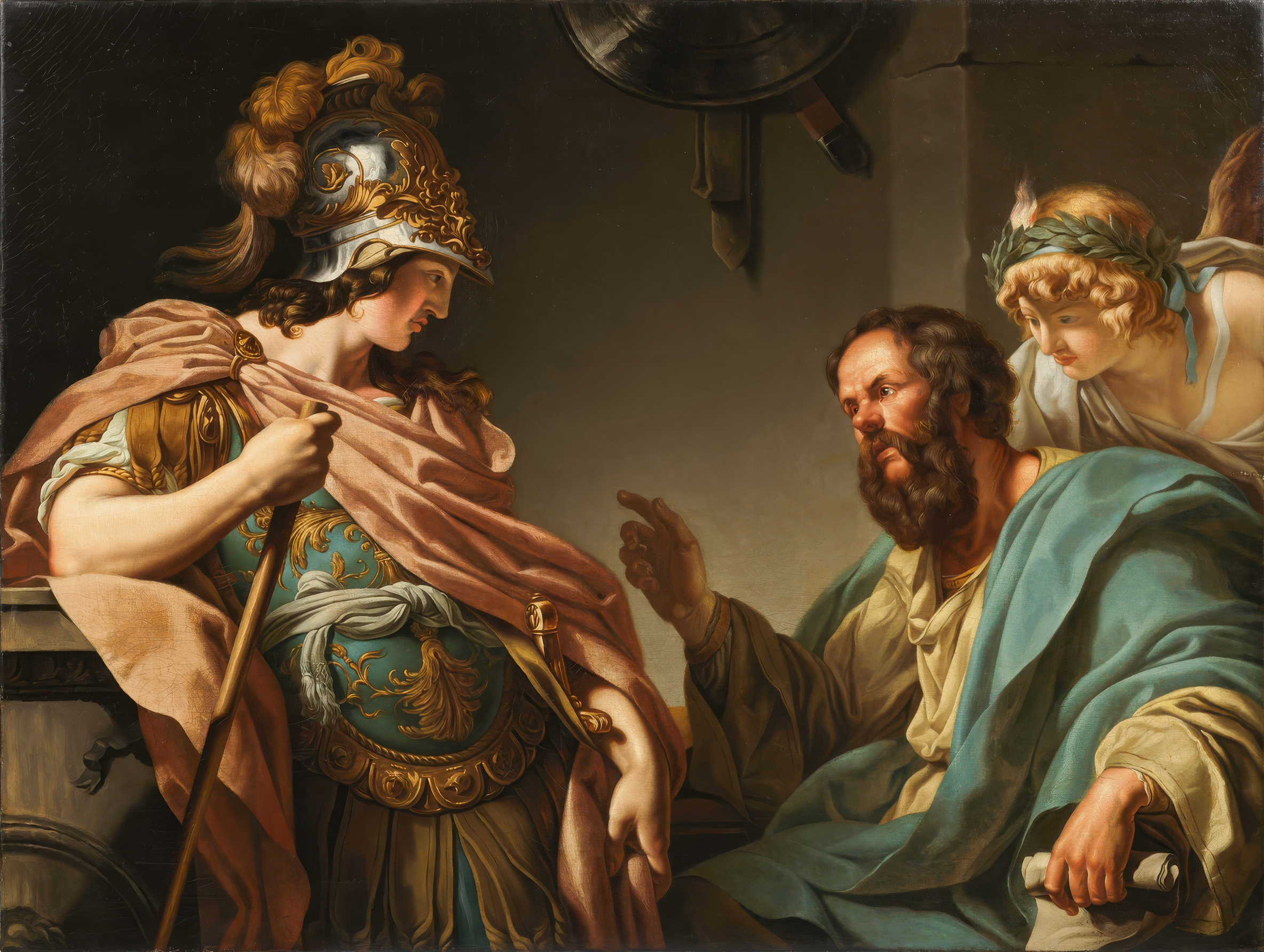
In 1777, François-André Vincent painted Alcibiades Receiving Lessons from Socrates, in which the philosopher instructs the young Athenian general. A winged genius leans in behind Socrates. The canvas in the Nationalmuseum, Stockholm, acquired in 2019, is a second version produced the same year. The original belongs to the Musée Fabre in Montpellier. It was shown at the Salon of 1777, Vincent’s first, alongside its pendant Belisarius. The painting sets the vain beauty of youth against the wisdom of age, a theme borrowed from Plato. A pupil of Vien and winner of the Prix de Rome in 1768, Vincent was Jacques-Louis David’s rival. He ranks among the first painters of French Neoclassicism.
What strikes me first is that we are looking at a philosopher who teaches. Socrates passes on his knowledge to the young Alcibiades, future Athenian statesman and general. I find that the whole scene rests on a contrast: on one side, the young man’s vanity and physical beauty; on the other, the old philosopher’s wisdom, age and inner depth. And that is quite a symbol. Socrates was famous for his ugliness, and yet he is the one who holds true beauty, the beauty of the soul. Plato stages this very relationship in the dialogue Alcibiades, where Socrates tries to convince his pupil that before governing others, one must learn to know oneself.
There is even a kind of tragic irony when you know what came next. Alcibiades did not really learn the lesson. Ambitious and unpredictable, he ended up betraying Athens for Sparta. Later, this association also weighed in the charge of “corrupting the youth” brought against Socrates. The cultivated viewer of the 18th century knew this story. He could not look at this lesson without thinking of its failure.
Finally, it seems to me a pivotal work. Vincent painted it in 1777, shortly after returning from Rome. By then, the return to Antiquity was already under way, notably around his teacher Vien. But it had not yet found its great manifestos: David’s Oath of the Horatii dates from 1785 and The Death of Socrates from 1787. Ten years before Jacques Louis David, Vincent was already choosing Socrates as a moral figure. To me, this painting shows that Neoclassicism did not begin with a single genius. It grew out of rivalry among several painters, and Vincent was one of the earliest and most inventive of them.
This is not the painting from the Salon of 1777. Or rather, it is its double. Paris, 1777: Vincent, just back from Rome, exhibits a first version at the Louvre. It now hangs in Montpellier. The Stockholm canvas repeats it the same year.
Alcibiades and Socrates: two bodies, two ages, one colour
Look at the helmet first. Gilded, chased with scrolling foliage, crowned with a plume, it catches all the light. The plume almost grazes the edge of the frame. Alcibiades stands, draped in a salmon-pink cloak. His turquoise cuirass is covered in gold arabesques. He dominates the scene, his hand tight around his spear. And yet his gaze drops. Socrates, seated lower down, raises his index finger. That gesture is enough to stop the soldier. His eyebrows lift, his mouth opens slightly: he is speaking. His other hand holds a scroll. Look at his cloak: the same blue-green as the young man’s cuirass. Everything sets the two figures apart, and colour binds them together. Behind the philosopher, a winged genius crowned with laurel leans forward. A small flame seems to burn above his brow. On the wall, a shield and a sword wait. War is present, hung up, suspended. The handling is smooth, almost enamel-like. The drapery is built up in broad planes. The dark background isolates the faces. The light comes from the left. It strikes the warrior first, then slides towards the old man. The eye follows the path of the lesson.
François-André Vincent
At the Salon of 1777, Vincent has just been approved (agréé) by the Academy. It is his first Salon. He shows fifteen canvases. Two of them form a pair: Belisarius and Alcibiades Receiving Lessons from Socrates. The catalogue numbers them side by side, 189 and 190. Same format, reversed logic. In Belisarius, an old, fallen general, reduced to begging, is helped by an officer. Here, the young general receives help of another kind from the old man. Age rescues youth. Youth rescues age. Both canvases celebrate the morality of the Ancients, in an almost intimate tone. The choice of subject matters. In Plato’s Symposium, Alcibiades compares Socrates to statuettes of Silenus. Ugly on the outside, they held images of the gods within. Vincent paints this paradox. Yet he rejects the grandiloquent tone of history painting. No crowd, no monumental setting. Three figures, a wall, a conversation. Both originals now belong to the Musée Fabre in Montpellier. The Stockholm canvas is a second version, painted the same year. The Nationalmuseum bought it in 2019, as its collection record states. A lesson on the truth of the soul, painted twice. Which one is the real one?
François-André Vincent is born in Paris in 1746, the son of a miniature painter. A pupil of Vien, he wins the Prix de Rome in 1768. In Rome, he befriends the Swedish sculptor Johan Tobias Sergel. The two friends sketch their fellow students from life. He later becomes Jacques-Louis David’s great rival. Long overshadowed, he regains his place thanks to Jean-Pierre Cuzin’s catalogue raisonné, published in 2013.
News: Vincent, Sergel and New York
The painting has only recently entered the Nationalmuseum’s collection. It was purchased in 2019 with the Hedda and N.D. Qvist Fund (inventory no. NM 7517) and is currently on display in Room 1602, devoted to the 18th century. The Swedish museum takes a keen interest in Vincent because of his friendship with the sculptor Johan Tobias Sergel. At the French Academy in Rome, Sergel and Vincent spent their spare time making quick, slightly caricatural portraits of their fellow students. The Nationalmuseum has in fact acquired a portrait of Sergel drawn by Vincent in 1774, which it describes as a snapshot captured by a friend and fellow artist. In 2026, the museum devoted a major retrospective to Sergel, from 19 February to 9 August. The exhibition then travels: Fantasy and Reality: The Art of Johan Tobias Sergel is on view at the Morgan Library & Museum in New York from 30 October 2026 to 31 January 2027. It is the first monographic exhibition devoted to Sergel in the United States. It offers a glimpse of the cosmopolitan circle in which Vincent matured before painting his Alcibiades in 1777.
Source: The Morgan Library & Museum.
A question for you
Can wisdom be painted without giving it the face of an old man?
About this work
- Alcibiade and Socrate or Alcibiades Receiving Lessons from Socrates
- François-André Vincent
- 1777
- Oil on canvas
- 98.5 x 129.5 cm
- Nationalmuseum, Stockholm (NM 7517)
- https://collection.nationalmuseum.se/en/collection/item/231861/