Key facts
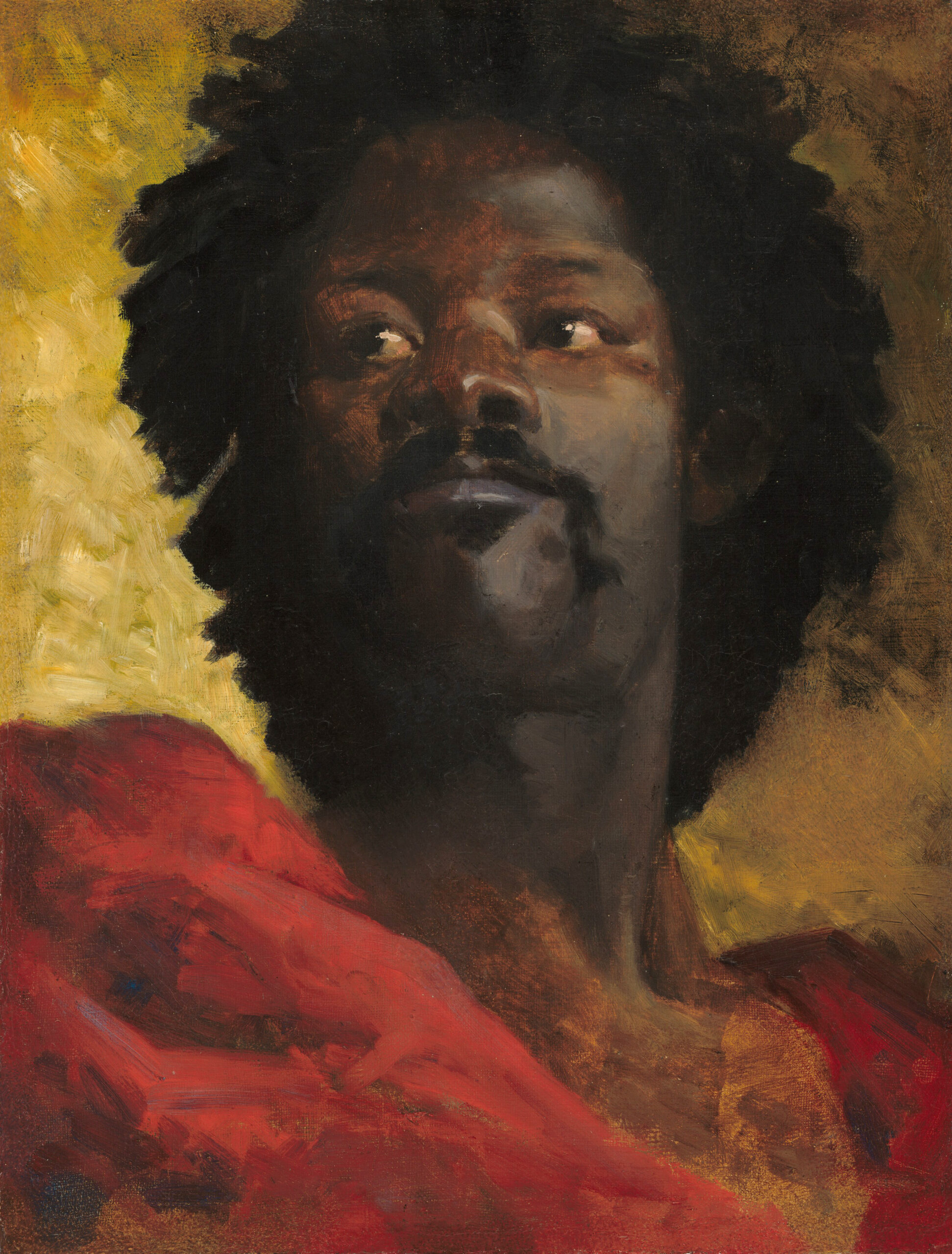
Painted around 1870 by Henri Regnault (1843-1871), A Chief of Abyssinia is a bust-length portrait held by the National Gallery of Art in Washington, which acquired it in 2014 from the Corcoran Gallery of Art. Contemporary with the artist’s stay in Tangier, the painting belongs to Orientalism. It was painted shortly before Regnault was killed in action at Buzenval in 1871. It stands out for its low viewpoint, its free brushwork and its plain yellow background. Exhibited in Washington as early as 1897, it later appeared in exhibitions devoted to French Orientalism, then to the depiction of Black figures in European art.
Henri Regnault was a French artist who died too young, swept away by war: he was killed at Buzenval in January 1871, during the Siege of Paris, at just 27. Though his career was brief, he left a number of striking works, and I believe this Chief of Abyssinia is one of them. Painted in connection with his trip to Tangier, where Regnault settled in 1869 after his stay in Spain, this portrait shows a proud man. What strikes me first is the framing: the sitter is seen bust-length and from below, which heightens the sense of dominance he gives off. He does not look at us. He turns his head and raises his eyes to the left, as if absorbed by something we cannot see. That gaze gives him real presence, almost a sovereign indifference toward the viewer. I also love the way his hair forms a kind of halo around his face, and the contrast between the crimson cloth draped over his shoulders and the golden yellow background that grows lighter toward the left. The brushwork is free, almost sketchy in the clothing and background, which gives the canvas an energy that the more polished Orientalist portraits of the same period often lack. For me, it is this freedom of handling that makes one regret what Regnault might have become.
You are standing before two white dots, tiny, caught in the pupils. They are enough to light up the whole face. Yet this gaze is not looking for you. It drifts up and to the left, out of the frame. You are looking at this man. He does not see you.
A Chief of Abyssinia who stands his ground
The format is modest: an oil on canvas barely 42 centimetres high. The face, though, fills almost the entire space. Regnault sets his viewpoint very low. You discover the sitter from below: the chin, the square jaw, the slightly jutting lower lip. The low angle makes him larger. It also holds him at a distance.
Look at the light. It falls from the upper right. It strikes the bridge of the nose, the forehead, the edge of the cheekbones. The rest of the face sinks into a warm half-shadow, modelled in deep browns and violet greys. The hair forms a dark halo, like an inverted aureole.
The background refuses any setting. No architecture, no exotic props. Only hatchings of yellow, crossing in every direction, growing lighter toward the left. At the upper right, the paint is so thin that the weave of the canvas shows through. The crimson drapery is dispatched in a few broad, loaded brushstrokes.
It could pass for a studio study. Yet nothing here feels provisional. The finish is concentrated on the eyes and the mouth. The rest is left to the brush. The contrast is deliberate.
What the period tells us: one title, three ways of looking
Around the same time, Regnault painted Summary Execution under the Moorish Kings of Granada, now in the Musée d’Orsay. There, a canvas three metres high and a scene of violence. Here, a single face, and no gesture.
The title promises a great deal: a chief, a distant Abyssinia. Nothing on the canvas confirms either his rank or his origin. The sitter remains nameless.
The painting’s history speaks above all of those who have looked at it. In 1897, the banker John W. Macartney was already lending it under this title to an exhibition in Washington. In 1954, it entered the Corcoran Gallery of Art. In 1982, it appeared in an exhibition on French Orientalism in Rochester. The portrait then became an example of a movement. In 2017, it joined the exhibition The Black Figure in the European Imaginary, in Florida. The question changed in nature. It was no longer about the dreamed-of Orient, but about how Europe painted Black men. Since 2014, the canvas has belonged to the National Gallery of Art, which displays it in the West Building, Gallery 81.
A pupil of Cabanel and winner of the Prix de Rome in 1866, Henri Regnault had mastered academic finish. In Tangier, he was after something else: colour, light, speed.
News: the National Gallery lends, Saint-Cloud remembers
On the museum side, the National Gallery of Art received a record gift of 116 million dollars in April 2026 from the Mitchell P. Rales foundation, intended to fund in perpetuity Across the Nation, its programme of loans to regional museums across the United States. The stated goal: to lend works to 50 museums in all 50 states within ten years. Source: The Washington Times.
On the artist side, Henri Regnault was the subject of a monographic exhibition in France, Henri Regnault (1843-1871), le sabre et le pinceau (The Sabre and the Brush), held at the Musée des Avelines in Saint-Cloud from 3 April to 13 July 2025.
Source Musée des Avelines.
A question for you
Do you prefer a highly finished painting, or brushwork that reveals the painter’s hand?
About this work
- A Chief of Abyssinia
- Henri Regnault
- c. 1870
- Oil on canvas
- 42.23 × 32.07 cm
- National Gallery of Art, Washington D.C.
- https://www.nga.gov/artworks/168756-chief-abyssinia