To understand the Renaissance, one must look at how artists broke away from the Middle Ages to place humanity and nature at the heart of their art. Between the 15th and 16th centuries, this intellectual and artistic movement rejected medieval conventions to embrace humanism, the mastery of perspective, and the observation of the world. From Self-Portrait in a Fur Coat of Albrecht Dürer to the genre scenes of Pieter Bruegel the Elder, here are 5 major artworks that embody the profound transformations of the Renaissance.
The legend begins with a painter who writes history
In 1550, a Florentine artist named Giorgio Vasari published Lives of the Most Excellent Painters, Sculptors, and Architects. In it, he described how painting had awakened after centuries of medieval darkness, thanks to the genius of a handful of Italians and the rediscovery of Greek and Roman Antiquity. He coined a word for this awakening: rinascita. The Renaissance.
The problem is that Vasari lived in Florence, his heroes were almost all Tuscan, and he worked for the Medici. He wrote this triumphant history in the very midst of the period he was describing, with all the distortion of perspective that implies.
Historians have debated ever since. Was there a genuine rupture with the Middle Ages, or did Vasari largely construct the mythology of his own era? And while he was writing in Florence, other Renaissances were quietly unfolding in Bruges, Nuremberg, and Amsterdam.
Five works from the Vmuseum collections offer a clearer view, and invite us to question some well-established certainties.
01 Albrecht Dürer: Self-Portrait in a Fur Coat, 1500
What this work reveals: The status of the artist undergoes a fundamental shift
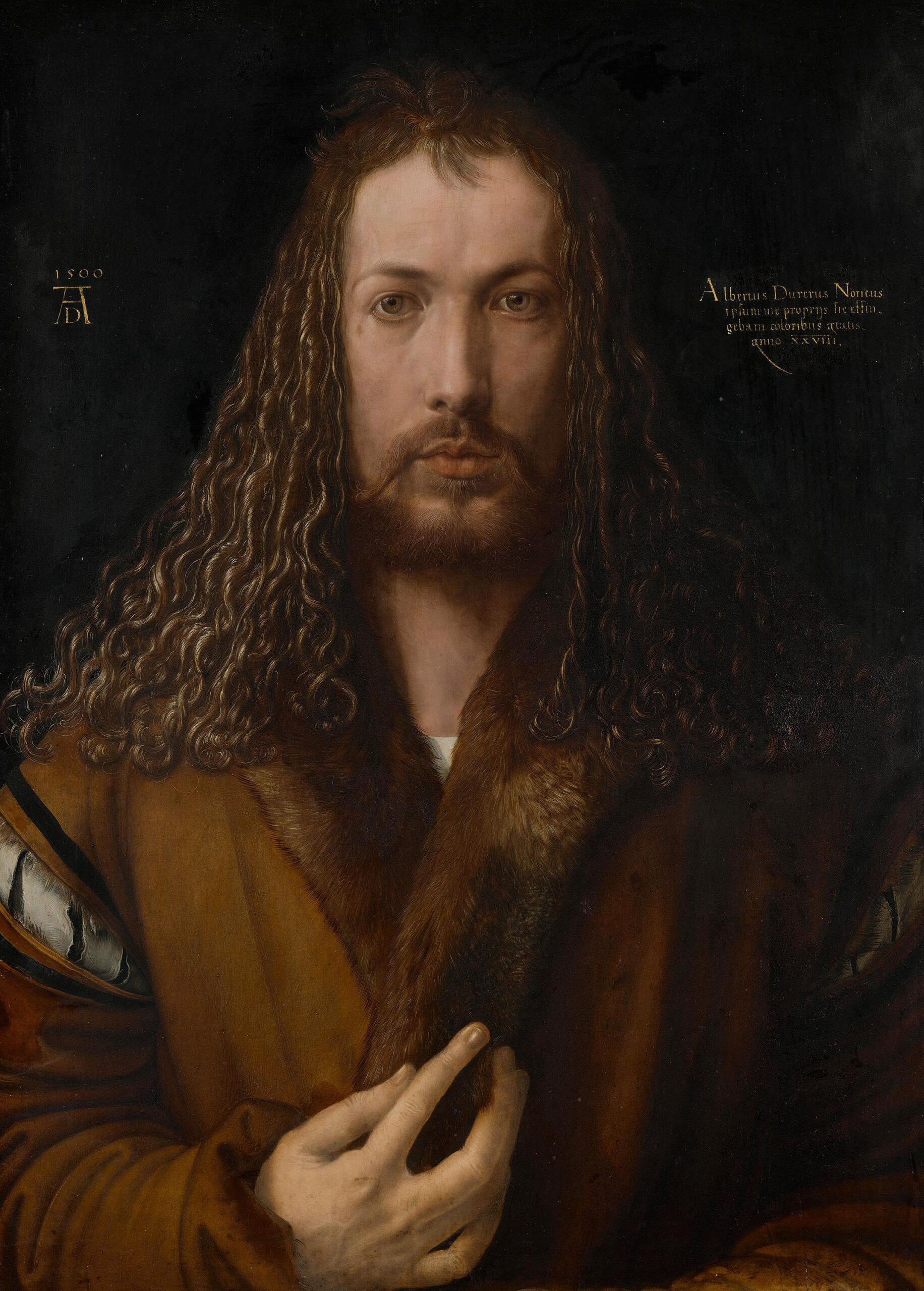
Dürer is twenty-eight years old when he paints this panel in Nuremberg. He represents himself facing front : a pose traditionally reserved for depictions of Christ. The fur and gloves are those of a nobleman. His initials, “AD,” are displayed prominently, like a maker’s mark.
This is not a style he is painting here. It is a claim.
Before the Renaissance, a painter belonged to the artisans’ guild, ranked alongside the tanner or the baker. He executed commissions. He did not sign his works, or rarely. Dürer overturns this with a single pictorial gesture: he paints himself as a genius in the Latin sense, the superior spirit believed to inhabit certain men. His letters confirm the ambition: he travelled twice to Italy, corresponded with humanists, and published treatises on proportion and perspective. He wanted the artist to hold an intellectual standing, not merely a manual one.
It is this shift, perhaps more than perspective or the return to Antiquity, that defines the Renaissance in its deepest sense: the moment when Western society decided that certain creators deserved to be figures in their own right.
The first sovereign self-portrait in Western art is a declaration of social status.
- Self-Portrait in a Fur Coat, Albrecht Dürer, 1500
- Oil on linden panel, 67.1 × 48.9 cm
- Alte Pinakothek, Munich
02 Petrus Christus: A Goldsmith in His Shop, 1449
What this work reveals: Multiple Renaissances exist, Florence is not the whole story
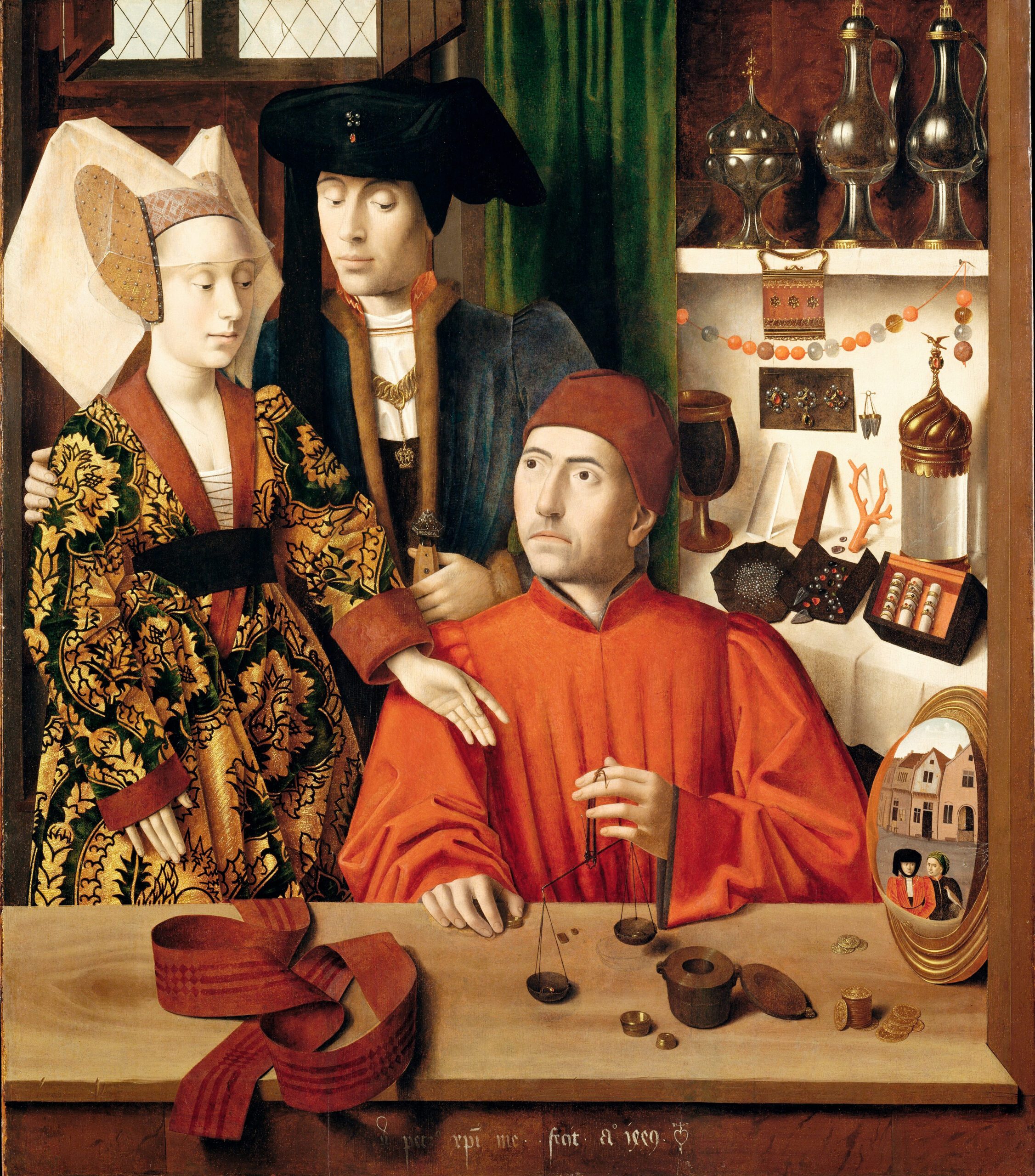
Bruges, 1449. Twenty years before Botticelli painted his Birth of Venus in Florence.
A goldsmith weighs a ring before an engaged couple. Behind him, objects rendered with astonishing precision: coral, crystal, brushes, necklaces. And in the right-hand corner, almost concealed, a convex mirror reflecting the entire shop, and two passers-by in the street beyond.
No Italian-style linear perspective. No references to Plato. No idealised bodies. And yet this painting is revolutionary.
Petrus Christus, a disciple of Jan van Eyck, proposes an entirely different means of reinventing painting: to observe the real world with near-photographic precision, to render light falling on materials, to make objects exist in space through the sheer power of oil paint, a technique the Flemish masters command more fully than anyone else in the fifteenth century.
Art historians long ranked these two approaches hierarchically: the “intellectual” Italian Renaissance at the top, the “artisanal” Flemish Renaissance below. This is a misreading that the discipline now widely acknowledges. They represent two different answers to the same question: how do we make the world visible, as it is, and as it might be?
The man who wrote the history of the Renaissance lived in Florence. That is not sufficient reason to grant him a monopoly on it.
- A Goldsmith in His Shop, Petrus Christus, 1449
- 98 × 85.2 cm
- The Metropolitan Museum of Art, New York
03 Titian: Venus and Adonis, c. 1553
What this work reveals: Antiquity as a licence; negotiation with the Church
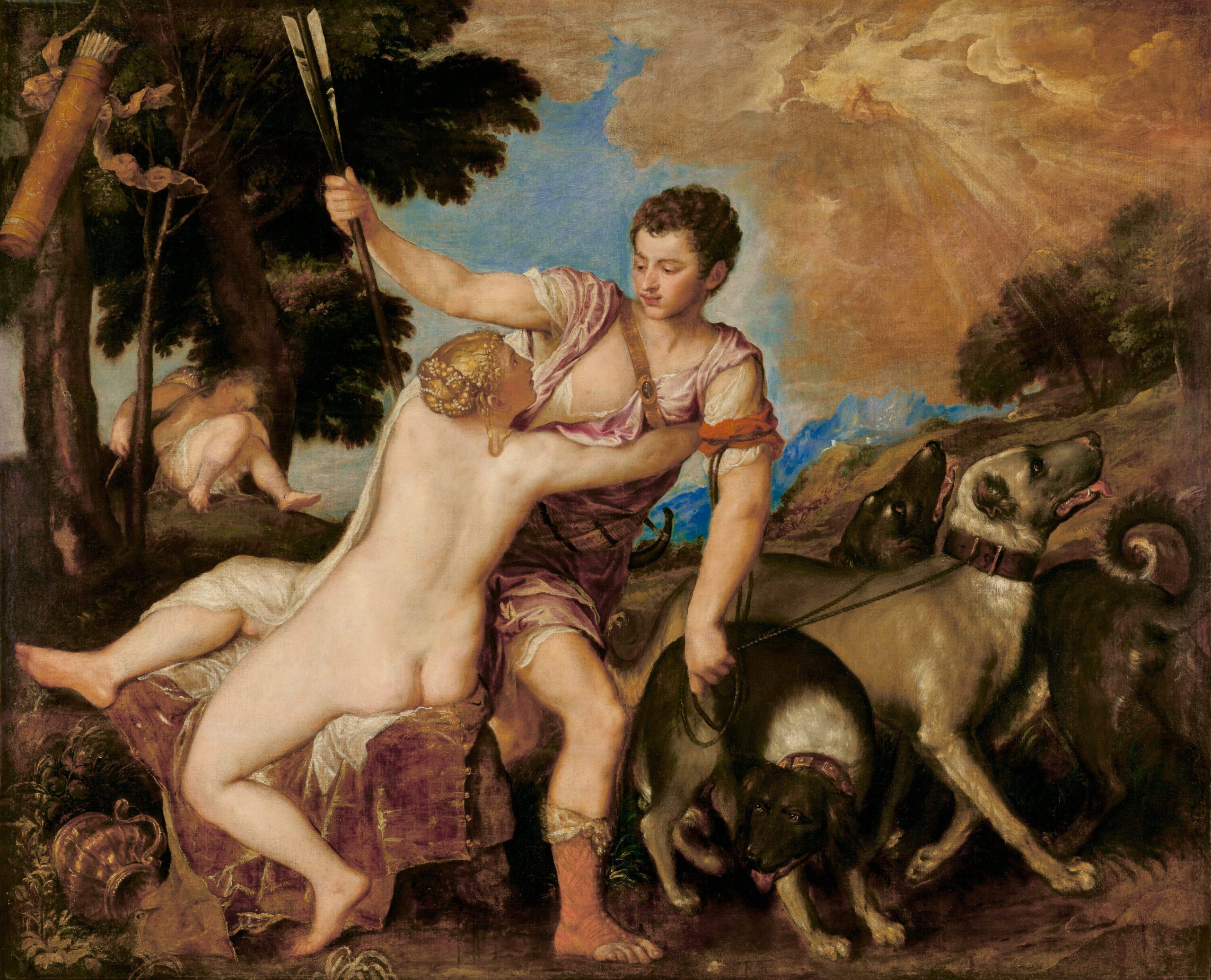
Venus holds back Adonis as he leaves to hunt. She knows he will die. He does not care. Their bodies are entwined, desirous, gilded in warm light. Love and death at once, the great register of ancient mythology.
Look closely. This is not a cold allegory. The hand of Venus on Adonis’s arm is a real hand on a real arm. The flesh is warm. The scene unfolds at dusk, not in some ideal space.
Titian uses mythology as a kind of licence. A nude female body of this kind would be deeply problematic without the pretext of Venus. But Greco-Roman Antiquity, now consecrated as the source of all wisdom, legitimises the glorified body, desire, and physical beauty as values in their own right.
This painting was commissioned by Philip II of Spain, the most Catholic king in Europe, the same monarch who funded the Inquisition. He owned several versions of it. The Renaissance is not a clean, linear revolution: it is a permanent negotiation between the new and the old, between the humanists and Rome, between desire and doctrine.
The patron of this mythological nude is the defender of the Catholic faith. The Renaissance always knew how to work with those in power.
- Venus and Adonis, Titian, c. 1555–1560
- 161.9 × 198.4 cm
- The J. Paul Getty Museum, Los Angeles
04 Bronzino: Portrait of a Young Man, c. 1530
What this work reveals: The individual as subject, and the generation already pushing back
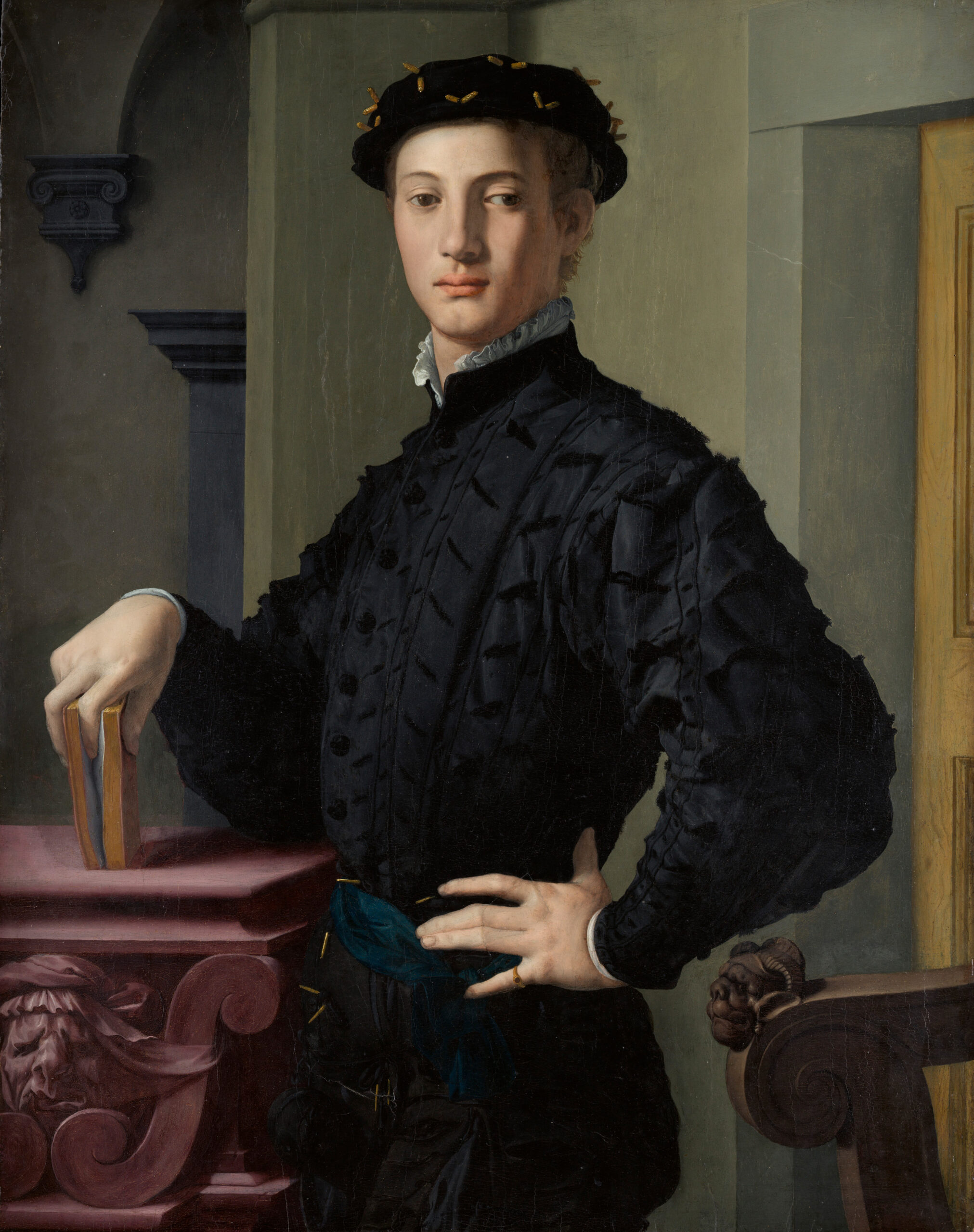
Who is this man? We do not know. He might be a Florentine nobleman, a courtier, a man of letters. He looks back at you with a composure that borders on arrogance. His black garment is coldly elegant. He holds a book.
In the Middle Ages, figures were rarely portrayed for what they were in themselves: they were represented through their function, the king, the bishop, the donor kneeling before the saint. The individual carried no significance apart from his relationship to God or to power.
The Renaissance changes this gradually. The portrait asserts: this person deserves to be remembered for who they are. Their features, their character, their singular gaze. Not their title, not their sanctity.
Bronzino goes a step further: he paints someone enigmatic. We do not know what this man thinks. His expression is closed, distant, perhaps ironic. It is a portrait that withholds, precisely as a real face does.
Note also the cooler palette, the more contorted poses compared to Raphael or Leonardo. Bronzino belongs to Mannerism, the generation that inherited the Renaissance and began playing with its conventions until they bent. Every significant movement carries within it the seeds of its own contestation.
The individual portrait is the most enduring invention of the Renaissance. Structurally speaking, Instagram is its heir.
- Portrait of a Young Man, Bronzino (Agnolo di Cosimo di Mariano), 1530s
- 95.6 × 74.9 cm, oil on panel
- The Metropolitan Museum of Art, New York
05 Pieter Bruegel the Elder: The Wedding Dance, 1566–1569
What this work reveals: The Renaissance from below, those Vasari forgot
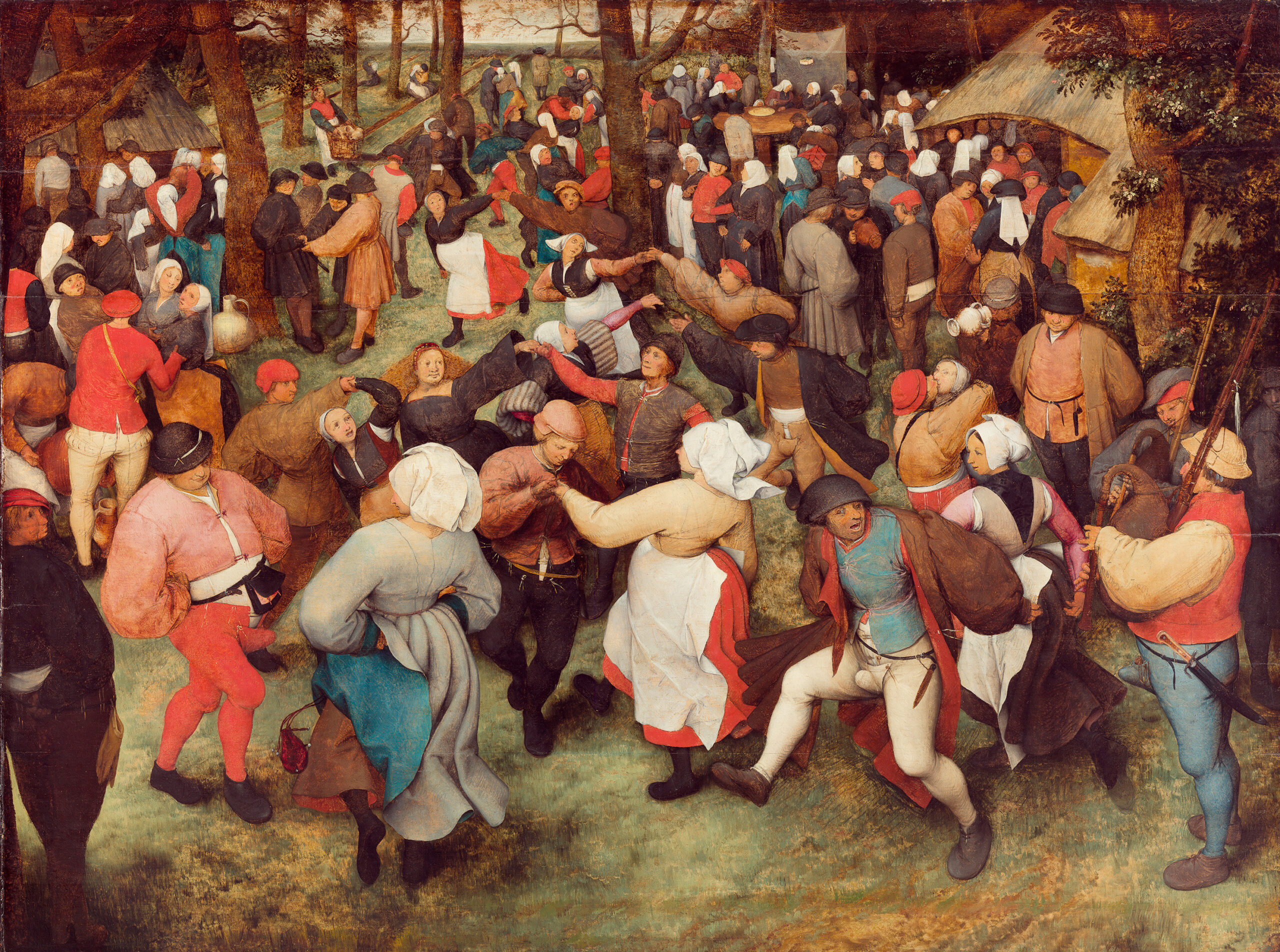
A Flemish peasant wedding. People eat, drink, and dance. No one is idealised. Faces are flushed, garments coarse. We identify the bride by her crown and by the fact that she is joining the dance.
Where is the Renaissance in all of this?
It is everywhere, but inverted. Bruegel does not paint the powerful, the saints, or the gods. He turns the same serious attention on the anonymous crowd that Italian masters reserved for their Virgins and mythological heroes. This is humanism in its most radical form: not “the ideal man” but “every man deserves to be seen.”
There is also a social reality that standard art histories frequently obscure: while princes collected Titians and humanists debated Plato, the vast majority of the European population continued to live as they had in the Middle Ages. Bruegel paints them, with a near-ethnographic precision that makes his canvases irreplaceable documents of sixteenth-century daily life.
The Renaissance did not concern everyone. Bruegel is the painter of those it passed over.
The Renaissance from below exists. It simply had no Vasari to write its story.
- The Wedding Dance, Pieter Bruegel the Elder, 1566
- Oil on panel – 119.4 × 157.5 cm
- Detroit Institute of Arts
What the official history left unsaid
Vasari devotes dozens of pages to Michelangelo. He barely mentions Lavinia Fontana.
And yet Lavinia Fontana, born in Bologna in 1552, died in Rome in 1614, represented in the Vmuseum collections, was the first professional woman painter in Europe to live entirely from her art and to receive public commissions. She had eleven children. Her husband, himself a painter though less gifted, managed her studio, prepared pigments, and cared for the household. She exhibited in Rome, worked for cardinals, and received commissions from Pope Gregory XIII.
Her story is not a charming footnote. It reveals something the official Renaissance prefers to overlook: behind the myth of the solitary male genius, the workshops of the period often functioned as collective enterprises in which women and apprentices laboured in the shadows. The master’s signature concealed a shared endeavour.
The Renaissance of women remains, to this day, largely unwritten. The history of art is also the history of who was permitted to write its pages.
Look first, read afterwards
Return to the Petrus Christus, A Goldsmith in His Shop. Before consulting the analysis, spend two minutes with the image alone.
Three things to observe:
- Count the identifiable objects on the shelf behind the goldsmith.
- Locate the convex mirror in the right-hand corner. What exactly does it reflect?
- Has this couple come to purchase the ring being weighed, or to bring their own gold for a bespoke commission?
There are no correct answers: there is your gaze, before anyone tells you what to see. This is the fundamental skill of the engaged viewer, and it is acquired only through practice.
Then compare your reading with the full Vmuseum analysis.
The Renaissance lives around you
The selfie Dürer paints himself face-on, as a genius, signature prominently displayed. Five centuries later, Instagram institutionalised every individual’s right to represent themselves, at the most carefully controlled angle. The underlying structure is identical: I deserve to be seen, and I control how.
Classical branding The Versace logo (the head of Medusa), the columns of bank facades, the friezes of Haussmann buildings. Brands seeking to signal longevity and prestige continue to draw on the visual vocabulary that the Renaissance recovered from Antiquity.
The myth of genius The idea that certain human beings possess an intrinsically superior creativity is a Renaissance invention. Before, art was a craft transmitted through workshop apprenticeship. When you say “she really has genius,” you are speaking the language of Vasari.
Frequently Asked Questions – FAQ
What is the difference between the Italian Renaissance and the Flemish Renaissance?
The Italian Renaissance, as theorised by Vasari, sought to recover the ideals of Greco-Roman Antiquity: mathematical perspective, idealised proportion, mythology. The Flemish Renaissance developed a different response: meticulous observation of the real world, mastery of light falling on materials, and oil painting brought to an unrivalled level of precision. Two paths toward the same pictorial revolution; two distinct theories of what painting ought to be.
What is Mannerism, and how does it differ from the Renaissance?
Mannerism refers to the current that emerged roughly between 1520 and 1580, when painters such as Bronzino, Pontormo, and Rosso Fiorentino began playing with the achievements of the Renaissance until they bent them out of shape: elongated bodies, acidic colours, elaborate poses, a cold and enigmatic atmosphere. It is not a deterioration of the Renaissance but a critical distancing from its own rules, the next generation questioning the certainties of its masters.
Why do historians say that Vasari “constructed” the Renaissance?
In his Lives of the Artists (1550), Giorgio Vasari was the first to use the word rinascita and to build a coherent narrative running from Cimabue to Michelangelo. But he lived in Florence, worked for the Medici, and his heroes were almost all Tuscan. Contemporary historians, notably Michael Baxandall and Lisa Jardine, have shown that this narrative was also an exercise in cultural prestige: Florence positioning itself as the centre of the artistic world by writing its own myth.
Why is the Renaissance associated with humanism?
Renaissance humanism is an intellectual movement that places humanity and reason at the centre of inquiry, in contrast to medieval theology. In painting, this translates into an interest in the individual portrait, the human body as a value in itself, and ancient mythology as a frame of reference. A word of caution, however: humanism does not mean secularism. The vast majority of artistic commissions throughout the Renaissance remained religious. Humanism and Christianity coexisted, often in tension.
What are the key dates of the Renaissance in painting?
By convention, the Renaissance spans from the early fifteenth century to the end of the sixteenth: Brunelleschi’s first experiments with perspective in Florence around 1420; the great Italian masters, Leonardo, Raphael, Michelangelo, Titian, between roughly 1480 and 1560; and Mannerism as the transition toward the Baroque from around 1520 onwards. In Northern Europe, the Flemish Renaissance begins earlier, with Jan van Eyck as far back as the 1420s and 1430s.
Further Reading – Bibliography
- Ernst H. Gombrich, The Story of Art (Phaidon)
- Daniel Arasse, On n’y voit rien + Histoires de peintures (Folio)
- André Chastel, L’Art italien (Flammarion, Champs-Arts)
- Françoise Barbe-Gall, Comment regarder un tableau – nouvelle édition augmentée (Éditions du Chêne)