Key facts
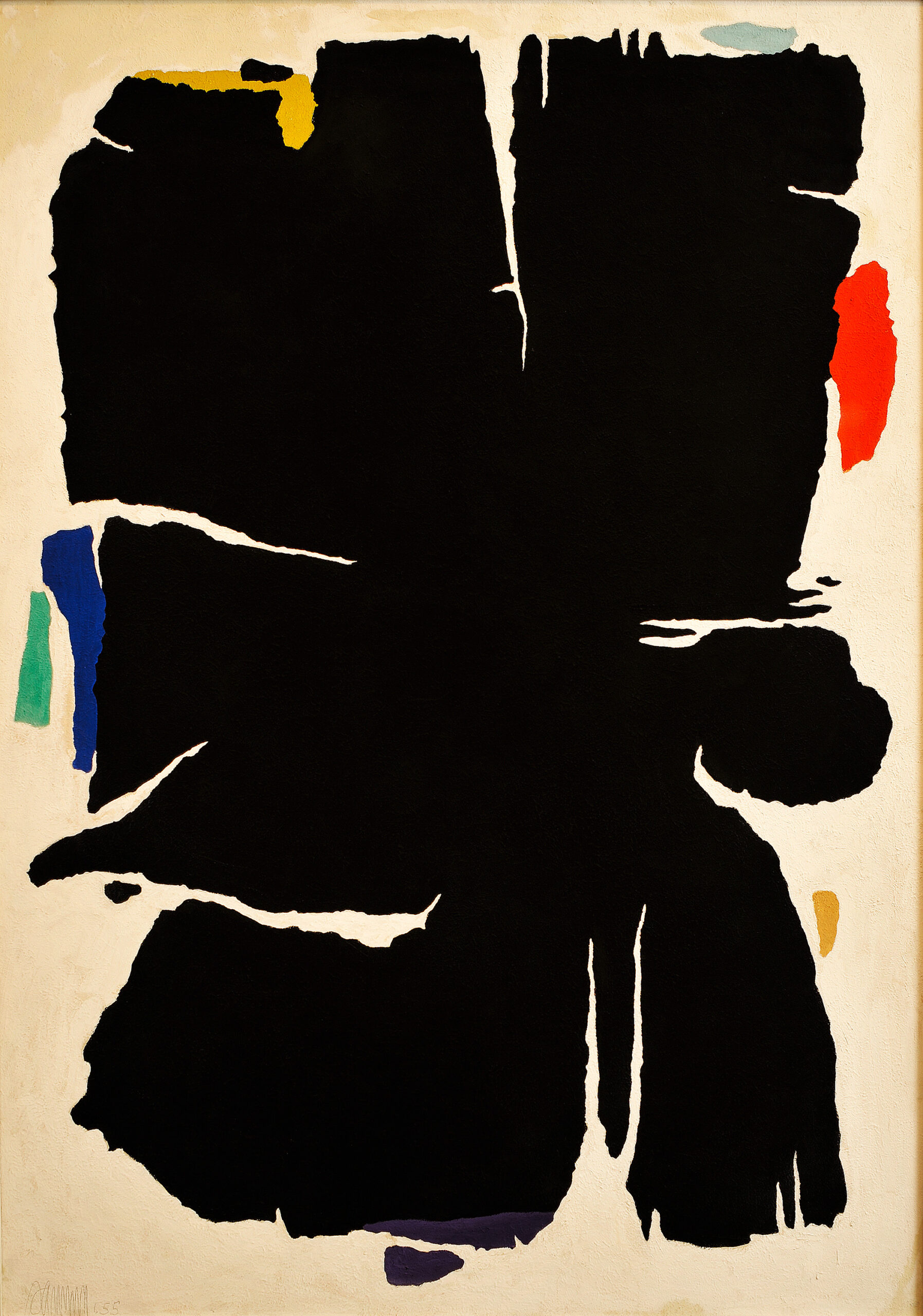
Painted by Willi Baumeister in January 1955, only months before his death, Aru 5 belongs to the “Aru” cycle, one of the artist’s final groups of work. Baumeister stands as a major figure of post-war organic abstraction in Germany. Executed in oil and synthetic resin on hardboard, the 185 x 130 cm panel is dominated by a fractured black mass punctuated with touches of primary colour, reflecting Baumeister’s enduring fascination with prehistoric art and archaic form. Held today by the Neue Nationalgalerie in Berlin, the work stands at the close of a career shaped by the artist’s decision to remain in Germany under the Nazi regime, where his art was branded “degenerate,” and by his lifelong commitment to developing an independent visual language.
This is a monumental work. What draws me in is its organic, shape-shifting quality: a black mass, cut and pierced, as if lightened here and there by the loss of its own matter. Small touches of primary colour reinforce that sense of living material. One can read in it something like a primitive script, something archaic, telluric. The flecks of colour act like musical notes, keeping the composition from settling into sheer weight. I am drawn to this powerful, restless material: the black mass holds the eye, which travels around it and is caught, again and again, by the coloured forms that punctuate its edges.
What you see in Aru 5
Look first at the white fissure that splits the black mass, close to the centre of the panel. It closes nothing. It opens a passage through the matter. Black dominates almost the entire surface, rising 185 x 130 cm against an ivory ground, a scale that exceeds the human body. The black is cut, pierced, threaded with fine pale lines like breaths drawn between the mass and the field around it. Touches of colour mark the edges: ochre yellow upper left, sky blue and vivid red on the right, deep blue and emerald green on the left, a flash of orange and a touch of violet below. None ventures toward the centre. They remain at the threshold, standing sentinel. The title, Aru 5, describes none of this directly. The work is held by the Neue Nationalgalerie in Berlin.
Willi Baumeister
Baumeister painted Aru 5 in 1955, months before his death on 31 August of that year. It belongs to the “Aru” cycle, developed once the geometric vocabulary of his early career had given way to organic form, a shift owed in large part to his fascination with prehistoric art, its carved signs, its archaic figures.
On the hardboard support, oil and synthetic resin merge. The resin hardens the surface, giving it a matte, almost mineral quality; the oil lets the edges run, uncertain, almost alive. The choice of panel over canvas was not incidental: it stabilises this dense black mass, preventing the distortion over time that a stretched canvas might suffer.
Twenty-two years earlier, in 1933, the Nazis had barred Baumeister from teaching and classed his work among so-called “degenerate art.” He remained in Germany nonetheless, continuing to paint, sometimes in secret, always on the margins of the regime. Aru 5 carries that double history: a form turned toward the origins of art, and a man who never abandoned the development of his own language.
Standing before the work
Before this black mass, the eye hesitates. It could overwhelm. It does not. White fissures cross it like breath. Flecks of colour hold it in check, like beacons, keeping it from sinking into pure weight. Baumeister was searching for a script, not an image. Look long enough and the form seems to move, never quite the same twice. Is this a threat subsiding, or a calm harbouring a threat? The question remains open.
Upcoming exhibition: Willi Baumeister at the Neue Nationalgalerie
The Neue Nationalgalerie in Berlin, which holds Aru 5, will present Schatten Reich – The Other German Art 1933–1945 from 29 January to 2 May 2027, curated by Maike Steinkamp with writer Florian Illies. The exhibition highlights artists who, after the Nazi seizure of power in 1933, continued or newly developed non-representational work in Germany despite defamation and a lack of exhibition opportunities. Baumeister holds a central place alongside Fritz Winter, Alexej von Jawlensky, and Jeanne Mammen; his 1938 work Tori is among the pieces on view. The exhibition is supported in part by the Willi Baumeister Stiftung.
Source: Neue Nationalgalerie
A question to consider
Between the geometric gestures of his early years and this organic mass at the close of his life, which decade of Baumeister’s work would you choose to live with?
About this work
- Aru 5
- Willi Baumeister
- 1955
- Oil and synthetic resin on hardboard
- 185 x 130 cm
- Neue Nationalgalerie, Berlin
- https://search.smb.museum/en/object/obj-963030