Key facts
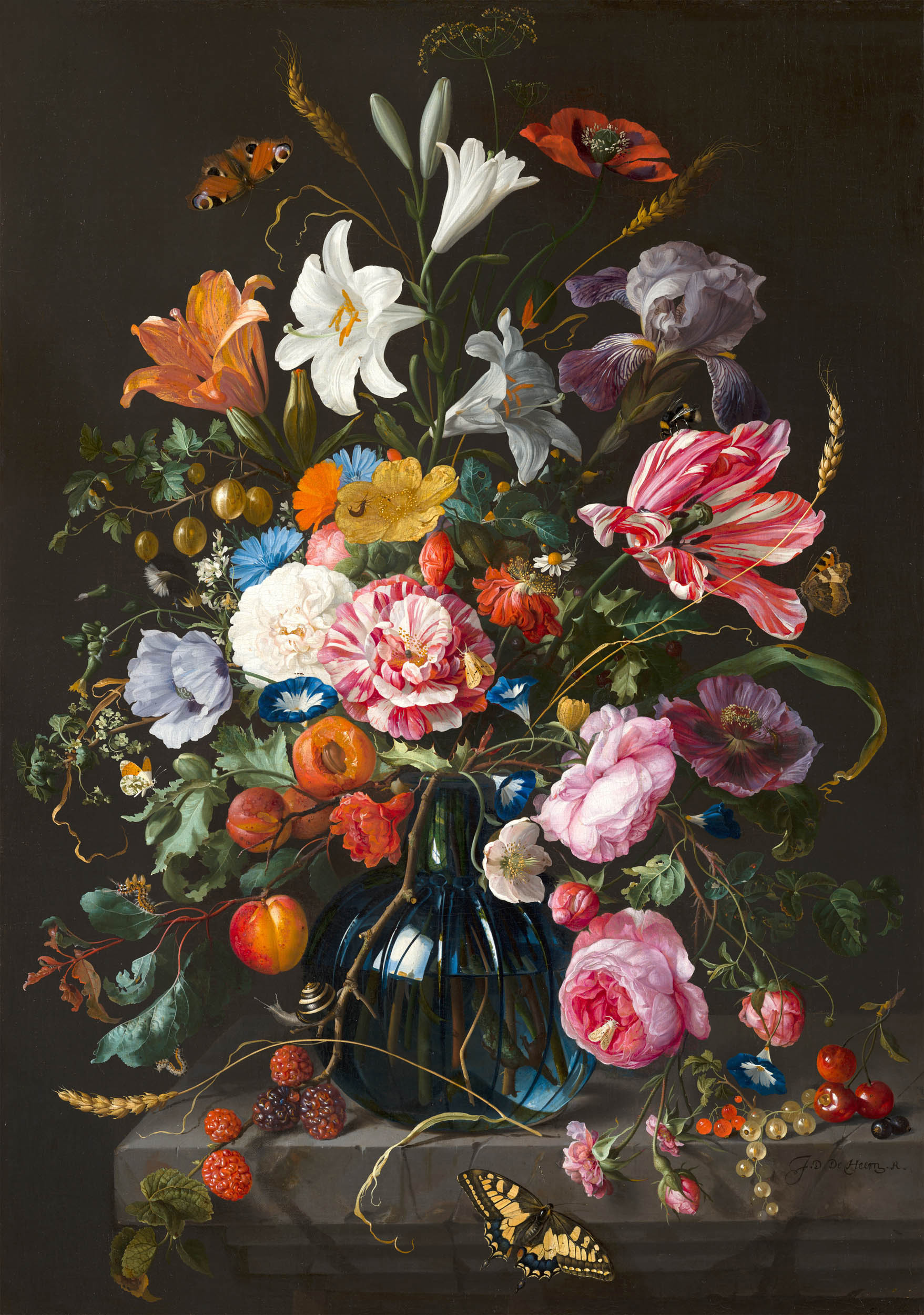
Painted around 1670 by Jan Davidsz de Heem, Vase of Flowers is a Dutch Golden Age floral still life held at the Mauritshuis in The Hague. Born in Utrecht in 1606, De Heem worked for many years in Antwerp, where he developed large, sumptuous still lifes. The Mauritshuis describes him as the most influential flower painter of his time. The painting shows how the genre evolved since the symmetrical bouquets of Ambrosius Bosschaert: the flowers spill freely over the vase, surrounded by insects and fruit. The glass vase reflects the studio window. Acquired in 1993 by the Friends of the Mauritshuis, the painting has been on display there ever since.
Another bouquet of flowers, you might say. But what a bouquet! What strikes me first is this sense of explosion: nothing stiff or lined up as in early 17th-century bouquets. The flowers spill over the vase, bend, droop, as if they had just been picked. The colours burst out, every flower seems alive. And the longer you look, the more you discover: an insect resting on a leaf, a piece of fruit at the foot of the vase… De Heem has scattered little joyful details everywhere, rewarding the patient eye. My favourite detail? The glass vase. Come closer: you can see the reflection of the studio window, a cloudy sky and even a few objects on the sill. The painter quietly slips into his own picture. I never tire of this bouquet: every time I look at it, I find something new!
A snail. Look at its shell: a few touches of brown, a dot of light, and the spiral comes to life. All around it, everything overflows. Flamed tulip, white lilies, mauve iris, red poppy. A caterpillar nibbles at a leaf. Cherries gleam on the cold stone.
A bouquet no garden could grow
Come closer still. The almost black background makes every colour leap out. The rose petals have the thickness of velvet. Those of the tulip look like crumpled silk. The cut fruit reveals its stone and moist flesh. Through the glass, you can make out the stems plunged in water. A few well-placed highlights are enough to convey transparency. In the belly of the vase, the studio window appears with its cloudy sky. The Mauritshuis catalogue entry also points out this detail.
Compare it with Vase of Flowers in a Window by Ambrosius Bosschaert, painted around 1618 and held in the same museum. Bosschaert generally arranges his flowers symmetrically. Each bloom has its own place, almost as in a herbarium. Half a century later, De Heem sets the stems free. They dive, twist and spill far beyond the vase. Yet one thing links the two painters. Bosschaert composes his bouquets from studies made over the course of the year. Here too, the calendar wavers. Spring tulip, ripe ears of wheat, summer cherries: everything blooms together. And already, at the lower left, leaves are turning brown.
Utrecht, Antwerp and the lesson of the South
A Golden Age painter, Jan Davidsz de Heem was born in Utrecht in 1606. He probably trained with the still-life painter Balthasar van der Ast. In the mid-1630s, he settled in Antwerp. The Flemish city taught him the abundance and exuberance of the South. There he painted large, sumptuous still lifes known as pronkstillevens. Between 1669 and 1672, he returned to Utrecht and ran a busy workshop. Abraham Mignon was among his pupils. The Mauritshuis regards Jan Davidsz de Heem as the most influential flower painter of his time. His catalogue raisonné, compiled by Fred Meijer, lists all his known paintings.
News: Madrid comes to The Hague
This autumn, the Mauritshuis is living on Spanish time. As part of an unprecedented exchange with the Museo Nacional Thyssen-Bornemisza in Madrid, the museum in The Hague is presenting Thyssen-Bornemisza ♥ Mauritshuis from 15 October 2026 to 17 January 2027, bringing together twenty-five masterpieces from Madrid, from Jan van Eyck to Dürer. In return, twenty-five paintings from the Dutch collection, including Vermeer’s View of Delft and still lifes by Bosschaert and Pieter Claesz, are on show in Madrid. As for Jan Davidsz de Heem, research has recently been enriched: Fred Meijer’s catalogue raisonné lists all his known paintings, and scientific analyses carried out at the Fitzwilliam Museum in Cambridge on four of his large banquet still lifes revealed the use of costly pigments such as ultramarine.
Source: Mauritshuis.
A question for you
What if this bouquet were not a single moment picked from the garden, but an entire year?
About this work
- Vase of Flowers
- Jan Davidsz de Heem
- c. 1670, Mauritshuis
- Oil on canvas
- 74.2 x 52.6 cm
- Mauritshuis, The Hague
- https://www.mauritshuis.nl/en/our-collection/artworks/1099-vase-of-flowers