Key facts
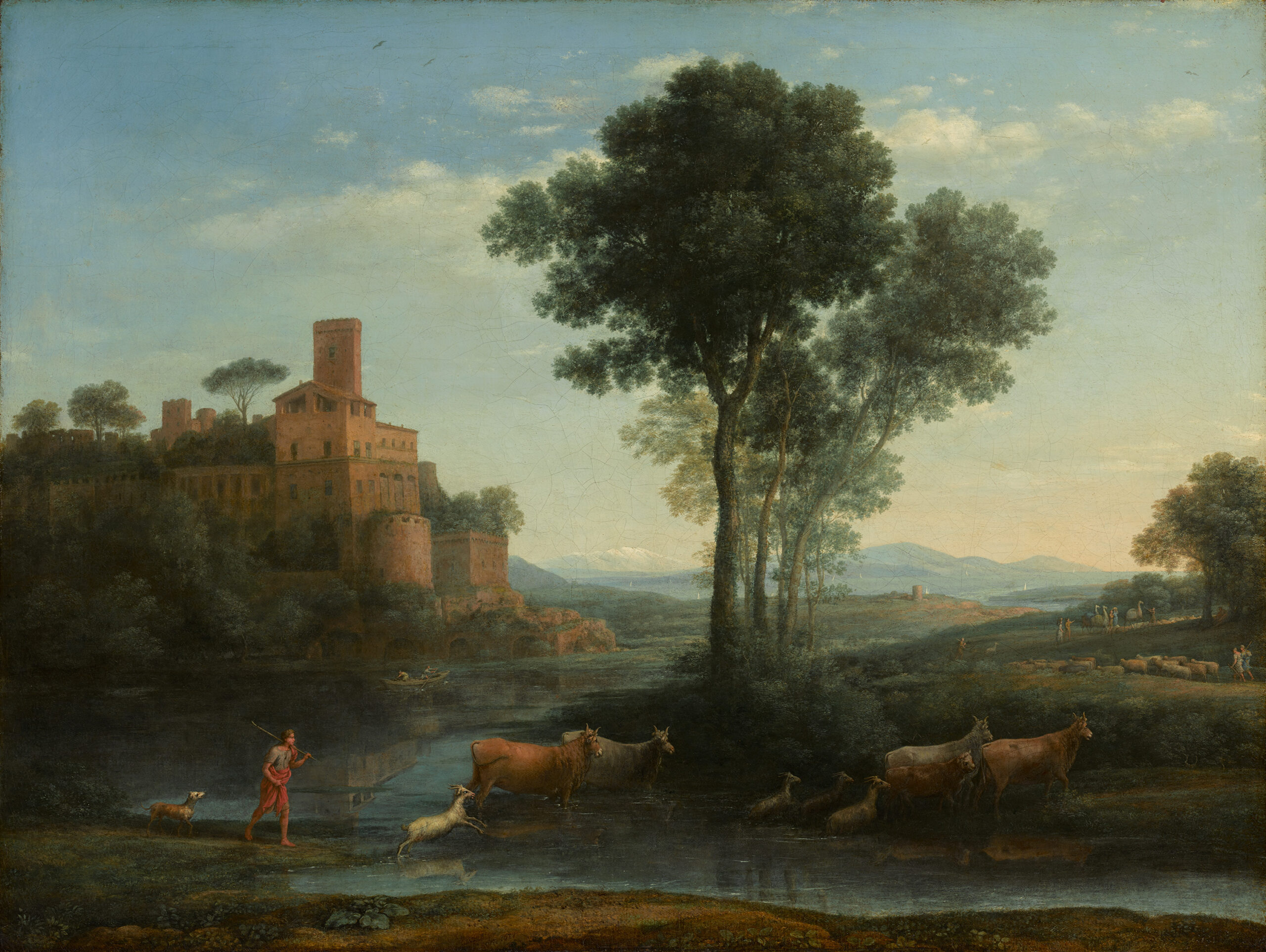
Landscape with the Voyage of Jacob is an oil on canvas painted in 1677 by Claude Gellée, known as Claude Lorrain (1604/1605–1682), five years before his death. Settled in Rome for most of his career, the French painter offers an idealized vision of the Roman countryside, characteristic of seventeenth-century classical landscape. The biblical episode of Jacob’s journey to Canaan is reduced to a few figures and camels in the background. Recorded in the Liber Veritatis, the book of drawings the artist kept to guard against forgeries, the painting was made for an abbé, probably Dominique Chevalier. Acquired by Robert Sterling Clark in 1918, it is held at the Clark Art Institute in Williamstown, Massachusetts.
First and foremost, it is a landscape I am sharing with you today. Claude Gellée, known as Claude Lorrain, established himself in the seventeenth century as the master of the ideal landscape: his views of the Roman countryside are always inhabited by a few figures, drawn from the Bible or mythology, which give the scene a historical dimension. Here, the reference is to the voyage of Jacob, who leaves his uncle Laban to return to the land of Canaan with his family and his flocks. Small figures, camels in the background: these few elements are enough to evoke the episode, without ever overpowering nature. This is what strikes me every time with Claude: the story is merely a pretext, and the true subject is the landscape itself. To my mind, the main appeal of this canvas is that it presents a poetic and idealized vision of the Roman countryside, nature recomposed to be more beautiful than nature itself. I love this poetic quality that elevates the depiction: the colors, the presence of that great castle anchoring the composition, and above all the warm golden light that bathes everything. It is this light, I believe, that gives the painting all its magic, and that we will find again later in Turner, a great admirer of Claude.
A white goat, legs outstretched, suspended above the water. Look at it: it alone leaps, while everything else moves at a walking pace. Ahead of it, the oxen are crossing the river. A shepherd in a red tunic follows them, staff over his shoulder, his dog at his heels. You can already feel the coolness of the ford.
A light rising from the horizon
Now raise your eyes. Here, the light does not fall from above. It rises from the distance, pale and golden, behind snow-capped mountains. Claude paints against the light. On this oil on canvas, the sky warms toward the horizon. The air turns the distance blue, and each plane recedes by one degree. The tall trees in the center, dark and dense, form a screen. The ochre castle catches the warmth on its stones and is reflected in the still water. On the right, tiny, Jacob’s camels move away with the flocks. The subject of the title is there, almost invisible.
This canvas also has a drawn double. To thwart forgers, from the mid-1630s the painter kept a “book of truth”: the Liber Veritatis. In it, he copied each of his paintings and noted who it was for. According to this record, our landscape was painted for an “abbé Chevallie,” probably Dominique Chevalier, a prelate in Tours. The canvas then passed through several British collections. Robert Sterling Clark bought it in 1918. Few seventeenth-century paintings can be traced like this all the way from the studio.
Claude Lorrain and the grand genre
In 1677, Claude Gellée has been living in Rome for decades. He has five years left to live. His century, the age of classicism, ranks the genres and places history painting at the top. Landscape alone has no standing. Claude elegantly sidesteps the rule: a few biblical figures are enough to ennoble the Roman countryside. The story lives in the title. Nature fills the canvas. And in the foreground, it is not Jacob who leads the herd.
News from the Clark Art Institute
2026 marks a turning point for the Williamstown museum, home to Landscape with the Voyage of Jacob. Esther Bell, previously Deputy Director and Chief Curator, became the Clark’s sixth director on July 1, and the first woman to hold the post in the institution’s 70-year history. She succeeds Olivier Meslay, who is returning to France after a decade at the head of the museum. On the exhibition front, the Clark is presenting An Exquisite Eye through February 21, 2027, featuring a selection from the 331 works of the Aso O. Tavitian Collection given to the museum in 2024. This gift, one of the largest in the Clark’s history, includes 132 paintings and 130 sculptures, and funds the construction of a Tavitian Wing scheduled to open in 2028.
Source: Clark Art Institute.
A question for you
Does this golden light bathing the water, the stones, and the distant hills soothe you, or does it leave you longing for a world too beautiful ever to have existed?
About this work
- Landscape with the Voyage of Jacob
- Claude Gellée, known as Claude Lorrain
- 1677
- Oil on canvas
- 71.2 x 95.1 cm (28 1/16 x 37 7/16 in.)
- Clark Art Institute, Williamstown (Massachusetts)
- https://www.clarkart.edu/ArtPiece/Detail/Landscape-with-the-Voyage-of-Jacob