Key facts
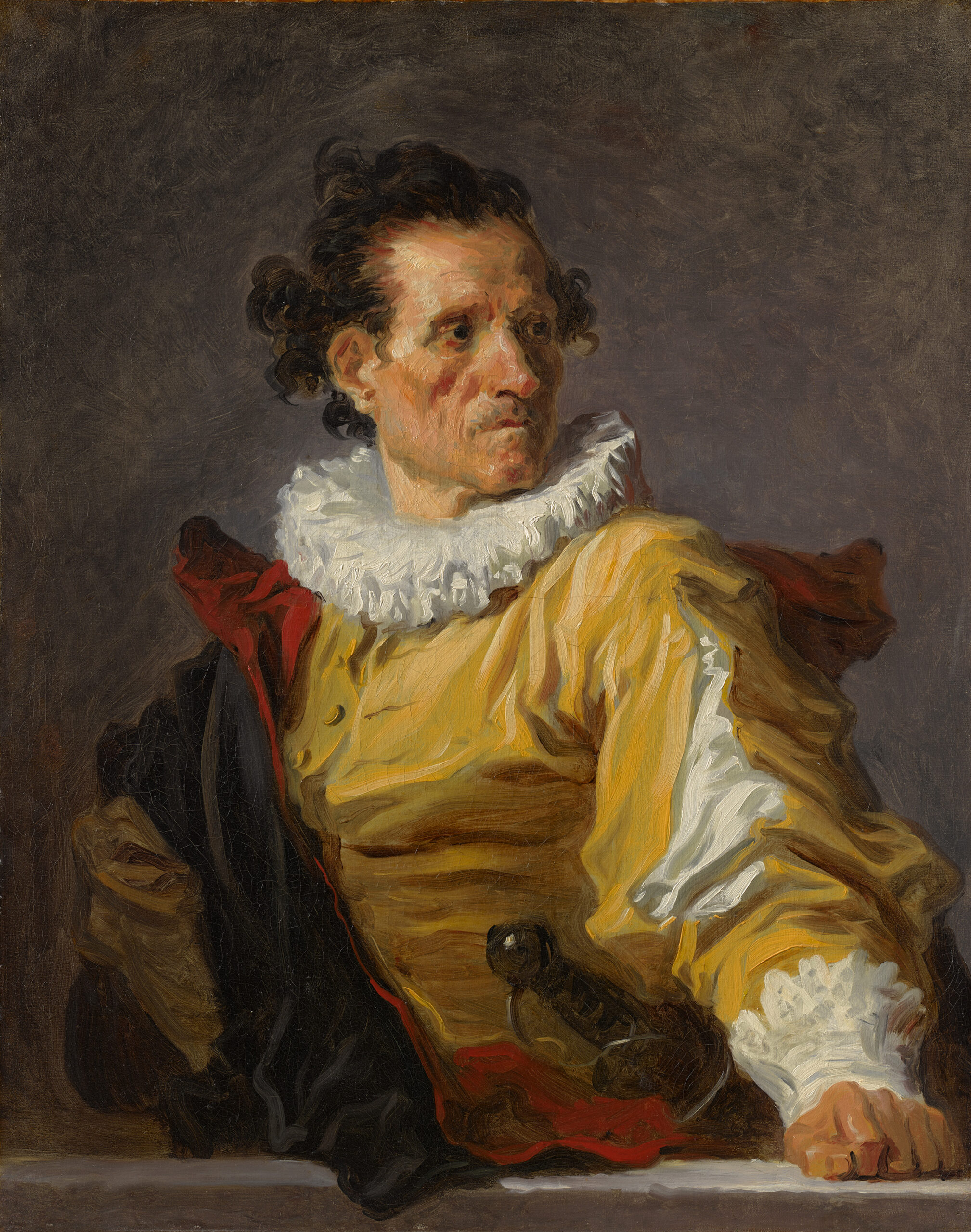
Painted around 1770 by Jean-Honoré Fragonard, The Warrior belongs to the “fantasy portraits” that mark a distinctive chapter in the career of this leading figure of the French Rococo. The canvas depicts a man with individualized features, dressed in an imaginary costume described at the time as “in the Spanish manner,” rendered with a rapid, unbound touch. Fragonard privileges painterly bravura and speed of execution over the identification of a sitter. The series reveals an original facet of his output, poised between portrait and exercise in style. Held at the Clark Art Institute in Williamstown, Massachusetts, the oil on canvas remains representative of eighteenth-century French painting.
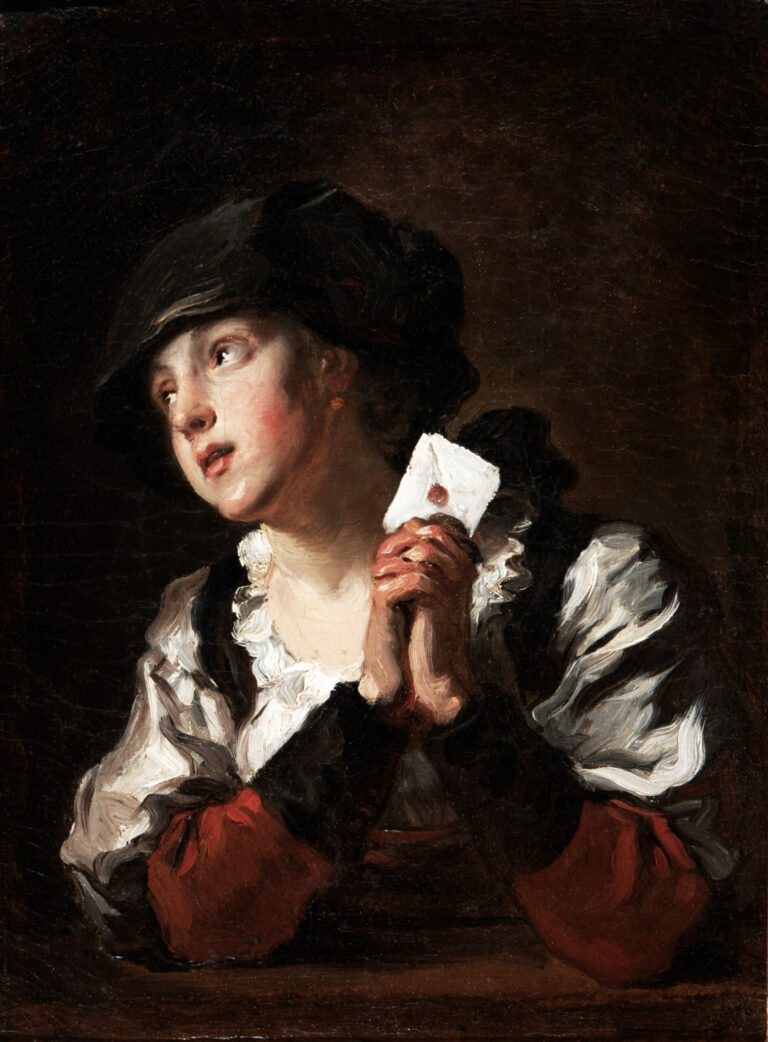
This painting has stayed with me, on more than one count. It seems to have been swept out in a single gesture, swift, and the resulting vibration matches perfectly the figure it conjures: a warrior caught in the moment, hand and mouth clenched, his eye fixed on something the viewer will never see. Such virtuosity in Fragonard. We are far from a work of the same period like The Love Letter, all delicacy and refinement, where the faint perfume of a charming young woman seems to linger. I love The Warrior too for the force it releases, and for the energy held entire within its subject.
Look first at that fist. It rests on the stone, clenched, motionless. Follow the yellow sleeve upward, split with luminous folds. The white ruff foams beneath the chin. The face, meanwhile, is already turning away. The eye drifts to the right, toward something beyond the frame. The whole body, taut, holds its breath.
Beneath the Surface
Come closer still. The paint remains alive, almost wet. Jean-Honoré Fragonard loads the brush, crushes it, lifts it away. The yellow doublet quivers under broad sweeps of the brush. The ruff is nothing but a white impasto, raised into a crest. The red cloak bleeds into the brown shadow of the ground. Nothing is smoothed; everything is laid down in one stroke. This figure belongs to the fantasy portraits, painted alla prima around 1770. The costume “in the Spanish manner” springs from the painter’s imagination. The face, by contrast, appears taken from a real, living model. A haughty warrior from a bygone century? A contemporary dressed up for the studio? The Clark’s label keeps its silence. The clenched hand signals menace. The touch, for its part, breathes exhilaration.
The Gesture Over the Model
Fragonard does not seek patient likeness. He seeks the instant, the energy, the bravado of the wrist. Each stroke stays legible, frank, avowed. We follow the brush as we would a signature. The yellow of the doublet captures all the light. The grey ground recedes, muffled, without detail. The color gathers on the bust and the ruff. The rest sinks into a warm penumbra. This choice gives the figure its raw presence. He is not recounted; he is flung onto the canvas. Speed of execution becomes the true subject of the painting. Look at the lace cuff, to the right. Three white touches suffice to bring it to life. The red collar of the cloak slips behind the shoulder. It supplies the one ardent note in the setting. Everything here serves effect and dash. Nothing checks the brush.
Fragonard and His Age
Jean-Honoré Fragonard was born in Grasse in 1732. He trained under Chardin, then under Boucher. Rome and the Prix de Rome shaped his eye. In Paris, he became the painter of love scenes and gardens. The Rococo found in him one of its masters. These fantasy figures nonetheless stand apart within his work. They stake everything on speed and panache. Then Neoclassicism imposed its new order. Taste turned its back on Fragonard. The artist faded little by little. He died in Paris in 1806, all but forgotten.
The Clark, Today
The painting remains at the Clark Art Institute in Williamstown. Since June 2026, the museum has presented An Exquisite Eye there. It is the first display of the Aso O. Tavitian Collection, among the great collections of European art assembled in North America in the twenty-first century. It remains on view through February 2027.
Source: Clark Art Institute
A Question for You
💭 This free, rapid touch almost anticipates Manet and Impressionism. How does a brush of 1770 outpace its own century?
About This Work
- The Warrior
- Jean-Honoré Fragonard
- c. 1770
- Oil on canvas
- 81.5 × 64.5 cm
- Clark Art Institute (Williamstown, Massachusetts)
- https://www.clarkart.edu/ArtPiece/Detail/The-Warrior