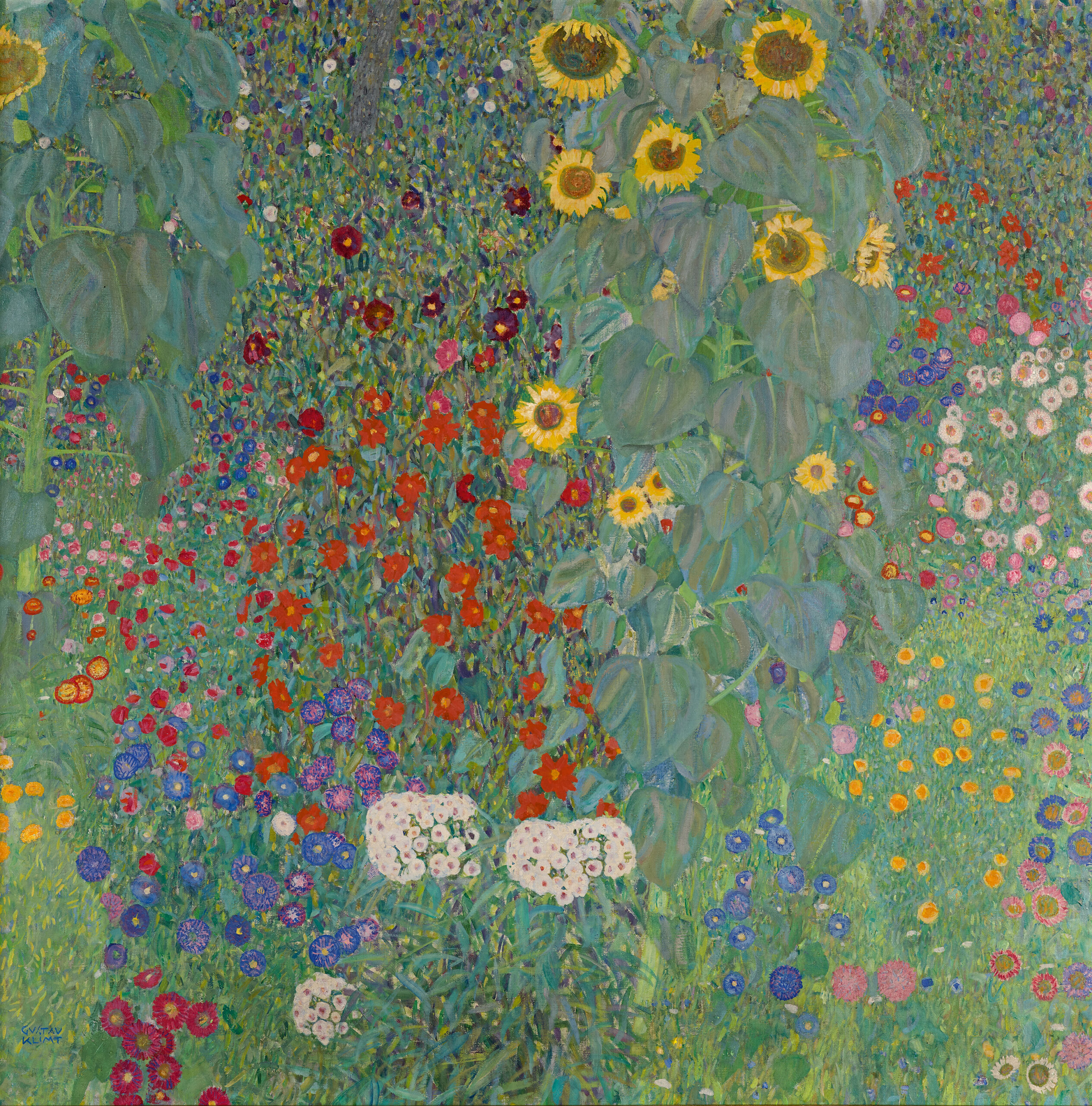
Standing before this painting, I am immediately struck. Klimt leaves no empty space, no room to breathe: the canvas is overrun with flowers to its very edges, with no sky, no horizon, no vanishing point. You do not observe this garden. You are swallowed by it.
What strikes me is the tension between the real and the dream. I recognise the sunflowers, the dahlias, the marigolds, that dense and damp vegetation of a summer morning. I can almost smell the sweet, earthy scent of the flowerbed. And yet something shifts. The flowers repeat, overlap, arrange themselves into a near-abstract carpet that follows no botanical logic. Klimt transforms the peasant garden into a living tapestry, something that belongs as much to stained glass as to a flower bed.
It is precisely this extravagant, teeming, colourful bloom that I love in this work: it overflows, it invades, it refuses restraint. It captures the eye in an instant and will not let go.
A sunflower. Yellow, burning, rooted at the centre of one’s gaze. Gustav Klimt raises his cardboard viewfinder, closes one eye, and cuts out the summer.
Klimt wants no sky. The sky distracts. It gives the eye an exit, the mind a consolation. He wants the gaze to remain captive, gently, pleasurably captive. There, at the Attersee, the peasant gardens grow without restraint. The sunflowers rise high, very high. The dahlias press against the asters. The white phlox thread themselves between the stems. Everything smells sharp, smells warm, smells of wet morning earth. He places his viewfinder and searches for the perfect fragment, the one in which nothing else exists. Just this sea of flowers. He begins with the yellows. Then the vivid red of the dahlias, like embers in the green. His touch is tight, small, repeated. It is not a garden he is painting. It is a sensation. The sensation of being inside it, not in front of it. In Vienna, he is asked for women, for gold, for symbols. Here, he needs none of that. The flowers are enough. They will not wither on his canvas.
The brushstroke as decision
In 1906, Klimt works on a square format. This choice is not incidental. The square refuses horizontal narrative and vertical hierarchy. It imposes equality across every point of the canvas. The oil paint is applied in small, dense, almost vibrating touches. No line, no outline. Colour builds form. Klimt, founder of the Vienna Secession and a leading figure of Art Nouveau, steps away here from gilded ornament toward something more physical, more immediate.
Gustav Klimt (1862-1918) is the most celebrated painter of Austrian modernism. His annual retreats to the Attersee produced a series of landscapes that stand in sharp contrast to his Viennese Symbolist works.
The Belvedere and Klimt: a living legacy
The Belvedere Museum in Vienna, home to Cottage Garden with Sunflowers, remains one of the world’s foremost centres for Klimt scholarship. From February to September 2025, the Lower Belvedere hosted the exhibition Gustav Klimt — Pigment & Pixel. Rediscovering Art with Technology, which brought new insight into the painter’s creative process through sophisticated scientific analysis. In collaboration with Google Arts & Culture, the museum used artificial intelligence to reconstruct in colour the celebrated Faculty Paintings, monumental canvases destroyed at the end of the Second World War, of which only black-and-white photographs survived. The museum continues in 2026 with new temporary exhibitions. Klimt’s works remain on permanent display at the Upper Belvedere, alongside the celebrated The Kiss.
Sources: magazine-acumen.com / belvedere.at
A question for you
💭 If you were to keep just one detail from this canvas in your memory, a colour, a flower, a sensation, which would you choose, and why?
About this work
- Cottage Garden with Sunflowers
- Gustav Klimt
- 1906
- Oil on canvas
- 110 × 110 cm
- Belvedere Museum, Vienna
- https://sammlung.belvedere.at/objects/2483/bauerngarten-mit-sonnenblumen