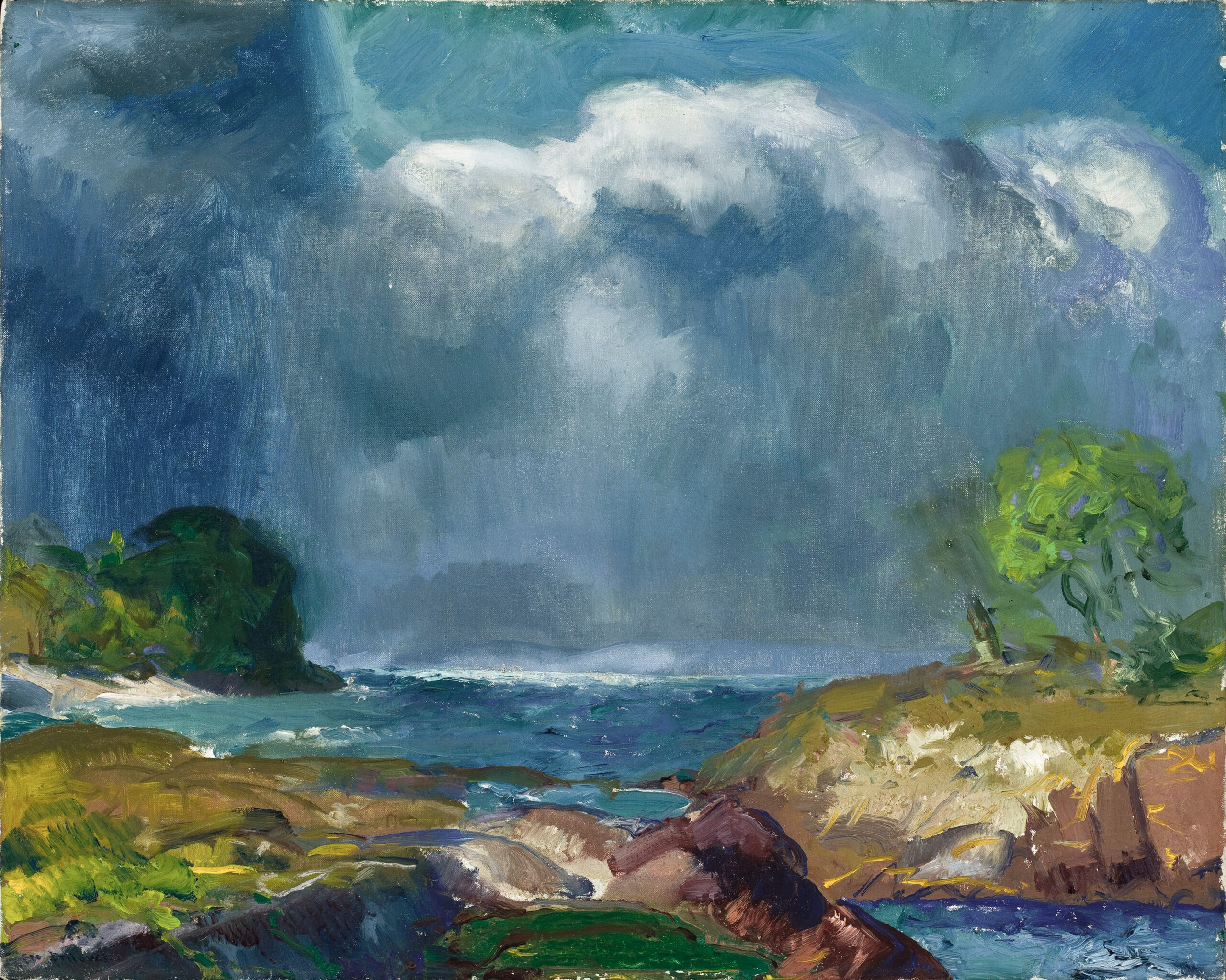
A new American discovery and what a discovery. What strikes me immediately in The Coming Storm is the command with which Bellows deploys chromatic contrast to render atmospheric tension. The raking light that bathes the foreground intensifies the greens and ochres to an almost unreal pitch; this is precisely the quality of light just before a storm breaks, when a sun still present collides with a sky drawing shut.
In the background, the violet-blues of the laden sky bear down on the horizon, and it is in that gap, between the vividness of the near and the menace of the far, that the painting finds its force. Bellows does not paint the storm: he paints the instant before, that suspended moment in which nature holds its breath. At once immediate and deeply considered, this is a work that stays with you.
Look at the rocks in the foreground. They burn. Warm ochres, deep purples, white flashes like dry bone. The paint is thick, almost tactile. Place your hand, in your mind, on this stone Bellows set down in 1916: it is warm, rough, alive.
Beneath the surface
The sky occupies two-thirds of the canvas. It does not decorate: it bears down. The cloud mass, built up in broad, dragged strokes, rises from the horizon with a mechanical slowness. Bellows is working here with the Maratta palette, a scientific system that assigns numerical values to hues. In his record book he notes: Yellow-Green 13.9.5.3.1, Blue-Purple 9, Red-Purple 5. This painting is a score. Yet nothing on the canvas resembles a calculation. The acid greens of the foliage at right vibrate against the cold blues of the sky. The brushwork is athletic, urgent, almost impudent. This is a painter who works fast. He knows the storm will not wait. Look at the line where sea meets sky: that is where the light breaks, white and cold, before swallowing everything.
The artist and his time
George Bellows (1882–1925) was a central figure of the Ash Can School, the American movement that turned its back on idealized landscape to confront the real. But in June 1916, at Camden, Maine, the real is this inlet pounded by daily storms. Bellows is there with his family and his friend Leon Kroll. The storms come almost every day. He paints. He is not after beauty: he is after the physical truth of the sky, its texture, its weight. The painting is held in the permanent collection of the Los Angeles County Museum of Art, LACMA.
Bellows in the spotlight
The centenary of Bellows’s death prompted a renewed engagement with his work. In 2024–2025, the Cincinnati Art Museum devoted an exhibition to his prints, 55 lithographs and drawings. The Columbus Museum of Art, which holds the largest collection of his work in the world, had planned for 2025 a dedicated exhibition, publication, and public programming.
Sources: cincinnatiartmuseum.org | seegreatart.art
A question for you
💭 If you were to place this painting in a museum gallery, would you hang it among American landscapes, or alongside the European Impressionists?
About this work
- The Coming Storm
- George Bellows
- 1916
- Oil on canvas
- 26½ × 32 1/16 in. (67.31 × 81.44 cm)
- Los Angeles County Museum of Art (LACMA)
- https://collections.lacma.org/object/11589