Key facts
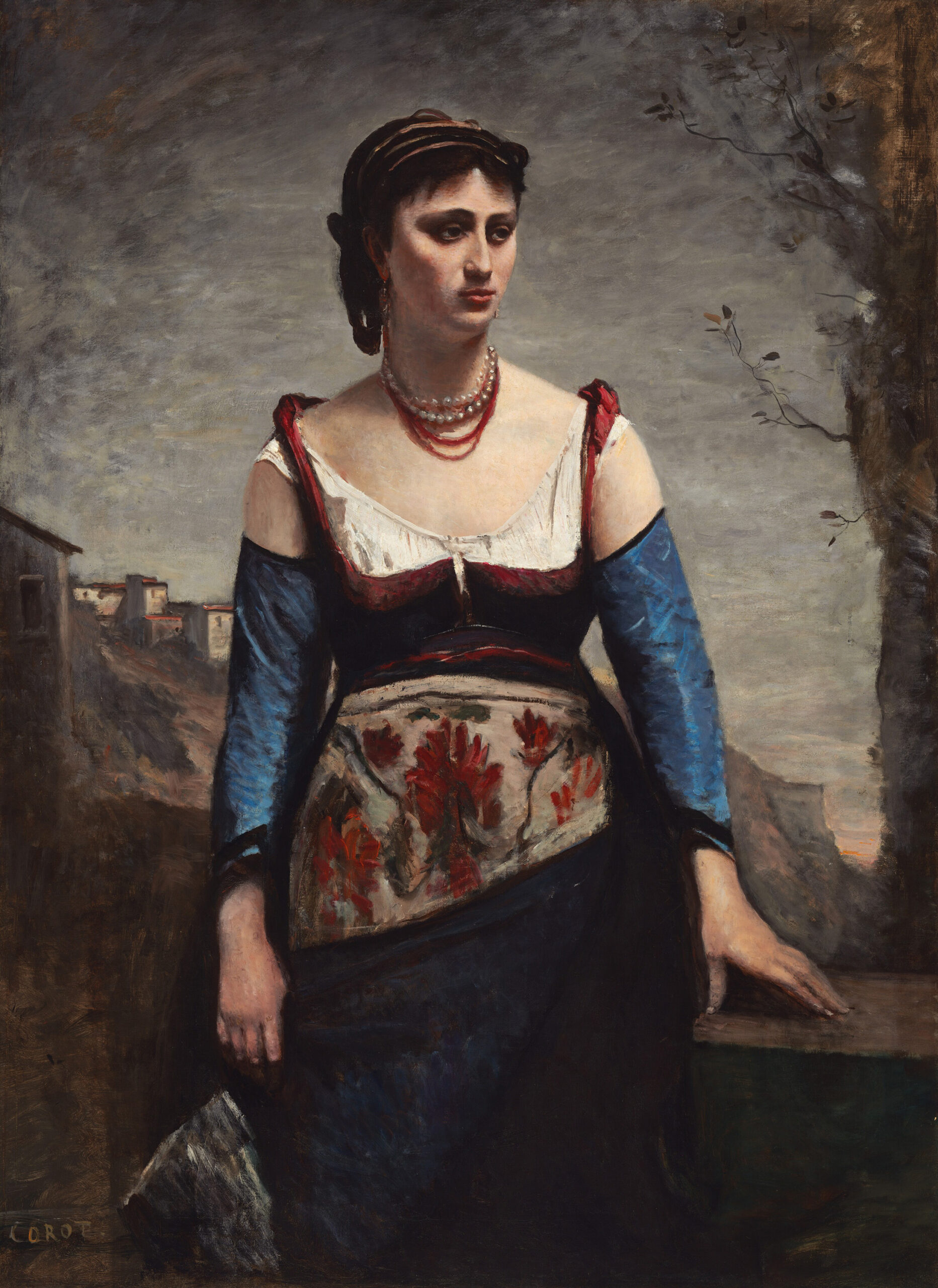
Painted in 1866 by Jean-Baptiste-Camille Corot (1796-1875), Agostina is held at the National Gallery of Art in Washington, thanks to the bequest of collector Chester Dale. The painting depicts a young woman, probably from the Roman countryside, wearing traditional dress in front of an Italian landscape. Corot was the most influential French landscape painter of the 19th century. Close to the Barbizon school, he paved the way for Impressionism. He also painted figures, which he rarely exhibited or sold. Agostina is the largest and one of the best known of them. The canvas was shown in 1875 under the title Étude de femme (Study of a Woman), then at the 1909 Salon d’Automne. It is among the works that revealed Corot as a figure painter.
I am not used to Corot’s figure paintings, since he is best known for his landscapes. Here we have a full-length portrait of a young woman, and a large one: more than 1.30 m (4 ft 3 in) high. That is rare for him. The young woman may have been an Italian immigrant from the Roman countryside. She wears traditional dress and holds the tip of her apron in her hand. Her gesture is simple, almost shy. She has a wistful expression. She does not look at the viewer: her gaze drifts into the distance, as if she were thinking of a country she has left behind. What strikes me is the contrast between her solid, almost sculptural pose and this silent melancholy. The landscape painter is still there in the background, more loosely sketched, which seems to extend her reverie. Corot kept this kind of painting to himself and almost never exhibited it. Looking at it, I feel I am entering a more intimate side of his work, far from the hazy “souvenirs” that made his name. To me, Agostina is not just the portrait of a model. It is the portrait of exile.
You would expect a landscape. Not at all. Agostina, painted in 1866 by Jean-Baptiste-Camille Corot, is an oil on canvas measuring 132.4 by 97.6 centimeters. It is held at the National Gallery of Art in Washington.
Formal and technical analysis
The figure fills almost the entire height of the canvas. She stands in three-quarter view. The composition forms a triangle, from the face down to both hands. Her left hand rests flat on a low stone wall. Her right hand hangs along her dark skirt. The pose is stable, almost statuesque. Yet her face contradicts this composure. Her eyes slip away to the left, out of the frame. Corot builds the modeling through strong contrasts of light and shadow. The eye sockets sink into shade, the bridge of the nose stands out sharply, the shoulders curve like marble. Look at the brushwork. It changes with each material. Thick and rich on the white blouse, it turns dry on the skirt and fluid on the blue sleeves. On the apron, the red flowers form small ridges of impasto. At her neck, strands of white and red beads catch the light. The background is handled in thin scumbles. A hilltop village on the left, a slender tree on the right, an orange glow on the horizon. The landscape painter is there, but in the background. He steps aside. Or rather, he frames.
Historical and artistic significance
In 1866, Corot is the most influential French landscape painter of his century. Yet his figure paintings belong to his private world. He rarely exhibits or sells them. Agostina is the largest example. The choice is surprising: at the height of his career, the painter keeps his largest figure for himself. The model probably comes from the Roman countryside. These are the hills Corot painted outdoors, from nature, as early as 1825.
The painting’s critical fortunes follow a paradoxical path. In 1875, after the painter’s death, it appears under an anonymous title: Étude de femme (Study of a Woman). The collector Jean-Baptiste Faure puts it up for sale at the Hôtel Drouot in 1878. In 1909, at the Salon d’Automne, it becomes l’Italienne Agostina (The Italian Woman Agostina). The Corot figures shown that year make a strong impression on Picasso and Braque, just as Cubism is taking shape. The painter of hazy souvenirs thus finds, after his death, admirers among the avant-garde. Chester Dale buys the canvas in 1931. He bequeaths it to the National Gallery of Art in 1963. In 2018, the exhibition Corot: Women puts it center stage.
A study, says the 1875 title. A canvas over four feet tall, answers the painting.
Jean-Baptiste-Camille Corot (1796-1875) traveled to Italy three times: from 1825 to 1828, then in 1834 and 1843. He spent time with the Barbizon painters without belonging to their group. His landscapes herald Impressionism. From around 1855, the human figure takes on a growing role in his work.
Agostina in Washington: news for 2026-2027
Agostina is currently on view in the West Building, Main Floor, Gallery 90. Admission to the National Gallery is always free, from 10 a.m. to 5 p.m. Corot lovers can already save the date for an important exhibition: Souvenirs of the Gilded Age: French Landscapes from the Corcoran Collection, from March 13, 2027, to January 17, 2028. It will bring together some twenty paintings by the most celebrated French landscape artists of the day, from the collection of industrialist William A. Clark, including Corot’s The Moored Boatman: Souvenir of an Italian Lake (1861). It is a chance to see the artist’s other side: the landscape painter who built his reputation, while figures like Agostina stayed in the studio. There is institutional news too: Mitchell P. Rales has just been elected president of the Board of Trustees, after a historic $116 million gift in April 2026 to endow Across the Nation, the museum’s nationwide loan program. This winter, the museum is also showing Remember Me: Picturing African Americans in Early Photography through March 14, 2027, and Tinker Tinker, a major printmaking exhibition, from December 19, 2026, to June 13, 2027.
Source: National Gallery of Art.
A question for you
Corot first discovered Italy at 29. Is he painting a model here, or a memory of his youth?
About this work
- Agostina
- Jean-Baptiste-Camille Corot
- 1866
- Oil on canvas
- 132.4 x 97.6 cm (52 1/8 x 38 7/16 in.)
- National Gallery of Art, Washington D.C.
- https://www.nga.gov/artworks/46583-agostina