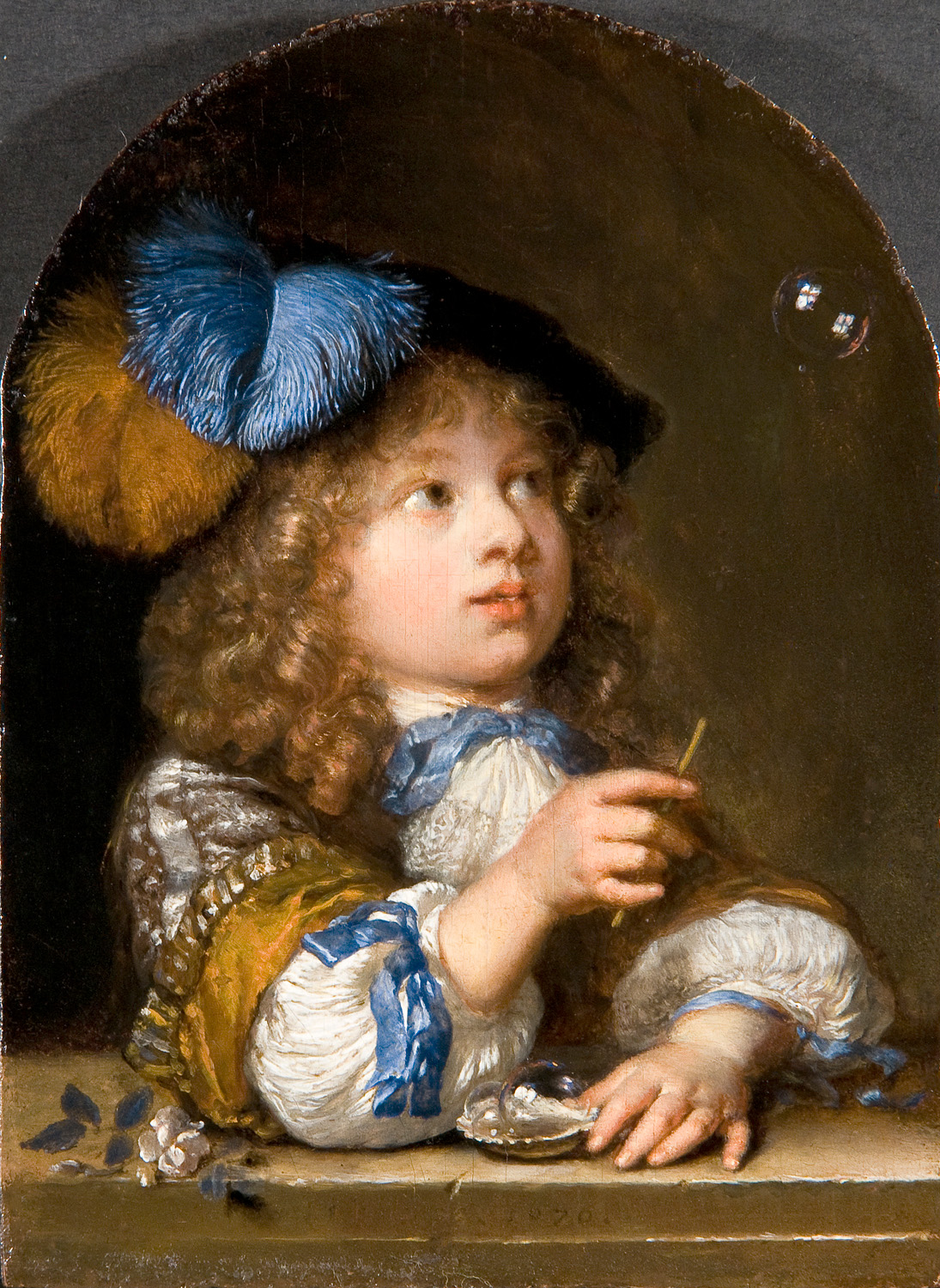
What strikes me first about this painting is the tension it sustains between two irreconcilable readings. The first is that of the vanitas: soap bubbles, ephemeral by nature, and a cut flower both speak to the fragility of all things, a motif deeply rooted in seventeenth-century Dutch painting. Yet Netscher adds a more intimate and more unsettling layer: the child himself becomes a figure of precariousness, in an age when infant mortality struck without distinction. The second reading is almost contradictory. This is a painting that radiates, that celebrates youth in its most vivid and concentrated form.
What strikes me technically is the mastery with which Netscher renders materials: the hat feathers, the ribbon, the fabric, all executed with a precision that rivals the great Flemish miniaturists. And therein lies, to my mind, the true achievement: all of this is contained within a panel less than twelve centimetres high. That constraint of format, far from diminishing the work, grants it a singular intensity, almost that of a jewel.
As for the child’s gaze, it seems to me the heart of the painting. This is not a carefree look. There is something grave, almost contemplative, as though the small bubble-blower already understood, intuitively, what his gesture means.
This is not a joyful painting. Or rather, it is, and that is precisely the trap.
You are standing before a child with auburn curls, wearing a hat adorned with blue and golden feathers. He holds a straw. A bubble escapes, perfect, towards the upper right corner. Caspar Netscher painted this in 1670, on a panel no larger than the palm of a hand.
What the painting tells us
Look at the materials. The gathered white satin, the blue ribbons, the feathers rendered strand by strand. Netscher is a painter of precision. Every detail asserts its permanence. Yet the subject says the opposite: a bubble always bursts. On the stone ledge, fallen petals. A cut flower. The vanitas is there, discreet, implacable. The technique endures. The subject vanishes. That contradiction, Netscher does not resolve.
What the period tells us
In seventeenth-century Dutch painting, the motif of a child blowing bubbles is codified. Homo bulla, the man is a bubble, says the Latin adage. But Netscher shifts the motif. His boy is not an abstraction. He is specific, physical, alive. And in an age when infant mortality could strike without warning, this vivid face carries an additional weight. Joy and grief occupy the same space.
Caspar Netscher, born around 1639, trained under Gerard ter Borch. He settled in The Hague in 1662, where he became portraitist to the elite, admired for his virtuosity in rendering textiles.
Current exhibition – Mauritshuis, 2026
The Mauritshuis is currently devoting a presentation to Golden Age genre painting. Two recent acquisitions, Girl Singing and Boy Playing the Violin by Frans Hals (c. 1628), are on display in Room 13 until 5 November 2026. Like Netscher’s boy, these children are caught in a suspended moment.
Source: mauritshuis.nl
A question for you
💭 A perfect bubble, a grave expression, a flower already cut: can one truly paint joy without painting its end?
About this work
- A Boy Blowing Bubbles
- Caspar Netscher
- 1670
- Oil on panel
- 11.2 x 8.4 cm
- Mauritshuis, The Hague
- https://www.mauritshuis.nl/fr/decouvrir-la-collection/oeuvres-d-art/l120-a-boy-blowings-bubbles