Key facts
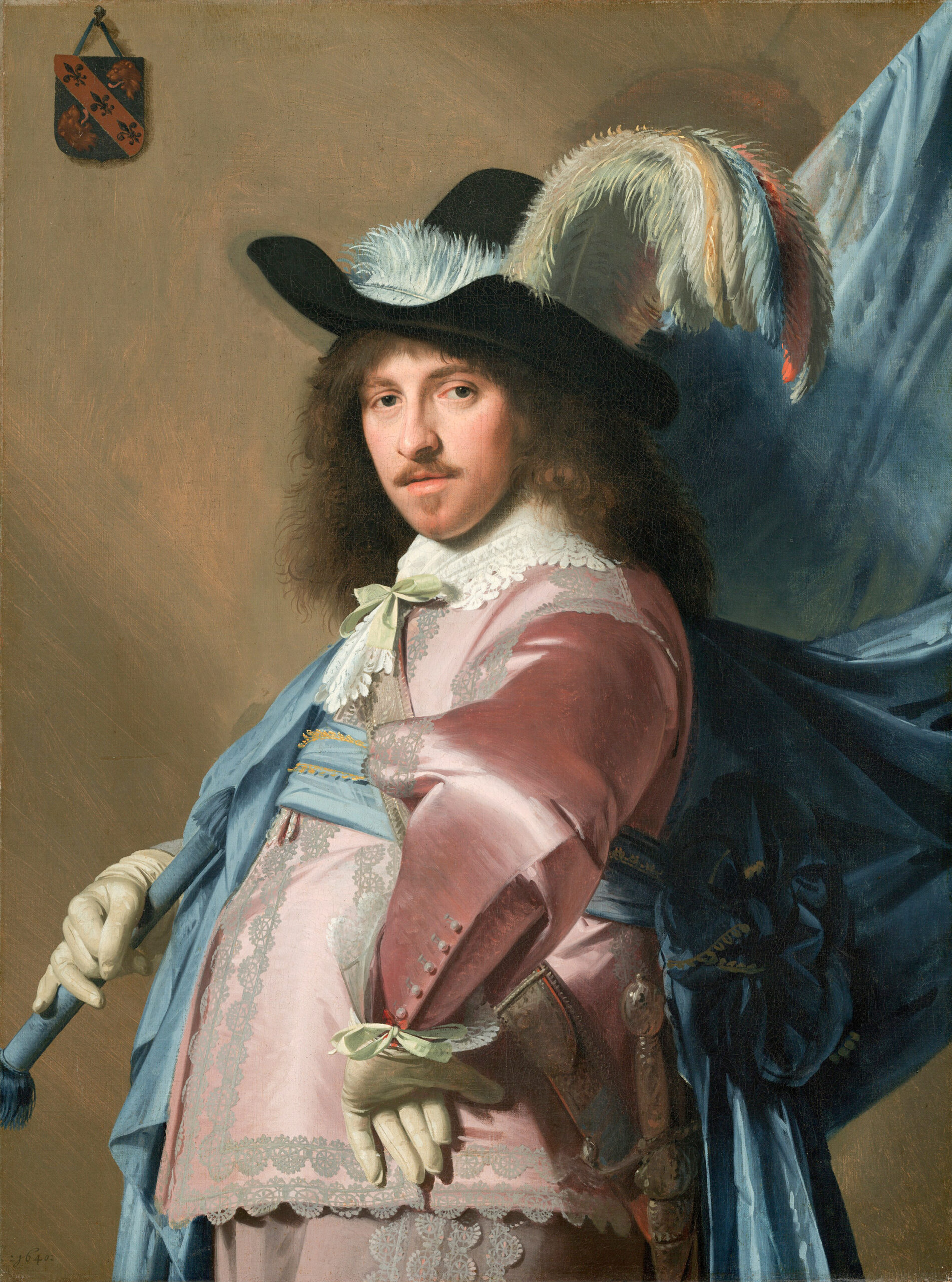
Andries Stilte as a Standard Bearer is an oil-on-canvas portrait painted in 1640 by Johannes Cornelisz Verspronck, a Haarlem portraitist active during the Dutch Golden Age. The sitter, a member of the Kloveniers militia company, appears in a pink satin costume. His blue sash and banner indicate his company and rank. Regulations reserved this office for unmarried men, and Stilte had the picture painted just before giving it up to marry. The painting is a rare individual, life-size portrait of a standard bearer. Held at the National Gallery of Art in Washington, it sheds light on the honorary role of civic militias and on the dress codes of the Dutch bourgeoisie in the seventeenth century.
While browsing the online collections of the National Gallery of Art in Washington, my eye was caught by this figure dressed all in pink, with such a proud and martial bearing. To a twenty-first-century Western eye, what an amusing contrast! In my culture, pink is seen as a distinctly feminine colour, far removed from the codes of seventeenth-century men’s fashion. That is precisely what interested me so much about this painting: it bears witness to the codes of an era. In Verspronck’s day, wearing such brilliant fabrics was a sign of wealth and prestige, and the standard bearer of a civic militia was expected to display his rank. The association of pink with little girls is a much more recent convention, one that only took hold during the twentieth century. Contemplating Andries Stilte, I grasp how much these codes have changed over time. It helps put many of today’s social conventions into perspective and shows that they are constructs, to be placed back within the course of history.
Beyond this reflection, I admire the painter’s virtuosity. The rendering of the fabrics is remarkably precise: the silky sheen of the costume, the supple folds of the immense banner that envelops the sitter. Where his fellow townsman Frans Hals would have multiplied lively, visible strokes, Verspronck works a smooth, careful surface, with almost no trace of the brush. The result is a portrait both elegant and alive, in which the young man’s confident pose says everything about the pride he takes in his office. We are truly in the presence of one of the great masters of Dutch Golden Age portraiture.
Haarlem, 1640. A nail driven into an ochre wall holds a blue ribbon. From it hangs a small coat of arms, strewn with fleurs-de-lis and lions’ heads. Below, a young man poses one last time as standard bearer.
Satin, silk, light
Look at the sleeve thrust towards you. The pink satin breaks into sharp ridges. Verspronck lays an almost white light on every raised fold. In the hollows, the colour slides towards mauve and brown. It is this stark contrast, with no velvety transition, that lets the eye recognise satin. Bands of silvery lace follow every curve of the doublet. Pale gloves, sea-green ribbons, a broad collar: the outfit is complete. Behind him, the blue banner coils around his body in dark waves. Finally, look at the background. Brushstrokes remain visible there, left free. The painter keeps his smooth handling for the sitter. The wall, meanwhile, breathes.
A bachelor in full dress
Andries Stilte belongs to the Kloveniers, one of Haarlem’s militia companies. During the revolt against Spain, these companies served as a civic guard. By 1640, they had lost most of their military role. Ranks became honours, fiercely sought by wealthy burghers. The blue sash and banner identify the company and rank. The rest of the costume speaks of fortune and personal taste. Regulations also reserved the office of standard bearer for unmarried men. Stilte therefore commissioned this portrait before relinquishing his rank to marry. As a married officer, he would have worn black. Here, he glows in pink. The canvas captures a status at the very moment it comes to an end.
Johannes Cornelisz Verspronck was born in Haarlem at the very beginning of the seventeenth century. He probably trained with his father, the painter Cornelis Engelsz. He may also have studied under Frans Hals. A member of the Guild of Saint Luke from 1632, he ranked among the city’s most prominent portraitists. A standard bearer painted alone and life-size remains a rarity. Compare it with Thomas de Keyser’s more sober and austere portrait of Loef Vredericx as an ensign (Mauritshuis, The Hague).
What’s on: Haarlem, at the Frans Hals Museum
To discover the artistic context in which Verspronck worked, this autumn is the perfect time to visit Haarlem. From 6 November 2026 to 28 February 2027, the Frans Hals Museum is devoting an exhibition to Frans Hals and Rembrandt. It brings together eleven paintings by Hals and eight by Rembrandt. Verspronck, a contemporary and fellow townsman of Hals, worked in this same Haarlem milieu. Comparing his smooth, precise handling with Hals’s free brushwork is an excellent way to understand his style. Note that time slots must be booked online before your visit.
Source: Rodi / Haarlem https://www.rodi.nl/haarlem/uit/509107/nooit-eerder-zo-tentoongesteld-grootmeesters-rembrandt-en-hals-samen-in-haarlem
A question for you
To you, does this portrait show a man first, or rather an office? Why?
About this work
- Andries Stilte as a Standard Bearer
- Johannes Cornelisz Verspronck
- 1640
- Oil on canvas
- 104 x 78.5 cm (40 15/16 x 30 7/8 in.)
- National Gallery of Art, Washington D.C.
- https://www.nga.gov/artworks/104729-andries-stilte-standard-bearer