Key facts
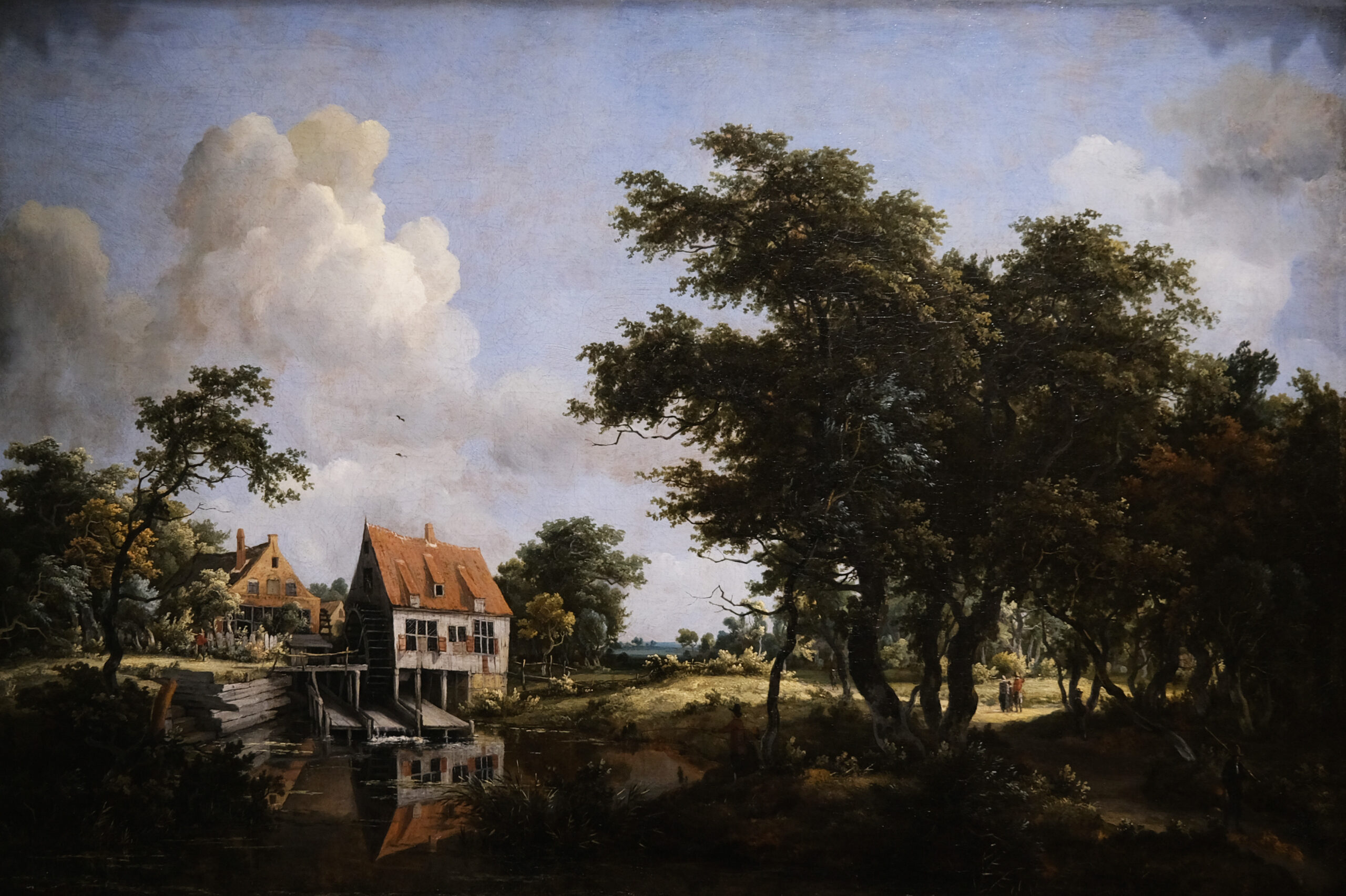
The Mills, painted by Meindert Hobbema between 1664 and 1668, belongs to the classical landscape tradition of the Dutch Golden Age. Trained under Jacob van Ruisdael, the artist returns here to a subject he favoured throughout his career: the water mill, inspired by a journey to Deventer in the 1660s. The canvas freely recomposes this memory, setting the building within a verdant countryside, though it in fact stood in an urban setting. This compositional freedom, characteristic of Dutch studio practice, makes the work both a representative example of the genre and a benchmark within the artist’s series of mill paintings. Held at the Petit Palais, in Paris, it illustrates the idealisation of nature typical of seventeenth-century Dutch painting.
Peasant scenes and landscapes of the Dutch Golden Age have always fascinated me, and this is one of the paintings I linger longest before whenever I visit the Petit Palais. What strikes me each time is the balance between human activity and the surrounding nature: neither dominates, and both are rendered with equal care. I particularly admire the treatment of the foliage, a way of suggesting the movement of leaves under light that feels almost tactile, with brushstrokes that seem hesitant from a distance but reveal, up close, real technical mastery. The sky, vast, occupies a large part of the composition and gives the whole a breadth very characteristic of Dutch painting of the period.
Beyond its pictorial quality, I also value this painting as a document: it records rural dwellings, the architecture of mills, and the organisation of peasant labour in the seventeenth century, with a realism that goes beyond mere picturesque anecdote. It is this blend of technical skill and documentary value that draws me back each time I visit the museum.
A red-roofed mill stands at the water’s edge. Its wheel bites into the surface, leaving a clear wake behind it. Around it, dense foliage absorbs the afternoon light. The sky, heavy with white clouds, fills nearly half the canvas. Two tiny figures walk beneath the trees. A dog crosses the path.
What the surface conceals
Meindert Hobbema builds his composition in layers. The foreground holds the shadow, dense, almost black. The eye then moves toward the light at the centre, where the mill catches every ray. The foliage, built up in small overlapping touches, seems to stir as if in a real breeze. The water reflects the buildings with near-photographic precision. The red of the roof doubles there, trembling in the current. The stacked timber by the jetty adds an almost tactile grain to the scene. Hobbema did see this mill. It stood on the banks of the Ijssel, at Deventer. He was travelling at the time with his master, Jacob van Ruisdael, in the 1660s. He brought back sketches from the journey, which he later reused in the studio. But he does not paint what he saw. He sets the scene in open countryside, though the mill in fact stood in a town. The Dutch landscape before us never existed quite as shown.
Hobbema and his time
Meindert Hobbema was born in Amsterdam in 1638. Trained under Jacob van Ruisdael, he adopts his master’s construction of skies and his botanical precision. He softens the contours and warms the light. He paints the mill motif repeatedly, a quiet obsession, resetting it each time within a different setting. Appointed wine-gauger for Amsterdam’s excise office in 1668, he painted less thereafter. Yet he never fully abandoned landscape painting. English collectors rediscovered him in the nineteenth century. His work remains today a high point of classical Dutch Golden Age landscape painting, poised between direct observation and studio recomposition.
News from the museum
The Petit Palais, which holds The Mills by Meindert Hobbema among its permanent collections, continues an active programme in 2026. Until 19 July, the museum hosts Visages d’artistes, de Gustave Courbet à Annette Messager, devoted to portraiture and self-portraiture through some hundred works, paintings, sculpture, works on paper, photography and decorative arts. Alongside it, until 20 September 2026, the Petit Palais presents We are [still] here, an urban art exhibition bringing 200 contemporary works by 75 artists into dialogue with the museum’s historic collections, free of charge. This programme reflects a museum committed to bringing its permanent holdings, including this Hobbema landscape, into renewed dialogue with contemporary creation.
Source: Petit Palais
A question for you
💭 In recomposing this mill so far from its actual setting, is Hobbema still working within the landscape “after nature”, or already within a tradition closer to the idealised landscape?
About this work
- The Mills
- Meindert Hobbema
- between 1664 and 1668
- Oil on canvas
- 77 x 111 cm
- Petit Palais, Musée des Beaux-Arts de la Ville de Paris, Paris Musées
- https://www.parismuseescollections.paris.fr/en/petit-palais/oeuvres/les-moulins