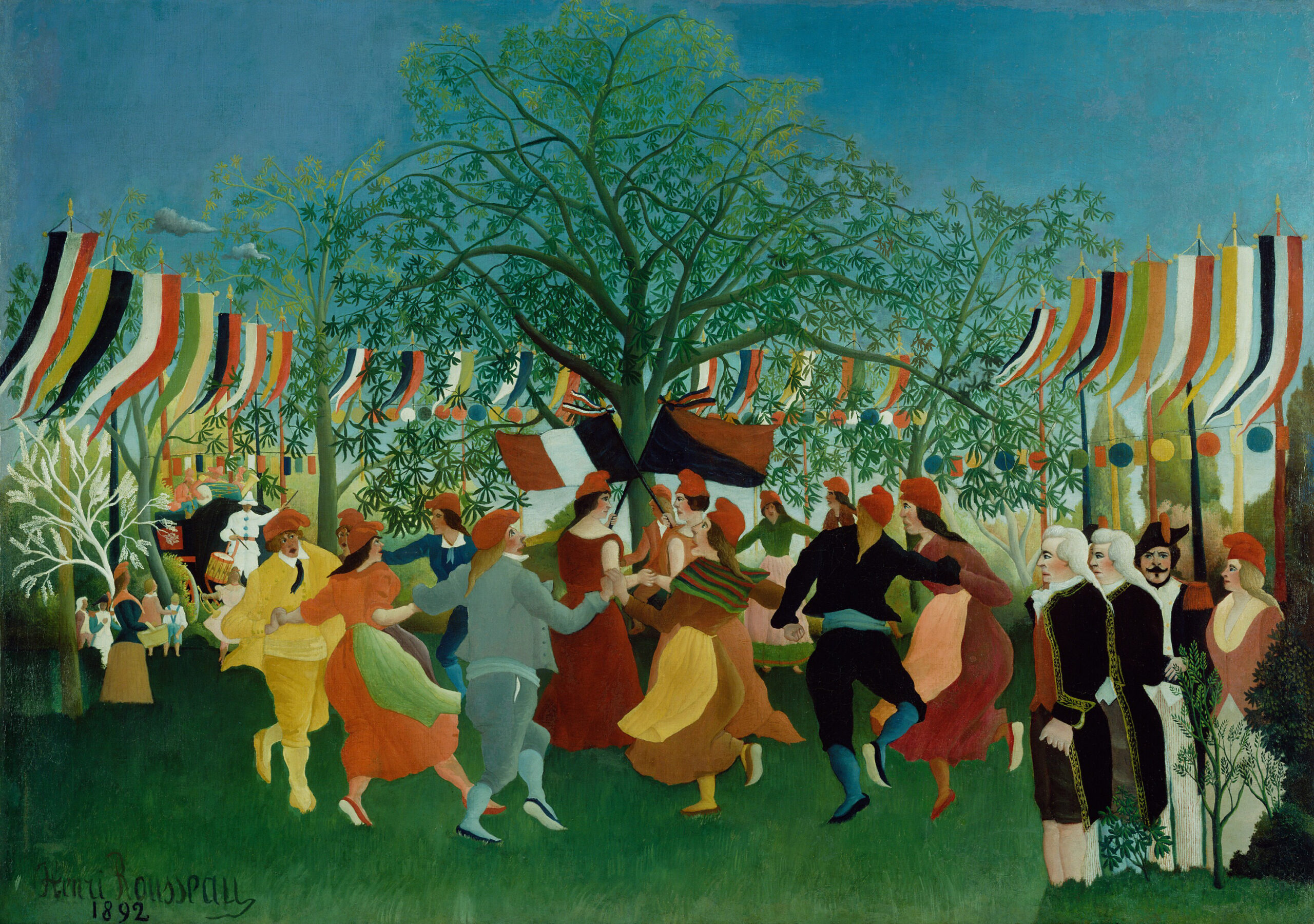
This past July 14th, I was looking for a painting connected to France’s national holiday, and I came across this work by Henri Rousseau. It commemorates the centenary of the founding of the First Republic, proclaimed in 1792. It struck me as a fitting choice for Bastille Day: a century on, the painting pays tribute to one of the defining moments of the French Revolution.
It is the Douanier Rousseau, with his unmistakable style, who captures the unguarded joy of the scene: a genuine sense of collective pride runs through the composition. The many tricolour flags rippling overhead, and the official figures lined up on the right, lend the painting a formality befitting the young Republic. More than a century after it was painted, the work still carries that symbolism. Quite a scene.
Two flags cross against the thick bark of a century-old chestnut tree. One is tricolour, the other dark and fringed. Red caps bob just beneath them. The farandole has only just begun.
The circle and its colour
Dancers link hands, skirts of yellow, red, and green whirling across the grass. Phrygian caps, scarlet, punctuate every head like a single flame repeated. The sky stays flat, an almost mineral blue, with no cloud to slow the momentum. Rousseau works in oil on canvas, the foliage rendered in dense, flat planes, closer to cut paper than to naturalistic depth. The light comes from no particular source: it settles evenly over the whole scene, without cast shadow. In the background, a cart carries costumed musicians. The ribbons tied to the liberty poles seem to catch a breeze one can almost feel, light, faintly warm.
A century after 1792
In 1892, the Third Republic marked the centenary of the First Republic’s proclamation in 1792. The country wished to present a united front, a hundred years after the Terror. Rousseau chose the farandole, a folk dance from the south of France, to embody national celebration. He drew on dancers he had seen in a magazine illustration, then added flags, liberty poles, and two allegorical female figures representing the First and Third Republics side by side. To the right, dignitaries in dark dress stand upright and still. Between the joyful circle and these fixed figures, the painting offers no resolution.
Henri Rousseau, known as “le Douanier,” was self-taught. Employed by the Paris toll office, he did not retire to devote himself fully to painting until the age of forty-nine. He began exhibiting at the Salon des Indépendants in 1886. His naïve style, mocked in his own lifetime, later won the admiration of Apollinaire and Picasso. Rousseau never set foot in a jungle, yet he painted jungles and national festivities with the same quiet conviction.
The painting is now held at the J. Paul Getty Museum in Los Angeles, where it continues to travel through the eyes of its visitors.
Currently on view: Rousseau at the Musée de l’Orangerie
Through July 20, 2026, the Musée de l’Orangerie in Paris presents “Henri Rousseau: The Ambition of Painting,” co-organized with the Barnes Foundation of Philadelphia. Following a recent change in the Foundation’s charter, the Orangerie becomes the first institution to receive loans from its collection, bringing together some fifty major works, several never before shown in France. The exhibition also draws on recent scientific analysis of the canvases, conducted jointly by the Barnes Foundation and the C2RMF, shedding new light on Rousseau’s technique. A rare opportunity to place The Centennial of Independence, now held at the J. Paul Getty Museum, within the broader context of the artist’s work and critical reception.
Source: musee-orangerie.fr
A question for you
💭 If you had to file this canvas under a single category at the Salon des Indépendants, which would you choose: popular, allegorical, or historical?
About this work
- The Centennial of Independence
- Henri Rousseau, known as “le Douanier”
- 1892
- Oil on canvas
- 111.8 × 158.1 cm (44 × 62¼ in.)
- The J. Paul Getty Museum, Los Angeles
- https://www.getty.edu/art/collection/object/103RJB