Dreams have a hold on us, and it is precisely this painting by Diziani that reminded us how ancient that fascination is. From Egyptian priests to contemporary neuroscience, every era has sought to decipher the language of the night. What never changes is the need: human beings have always refused to believe that their dreams mean nothing. At VMuseum, it is this resonance between an eighteenth-century scene and our own nights that made us want to share this work with you today.
What does Joseph, the captive stranger, see in the pharaoh’s dream, a dream that the entire assembled court cannot perceive?
A suspended scene
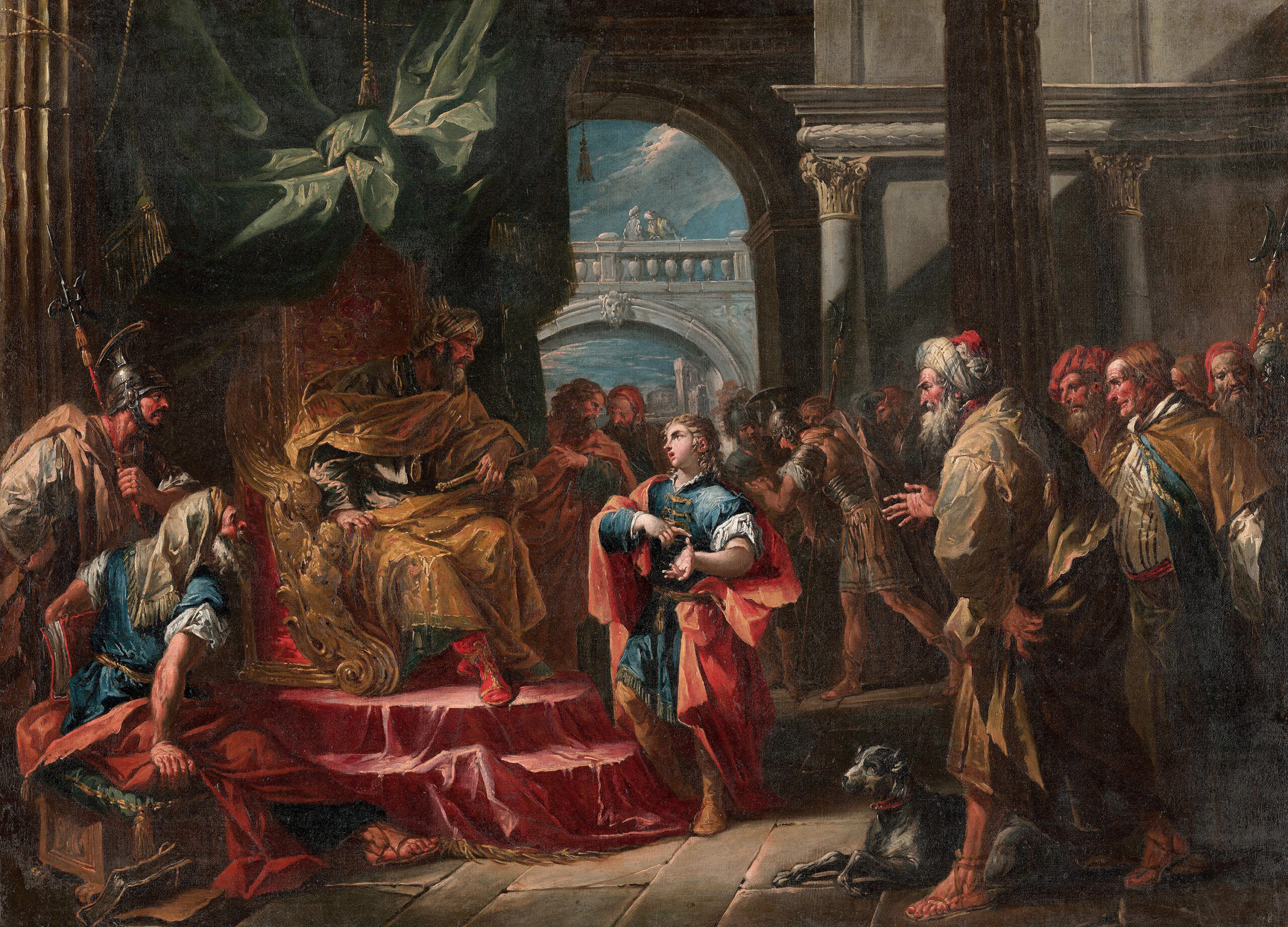
At the centre of the canvas, the young Joseph stands upright. White shirt, blue mantle, scarlet drape knotted at the waist, ochre boots. His gesture is held in suspension, fingers joined, gaze lifted toward the sovereign. The pharaoh, draped in gold, leans forward from his garnet throne carved with volutes. A deep green canopy weighs down over the scene. In this oil on canvas, Diziani orchestrates a true theatre of gazes: wizened advisors to the right, a stooping scribe to the left, a soldier in a gleaming helmet, courtiers in the background. Light falls diagonally, sculpting the faces and setting the reds of the carpet aquiver. At the back, an archway opens onto a lavender sky. A motionless dog on the threshold closes the composition.
The dream and the court
The scene comes from Genesis. Joseph, a young Hebrew imprisoned in Egypt, interprets the pharaoh’s dreams: seven fat cows devoured by seven lean ones; seven full ears of grain replaced by seven withered ones. In them he reads the promise of seven years of abundance, followed by famine. Diziani painted this around 1755, as Venice was living through the twilight of its Baroque splendour. Biblical subjects remained highly prized at Catholic European courts, which read in them lessons in governance. Diziani’s Joseph embodies the wise counsellor to the prince, a figure entirely familiar to the Age of Enlightenment. The Johannisburg Palace, formerly the residence of the Archbishop-Electors of Mainz, now belongs to the Bavarian national collections.
The artist
Gaspare Diziani (1689–1767) trained in Belluno before moving to Venice at a young age. He worked for theatres, painted stage sets, and travelled as far as Munich and Dresden. His spirited, theatrical and virtuosic compositions embody the last flowering of Venetian Rococo. He served as president of the Accademia veneziana, founded in 1750, on several occasions. His career illuminates the final chapter of Venetian painting.
In the news: Diziani rediscovered in Venice
In April 2026, the Fondazione Dries Van Noten opened its doors at the Palazzo Pisani Moretta in Venice, casting new light on Diziani’s legacy. Chiara Pisani had commissioned the painter, alongside Jacopo Guarana, to create several decorative schemes in the 1740s. These Baroque frescoes are now in dialogue with 200 contemporary works, until 4 October 2026.
Source: fondazionedriesvannoten.org/en/palazzo
A question for you
💭 Who would you turn to with the account of a troubling dream, one you cannot quite interpret yourself?
About this work
- Joseph Interpreting the Pharaoh’s Dreams
- Gaspare Diziani
- c. 1755
- Oil on canvas
- 34 × 46¾ in. (86.3 × 118.7 cm)
- Bavarian State Painting Collections, State Gallery at Johannisburg Palace, Aschaffenburg
- https://www.sammlung.pinakothek.de/de/artwork/jpxeyDvxJ7/gaspare-diziani/josef-deutet-die-traeume-des-pharao
Diziani, the Serenissima, and the Taste of European Courts
Gaspare Diziani (1689-1767) was born in Belluno in the Venetian region and trained in Venice before travelling to Munich and Dresden, where he designed theatrical sets. These scenographic experiences left a lasting mark on his pictorial language: his compositions are driven by a theatrical sense of staging and light that recalls the great display machines of late Baroque painting. Joseph Interpreting the Pharaoh’s Dreams, painted around 1755, is characteristic of this manner. The scene reads as a public ceremony as much as a biblical narrative: Joseph, at the centre, addresses a Pharaoh surrounded by an extensive court, while diagonal light sculpts the faces and separates the protagonists from the architectural backdrop. Diziani served multiple times as president of the Accademia veneziana, a mark of his recognised authority in the artistic life of the Serenissima.
A Story of Governance for a Princely Collection
The work belongs to the Bavarian State Painting Collections and is held at the Staatsgalerie in Johannisburg Palace in Aschaffenburg. The biblical subject, Joseph’s interpretation of the seven fat and seven lean cows as a sign of seven years of abundance followed by seven years of famine, was not chosen arbitrarily for a princely collection. In the 18th century, this Genesis narrative was read as a lesson in governance: it stages a man of knowledge advising a sovereign, the archetype of the enlightened minister that Enlightenment philosophers called for. Catholic European courts were particularly drawn to Old Testament subjects that clothed political reflection in sacred legitimacy.
The Twilight of Venetian Baroque
Joseph Interpreting the Pharaoh’s Dreams belongs to the last great phase of Venetian painting before the Republic’s decline. Diziani was a contemporary of Tiepolo, sharing his taste for large compositions, luminous colours, and dramatic movement, but his handling is denser, heavier, less airy. The work illustrates what Venice could still achieve in the mid-18th century: large-scale history painting, narrative and virtuosic, responding to the demands of the religious and princely patrons of a Europe still largely committed to the Counter-Reformation’s iconographic programme.