Key facts
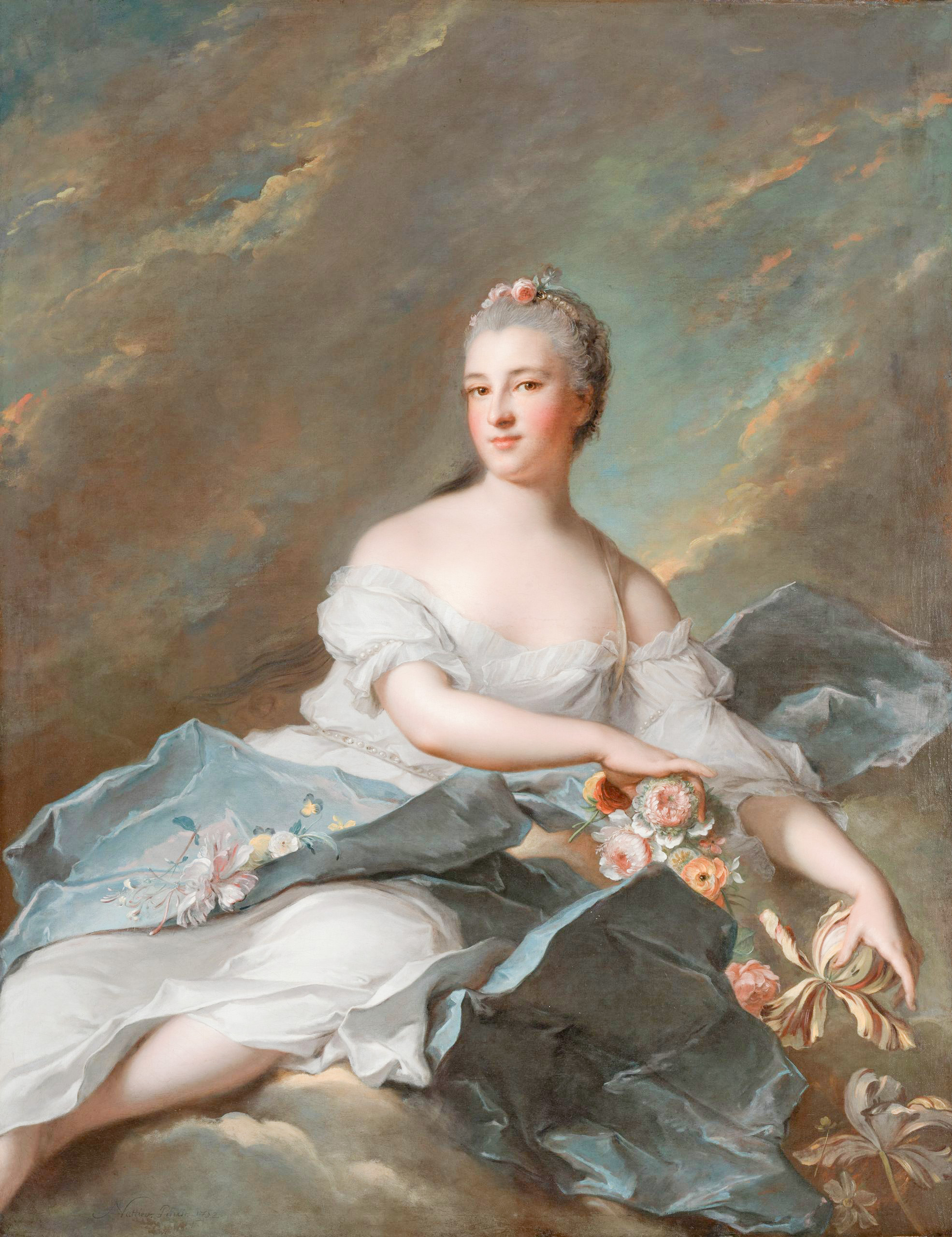
Painted in 1752 by Jean-Marc Nattier (1685–1766), Élisabeth Rigoley d’Ogny as Aurora is a mythological portrait in oil on canvas, held by the Baltimore Museum of Art in the Mary Frick Jacobs Collection. The sitter takes on the role of Aurora, goddess of the dawn, seated on a cloud and scattering flowers over the earth to herald the day. The painting belongs to French Rococo. It exemplifies the genre that made Nattier famous: portraits of high-society women in the guise of ancient deities, idealized according to the eighteenth-century canons of beauty. The painter applied this formula to the daughters of Louis XV, whom he portrayed as Diana or Hebe.
This portrait by Nattier depicts Élisabeth Rigoley d’Ogny as Aurora, goddess of the dawn. Portraying sitters as mythological figures was a classic device of the period, and I find it fascinating: the portrait does not simply show a woman, it gives her a role. Nattier was in fact one of the painters who did most to popularize this fashion. From the 1730s onward, he made it his specialty, painting the daughters of Louis XV as Diana or Hebe, for example. Nattier was also known for flattering his sitters to match the beauty standards of his day: porcelain complexion, oval face, full lips. So here we have an Élisabeth Rigoley d’Ogny at her most beautiful. What we see is probably less her real face than an eighteenth-century feminine ideal, and that is precisely what I love about this kind of portrait. Dawn is suggested by the cloud on which she sits and by the flowers the goddess scatters over the earth to announce the break of day.
You are looking at a striped tulip slipping between two fingers. It falls, petals open, toward an unseen earth. Further down, a second tulip has already dropped. Look at this suspended gesture: the whole portrait plays out right there, between the hand and the void.
What the portrait of Élisabeth Rigoley d’Ogny as Aurora tells us
Élisabeth Rigoley d’Ogny sits on a cloud. Her white gown slips from her shoulders, light as muslin. A sweeping silk drapery wraps around her, storm-gray in the shadows, pale blue in the light. This soft blue now bears the painter’s name: we call it Nattier blue. Look at the satin. Nattier lays bright highlights along the crests of the folds, then lets the hollows fall into shadow. The fabric feels cool and slippery to the touch. Against it, the skin seems warm. The cheeks are flushed, the throat glows like mother-of-pearl. Pearls run along the sleeves and through the powdered hair, studded with roses. Her right hand holds a spray of roses and orange blossoms. Behind her, the sky catches fire in streaks of pink and copper. This is the fragile hour when night gives way to day. Her bare leg extends the curve of the cloud in the foreground. Her gaze, meanwhile, ignores the flowers. It seeks out yours. The painter works in oil on a large canvas, and the light seems to come from within the clouds.
What the era tells us
In the eighteenth century, high society adored the mythological portrait. To be painted as a goddess was to step into fable without giving up one’s rank. Nattier, a leading name of the Rococo, made it his signature from the 1730s onward. The daughters of Louis XV sat for him as Diana or Hebe. As the Baltimore Museum of Art’s catalogue entry points out, the painter idealizes. Flawless skin, oval face, full lips: every sitter conforms to the same canon. And yet, look at this face. The lower cheeks keep a very real roundness that the ideal does not erase.
The theme of dawn did not come out of nowhere. An engraving by Pierre Maleuvre after Nattier is titled La Nuit passe, l’Aurore paraît (Night Passes, Dawn Appears). It shows a woman holding flowers beside a child carrying a torch. The Fitzwilliam Museum in Cambridge links this title to a portrait of the Duchesse de Châteauroux. A year after our Aurora, Nattier also painted Madame Le Fèvre de Caumartin as Hebe, seated beside an eagle. Same formula, different goddess, different attribute. In Baltimore, the child and the torch are gone. Only the flowers and the glow of the sky remain. The goddess is distilled into a single gesture. Myth becomes almost a costume, chosen the way one chooses a gown.
The artist, Jean-Marc Nattier
Jean-Marc Nattier was born in Paris in 1685. His father, Marc Nattier, was a portrait painter, and his mother, Marie Courtois, a miniaturist. As a young man, he made drawings for engravings of Rubens’s Marie de’ Medici cycle at the Luxembourg Palace. He went on to become the painter of the ladies of Louis XV’s court. His soft blues and pearly flesh tones embody French Rococo. He died in Paris in 1766.
News: Nattier and the Baltimore Museum of Art
The portrait of Élisabeth Rigoley d’Ogny as Aurora belongs to the Mary Frick Jacobs Collection, one of the founding collections of European art at the Baltimore Museum of Art. The department is at a turning point. In September 2026, the museum appointed Alexandra Letvin as its head, with the title of Senior Curator of European Painting and Sculpture. A specialist in early modern Spanish painting, she comes from the Princeton University Art Museum. She studied at Johns Hopkins University and had previously worked at the BMA. According to the job description published by the museum, her role is to rethink how European art is presented in Baltimore, through exhibitions and new installations of the collection. As for the artist, Nattier remains a presence in museum news. In 2026, the Staatliche Kunsthalle Karlsruhe put on display a new acquisition, a drawing of Madame Adélaïde as Diana (c. 1745). In Paris, the Musée Cognacq-Jay featured him among the great portraitists in the exhibition Révéler le féminin. Mode et apparences au XVIIIᵉ siècle (Revealing the Feminine: Fashion and Appearances in the Eighteenth Century), March 25 – September 20, 2026.
Source: Baltimore Museum of Art.
A question for you
If Nattier were to paint you today as a deity, which would you choose: Aurora, Diana, Hebe, or Flora?
About this work
- Élisabeth Rigoley d’Ogny as Aurora
- Jean-Marc Nattier
- 1752
- Oil on canvas
- 135.3 x 105.4 cm (53 1/4 x 41 1/2 in.)
- Baltimore Museum of Art, Baltimore
- https://artbma.org/artwork/elisabeth-rigoley-dogny-as-night/