Here at VMuseum, we chose this painting for its joyful immediacy, and because the current Parisian exhibitions cast a fresh light on this Renoir from his happiest years.
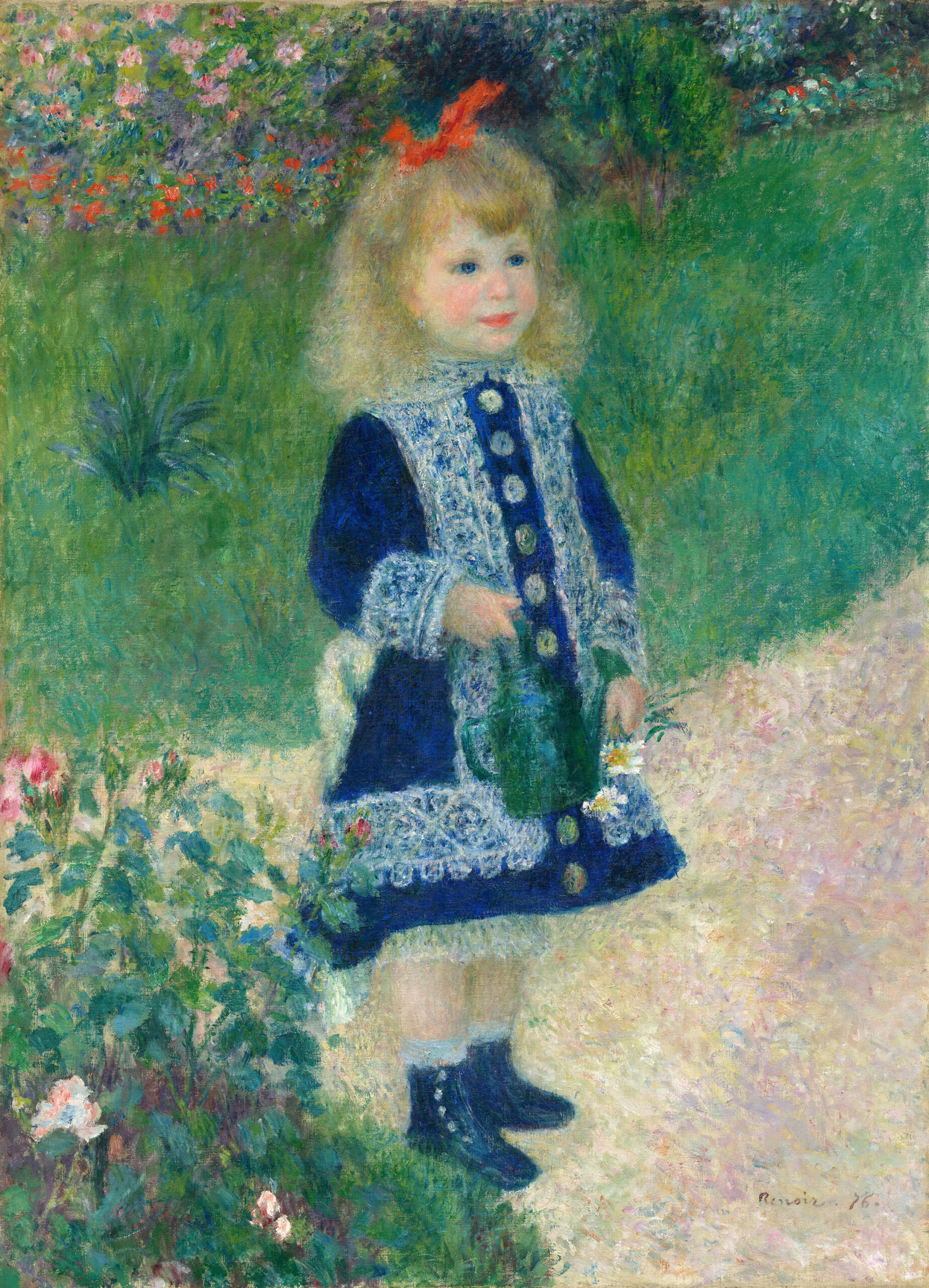
You are standing before a fair-haired little girl, planted in the middle of a garden path. She holds a green watering can and a bunch of daisies, and she looks you straight in the eye. The summer of 1876 pauses for a moment.
What the canvas tells you
Look at this midnight-blue dress, trimmed with lace and golden buttons lined up like musical notes. Renoir applies short, vibrant, almost stippled brushstrokes to the round face and rosy cheeks. The Impressionist palette bursts here in all its prismatic freshness: tender greens of the lawn, powdery pinks of the path, the vivid red ribbon in her hair. The technique is more controlled than in his landscapes, more refined in its handling of the figure. No hard line outlines the child. Light envelops her, softens her contours, dissolves the boundary between body and garden. This is innocence painted in full light.
What the period tells you
We are at the height of Impressionist ferment. Renoir (1841–1919) has just taken part in the group’s first exhibition in 1874. That same year of 1876, he painted Ball at the Moulin de la Galette, a manifesto of modern happiness. The little girl has not been identified with certainty, most likely a neighbourhood child, charming in her features, who reappears in several canvases. Renoir was then inventing an iconography of everyday life, feminine and childhood-centred, running counter to history painting.
The artist, son of a tailor from Limoges, first painted porcelain. That craftsman’s hand remains perceptible in the delicacy of the lace and the velvety softness of the flesh.
Current exhibitions
The Musée d’Orsay is dedicating two complementary exhibitions to Renoir until July 2026.
Renoir and Love, The Joyful Modernity (1865–1885) brings together fifty masterworks including Luncheon of the Boating Party.
🔗 https://www.musee-orsay.fr/fr/programme/agenda/expositions/renoir-et-lamour
Renoir the Draughtsman unveils watercolours, pastels and red chalk drawings. Two essential perspectives for rediscovering the painter of happiness.
🔗 https://www.musee-orsay.fr/fr/programme/agenda/expositions/renoir-dessinateur
A question for you
💭 How does Renoir manage to dissolve the boundary between figure and landscape, where his academic contemporaries would have drawn it with care?
About this work
- A Girl with a Watering Can
- Auguste Renoir
- 1876
- Oil on canvas
- 39⅜ × 28¾ in. (100 × 73 cm)
- National Gallery of Art, Washington
- https://www.nga.gov/artworks/46681-girl-watering-can