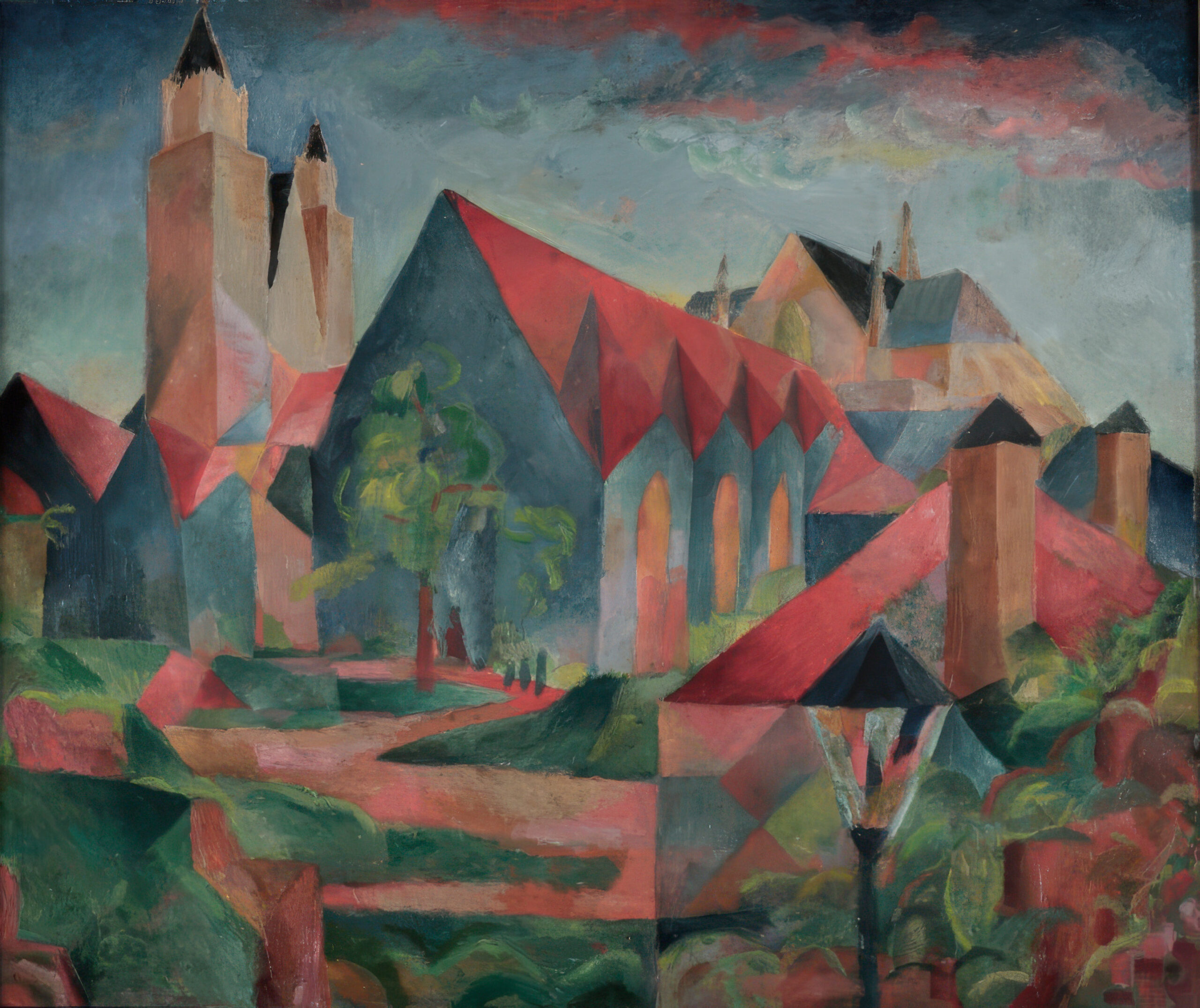
What first draws me into this canvas is its dominant reddish-pink glow, almost incandescent. Not knowing this building, I went looking for its history and a few photographs. I discovered it to be the first Gothic cathedral built on German soil, standing in Magdeburg, capital of Saxony-Anhalt, east of Berlin. What colours to depict a monument of stone!
The composition, built from juxtaposed forms, remains profoundly expressive nonetheless: beneath the cathedral a landscape unfolds, while a lamppost springs up from the bottom edge of the canvas, an anchor in the real confronting the building’s dreamlike vision. I must confess I did not know Seehaus before coming across this work in the collections of the Neue Nationalgalerie in Berlin, a discovery that leaves one wanting to learn more about this painter who died so young.
What you see first
A black lamppost springs up from the bottom of the canvas. Its wrought iron cuts across the flat reds and greens of the foreground. Then the eye climbs: Magdeburg Cathedral rises, ablaze with pink and blue-grey, beneath a sky streaked with carmine clouds. Nothing here resembles the grey stone of the actual monument.
What the surface conceals
Seehaus works in oil on wood, a modest format of 45 x 54 cm. The grey stone becomes a crystalline network of luminous facets. The composition recalls the Orphism of Robert Delaunay: colour and structure fuse into one. Higher up, the architecture still aims for a spatial reading, towers and spires overlapping in an almost geometric logic. In the foreground, fields of colour fragment, refracted as if through a prism, with no fixed perspective. Ludwig Justi, director of the Nationalgalerie, acquired the painting as early as 1920. In 1937, the Nazi regime confiscated it as “degenerate art”, a work condemned for its very freedom of colour.
The artist and his era
Born in Bonn, Paul Adolf Seehaus was the sole pupil of August Macke between 1911 and 1914. In 1913, he exhibited in Bonn alongside Campendonk, Max Ernst, and Nauen, gathered under the banner of Rhenish Expressionism. That same year, under the pseudonym Barnett, his work appeared at the First German Autumn Salon, at Galerie Der Sturm in Berlin. Seehaus died in 1919, at just 27. This 1918 cathedral belongs to his final creative period, the freest of his short career.
Current news
The Neue Nationalgalerie in Berlin, home to this painting, is enjoying record attendance: over 600,000 visitors in 2025. Until 9 August 2026, it hosts a Constantin Brancusi retrospective with the Centre Pompidou, already drawing more than 100,000 visitors.
More information: Neue Nationalgalerie – Brancusi.
A question for you
💭 This “Cathedral,” confiscated in 1937 as “degenerate art”, was it judged dangerous for its colour, or for its freedom of form?
About this work
- Magdeburg Cathedral
- Paul Adolf Seehaus
- 1918
- Oil on wood
- 45 x 54 cm
- Neue Nationalgalerie, Berlin
- https://recherche.smb.museum/detail/962289/der-dom-zu-magdeburg