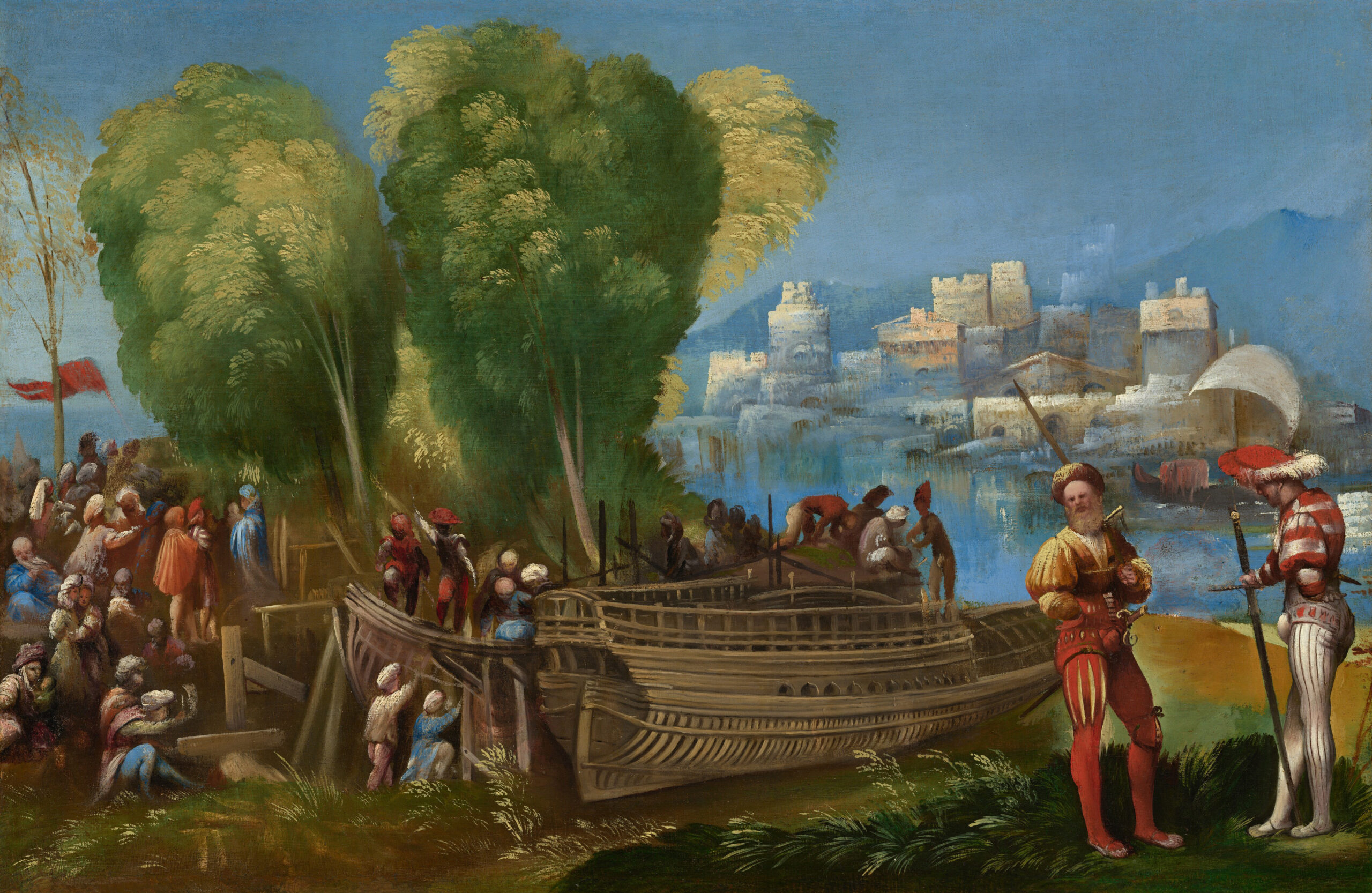
Ferrara, c. 1520. Dosso Dossi depicts Aeneas and his Trojan companions at work on the shore. The ships, shattered by the storm, are taking shape again. The odyssey continues.
A scene seized in urgency
In the foreground, the hull of a ship under repair. Dozens of figures bustle around it. Some carry beams, others hammer, others still stand and watch. On the right, two figures in Renaissance costume stand out sharply: a deliberate anachronism. Behind them, a fortified city bathes in a golden, vaporous light. The blue sky, the deep greens of the trees, the vivid reds of the costumes: the palette is Venetian, luminous.
A fragment of the Aeneid for a prince
This work belongs to a cycle of ten paintings commissioned by Alfonso d’Este for his camerino — his private study — in the castle of Ferrara. The subject is drawn from Book I of Virgil’s Aeneid: after a shipwreck, Aeneas and his faithful Achates make landfall before pressing on toward Italy, where Rome will one day be born. Two other scenes from the cycle have been traced to collections in England and Canada. Together, they formed an ambitious narrative frieze combining humanist culture with dynastic prestige — a commission worthy of the most influential patrons of the Italian Renaissance.
Dosso Dossi, court painter
Dosso Dossi (c. 1486–1542) was the official painter of the Este court in Ferrara. Deeply shaped by Titian and Giorgione, he developed a personal style that blended poetic landscape with mythological narrative. In this canvas, his mastery of color and his ability to dissolve figures into luminous landscape are fully at work.
A question for you
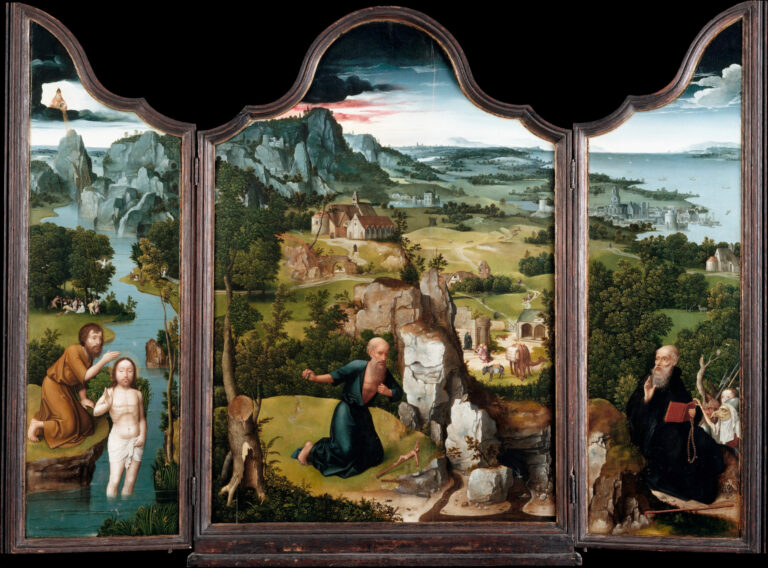
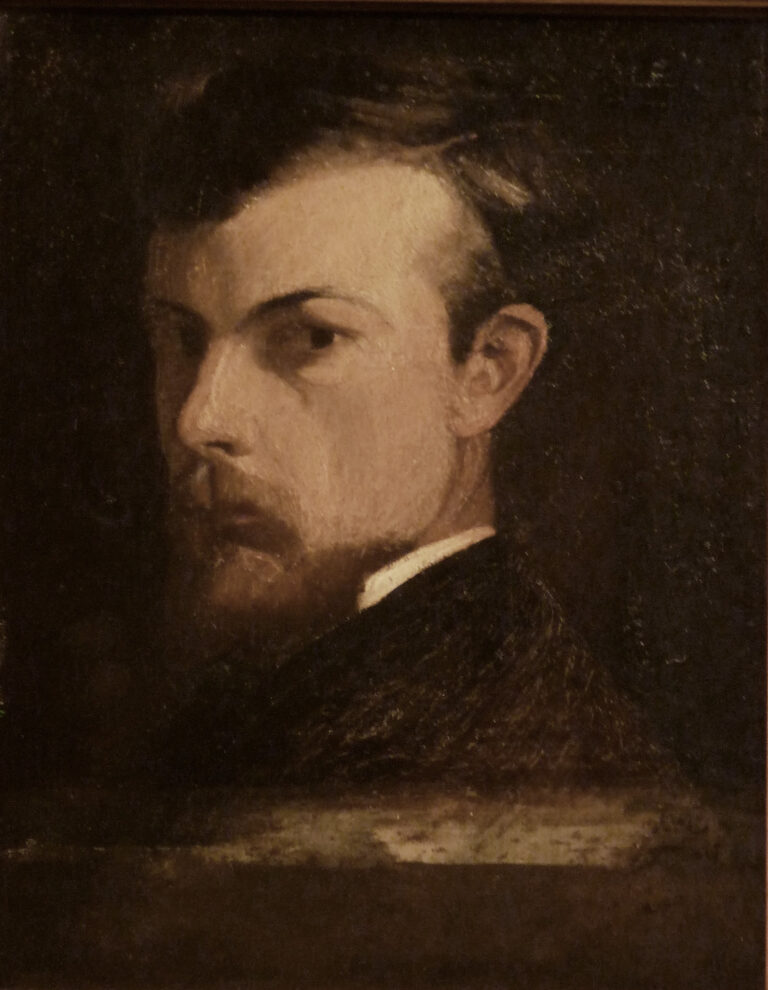
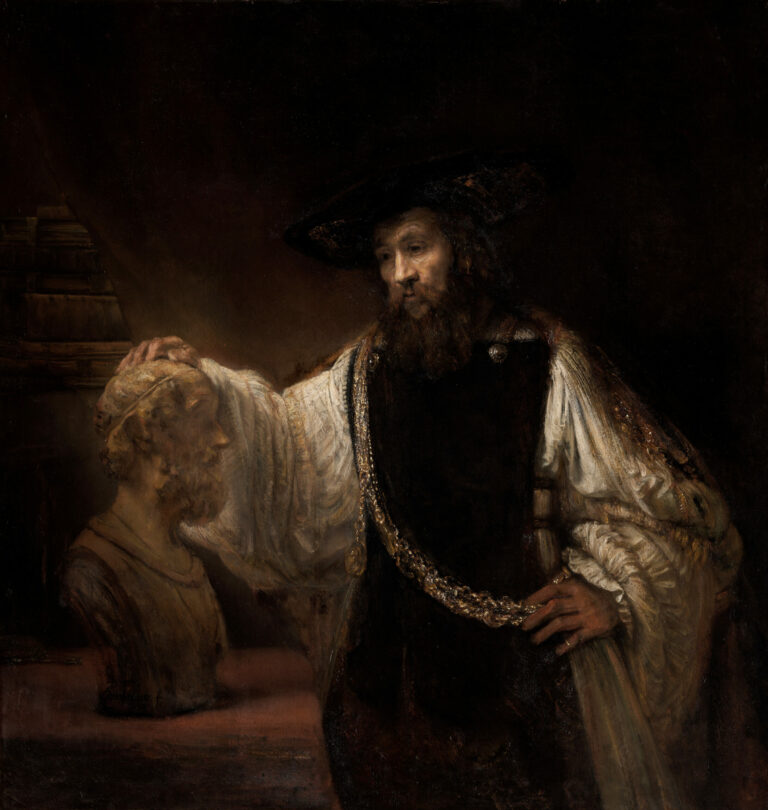
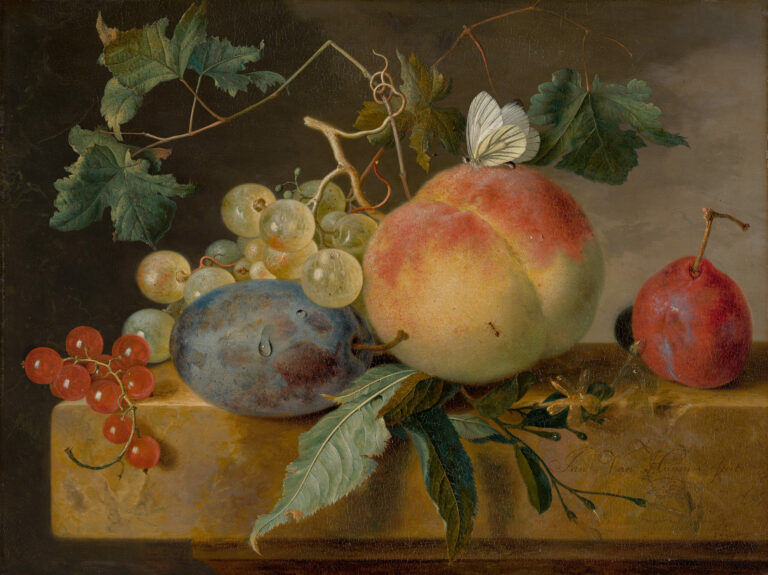
💭 Titian, Giorgione, Dosso Dossi — all three dissolve their figures into luminous, poetic landscapes. Is it the landscape that serves the narrative, or does the narrative become a pretext for the landscape?
About this work
- The Trojans Repairing Their Ships in Sicily
- Dosso Dossi
- c. 1520
- Oil on canvas
- 58.7 × 87.6 cm
- National Gallery of Art, Washington
- https://www.nga.gov/artworks/391-trojans-repairing-their-ships-sicily
The “Camerino d’Alabastro” of Alfonso I d’Este
This work belongs to one of the most ambitious decorative programmes of the Italian Renaissance: the “Storie di Enea” (Stories of Aeneas) commissioned by Alfonso I d’Este for his private study, the “camerino d’alabastro” of the castle of Ferrara. This cabinet, conceived as a space of meditation and prestige for the duke, was intended to bring together a series of panels illustrating episodes from Virgil’s Aeneid. Dosso Dossi, the official court painter to the Este family, was responsible for executing the narrative scenes of this cycle. The episode depicted here, in which the Trojans repair their ships in Sicily after a storm, corresponds to a passage from Book I of the Aeneid.
A Cycle Dispersed Across World Collections
The panels of the “Storie di Enea” have been scattered over the centuries. The National Gallery of Art in Washington, which holds this painting as part of the Kress Collection, acquired a second panel from the same cycle in 2021 (number 2021.6.1), allowing two long-separated works to be reunited. Other panels from this series are held at the Galleria Borghese in Rome, where an exhibition devoted to “The Aeneas Frieze by Dosso Dossi” was presented in 2023. This dispersion illustrates the vicissitudes of the great Italian princely collections of the Renaissance.
Dosso Dossi and the Venetian Tradition
Dosso Dossi (c. 1486-1542) developed a personal style deeply shaped by the influence of Titian and Giorgione, whom he encountered during stays in northern Italy. From Giorgione he took the manner of dissolving figures into luminous, atmosphere-laden landscapes; from Titian he absorbed mastery of colour and compositional energy. This dual Venetian inheritance gave his works a poetic and chromatic quality that sets them clearly apart from contemporary Florentine or Roman production.