Key facts
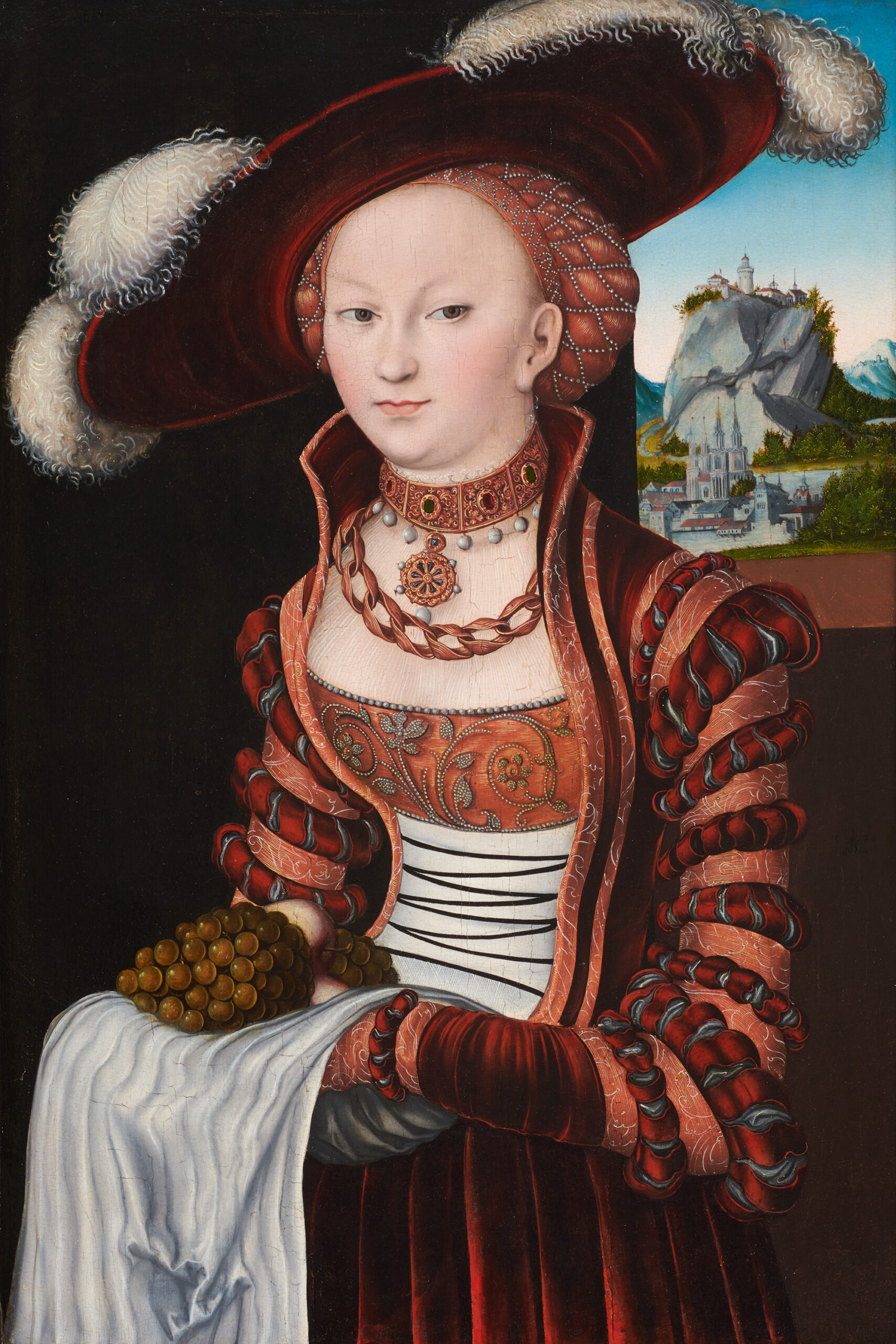
Painted in 1528 by Lucas Cranach the Elder, Portrait of a Young Woman Holding Grapes and Apples belongs to the German Renaissance. Court painter to the Electors of Saxony in Wittenberg since around 1505, Cranach depicts an anonymous young woman dressed in the fashion of the German courts: an ostrich-feather hat, a pearl-studded hairnet, a jewelled choker and a gold chain. She holds a bunch of grapes and an apple in a white cloth that conceals her hands, a presentation the Cranach Digital Archive considers unusual for the artist. The painting, now transferred to canvas, entered the Clark Art Institute in Williamstown as part of the Aso O. Tavitian Foundation gift.
I personally find Lucas Cranach the Elder one of the most fascinating painters of the sixteenth century. Fascinating for the quality of his work, for the grace of the figures he portrays, and for the detail and precision of his painting. Here, we are facing a young woman holding grapes and apples in her hands, resting on a white cloth. What strikes me first is the contrast between her face, calm and a little distant as is often the case with Cranach, and the very tangible presence of the fruit, almost within reach. I can’t help looking for a meaning: at the time, the apple evoked Eve and original sin, the grapes recalled the wine of the Eucharist, and fruit could also symbolise fertility, which sometimes suggests a betrothal or wedding portrait. A window in the upper right corner reveals a landscape with a mountain and a village, a detail I love because it opens the painting to the outside world and gives depth to an otherwise very tight composition. The precision of the work also tells us about the clothing of the period, and that is probably what interests me most: in the fabrics and ornaments, we can almost read the fashion of the German Renaissance courts. Finally, knowing that this portrait, painted on wood in 1528, was transferred to canvas, I appreciate the care it took for it to reach us with its finesse intact.
A pearl. Then dozens more, sewn onto the net that holds her hair. Your eyes drift to the ostrich feathers, so tightly curled you can almost feel them quiver. The red velvet of the hat drinks in the light. Her face sends it back, smooth and pale as porcelain.
The cloth, the pearls, the canvas
Look at the hands. You search for them. A white cloth, broken into long silvery folds, carries the golden grapes and the apple. The hands vanish beneath it. The Cranach Digital Archive considers this presentation unusual for the painter. All around, everything glitters. A choker set with red and green stones grips her throat. A string of pearls holds a rosette pendant. A twisted gold chain falls across the embroidered bodice. The sleeves swell into rolls of velvet. Come closer still. A fine web of cracks runs across the skin. Painted on panel, the picture was later transferred to canvas. The technique spread in Paris in the mid-eighteenth century. Restorers thinned the wood down to the paint layer, then laid it onto a new canvas. The process was risky, often destructive. Yet here, the velvet keeps all its depth.
Lucas Cranach the Elder, Wittenberg, 1528
Lucas Cranach the Elder is born in 1472 in Kronach, Franconia. Around 1505, Frederick the Wise, Elector of Saxony, summons him to Wittenberg as court painter. He serves three successive Electors, at the heart of the emerging Reformation. In the mid-1520s, his workshop expands and his output accelerates. This portrait dates from that period of full maturity. It records the fashion of the German Renaissance courts with a goldsmith’s precision. Every pearl is in its place. The young woman’s name, however, escapes us. The Clark Art Institute’s record for the work does not identify her either.
News: the Tavitian Collection at the Clark
This portrait is part of an exceptional ensemble given to the Clark Art Institute: 331 works and more than $45 million bequeathed by the foundation of Aso O. Tavitian, a philanthropist and former trustee of the museum who died in 2020. Visitors can discover a first selection in the exhibition An Exquisite Eye: Introducing the Aso O. Tavitian Collection, on view from 13 June 2026 to 21 February 2027 and bringing together some 150 works, including pieces by Jan van Eyck, Jean-Antoine Houdon and Élisabeth Vigée Le Brun. In the longer term, the collection will have a home of its own: in July 2026 the museum unveiled plans for the new Aso O. Tavitian Wing, designed by Selldorf Architects, with construction starting in January 2027 and an opening planned for 2028. It will house twelve galleries on a single level, devoted entirely to the Tavitian Collection. On the research side, Cranach remains intensely studied: a symposium on the graphic work of Cranach and his sons was held in Cologne on 16–17 October 2026, and Berlin’s Kulturforum is preparing the exhibition Cranach – Menschen – Bilder, scheduled from 31 October 2027 to 30 January 2028.
Sources: Clark Art Institute and The Art Newspaper.
A question for you
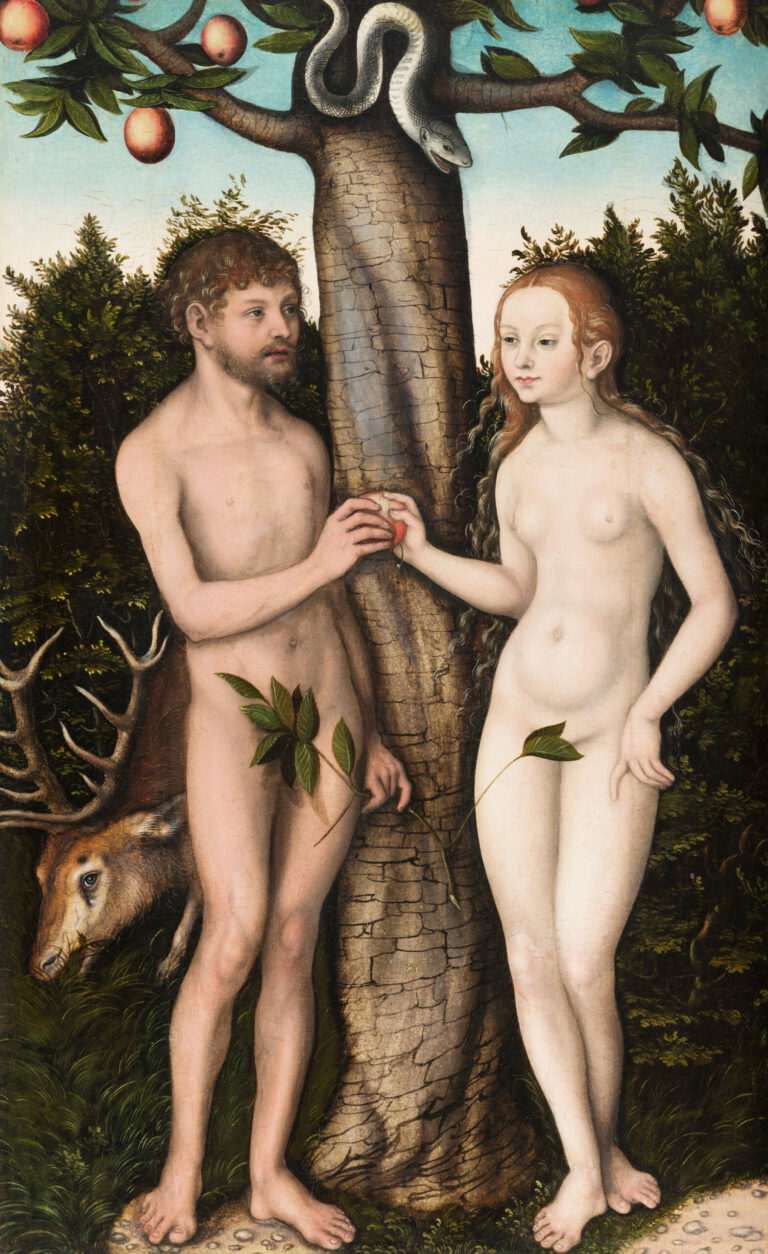
Cranach was also painting Venuses and Eves around the same time: do you see something of their features in this face?
About this work
- Portrait of a Young Woman Holding Grapes and Apples
- Lucas Cranach the Elder
- 1528
- Oil on panel, transferred to canvas
- 81.6 × 54.9 cm
- Clark Art Institute, Williamstown (Massachusetts)
- Gift of the Aso O. Tavitian Foundation, 2025.1.9
- https://www.clarkart.edu/ArtPiece/Detail/Portrait-of-a-Young-Woman-Holding-Grapes-and-Apple