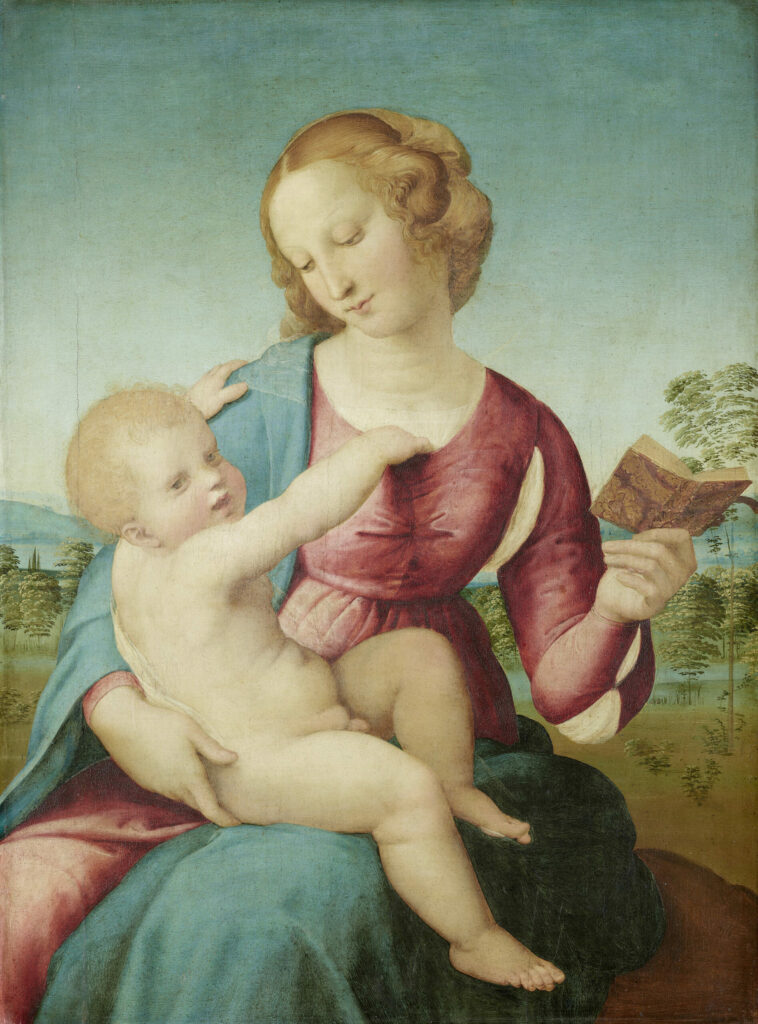
Florence, 1507. Raphael concludes his Tuscan sojourn with a Virgin of new grace. The Madonna Colonna marks a turning point: light triumphs, forms soften, tenderness prevails. This oil on poplar panel, now preserved in Berlin, captures the moment when the Christ Child turns his face toward us.
A Palette of Clarity
Observe this exceptional luminosity. Mary’s light blond hair replaces the dark browns of previous madonnas. The carmine red and azure blue draperies undulate with suppleness. The modeling becomes refined, the chiaroscuro discreet. The Child’s pearlescent skin breathes a voluptuous softness. Raphael builds his volumes through delicate touches, favoring subtlety. Christ, in an apparently spontaneous gesture, seeks our gaze with benevolence. Behind them, an airy landscape extends: the horizon lowers, the trees become vaporous, almost evanescent.
The Evolution of a Master
This work testifies to Raphael’s Florentine maturation. Compared to his Madonna Terranuova painted a few years earlier, it reveals a liberated artist. The movements gain in naturalness and elegance. The classic pyramidal composition softens. The master from Urbino integrates Leonardo da Vinci’s lessons while developing his own language. This Florentine period (1504-1508) prepares him for the great Roman commissions that await him.
Raphael
Raphael (1483-1520) embodies the perfection of Renaissance classicism. Trained in Umbria, he conquers Florence, then Rome. His genius: merging grace and balance, impeccable technique and accessible emotion. His madonnas remain unequaled.
Think about it
💭 Can grace be a universal language that transcends centuries and beliefs?
About This Work
- Virgin and Child – Madonna Colonna
- Raphael
- circa 1507-1508
- Oil on poplar panel
- 79 × 58.2 cm
- Staatliche Museen zu Berlin, Gemäldegalerie
- https://recherche.smb.museum/detail/871327/maria-mit-dem-kind—madonna-colonna