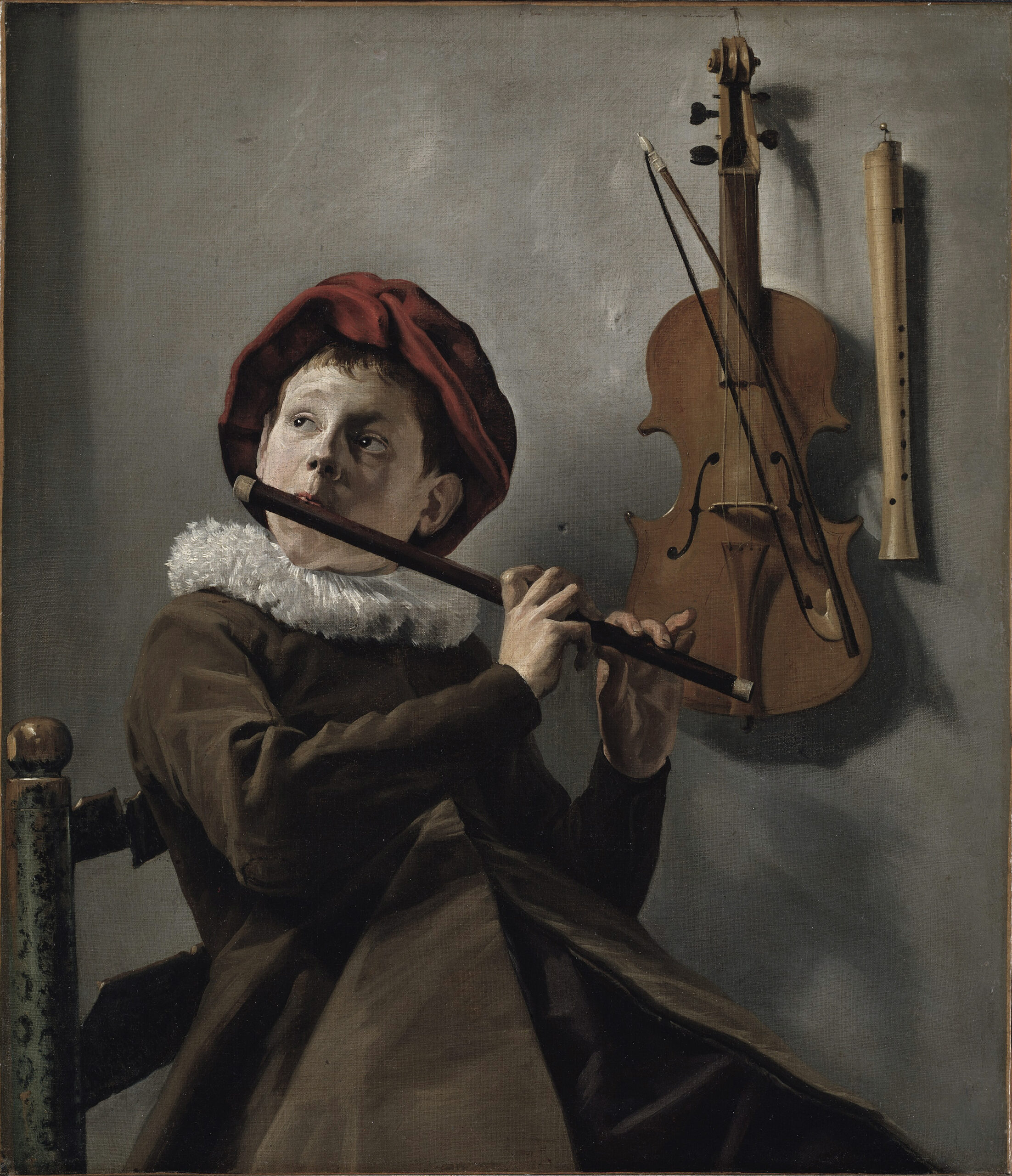
Haarlem, early 1630s. A boy surrenders himself to music. Cheeks puffed, eyes lifted toward some invisible elsewhere, he plays. The world around him falls away.
The vibration of a moment
Look at this concentrated face beneath the scarlet red beret. Light strikes the cheeks, models the hands, brings the skin to life. Judith Leyster works in loose, almost nervous brushstrokes. The dark wood of the flute contrasts with the white ruff. Behind the boy, a violin and a recorder hang on the wall — silent instruments. Notice the chair: its back is broken. This instability is no incidental detail. It reinforces the fleeting quality of the entire scene.
Music between pleasure and vanity
In 17th-century Dutch painting, music carries a double meaning. It embodies the joy of life so dear to the prosperous Dutch Republic. But it also evokes lust and vanity: sound vanishes the moment it is born. This painting most likely belongs to the allegorical tradition of the five senses, here representing hearing. Dutch society of the period delights in these symbolic games concealed within apparently innocent genre scenes. The striking realism masks a subtle moral message.
Judith Leyster, an exceptional painter
Judith Leyster (1609–1660) was admitted to the Guild of Saint Luke in Haarlem in 1633 — a remarkably rare achievement for a woman. Her dynamic style, shaped by the influence of Frans Hals, combines spontaneity with technical precision. This Boy Playing a Flute perfectly demonstrates her command of chiaroscuro and her keen sense of life caught in the moment.
A question for you
💭 Genre scene or allegory of the five senses? Dutch painting loves these double readings. Look again: what do you see first — the child, or the symbol?
About this work
- Boy Playing the Flute
- Judith Leyster
- early 1630s
- Oil on canvas
- 73 × 62 cm
- Nationalmuseum, Stockholm
- https://collection.nationalmuseum.se/en/collection/item/18123/