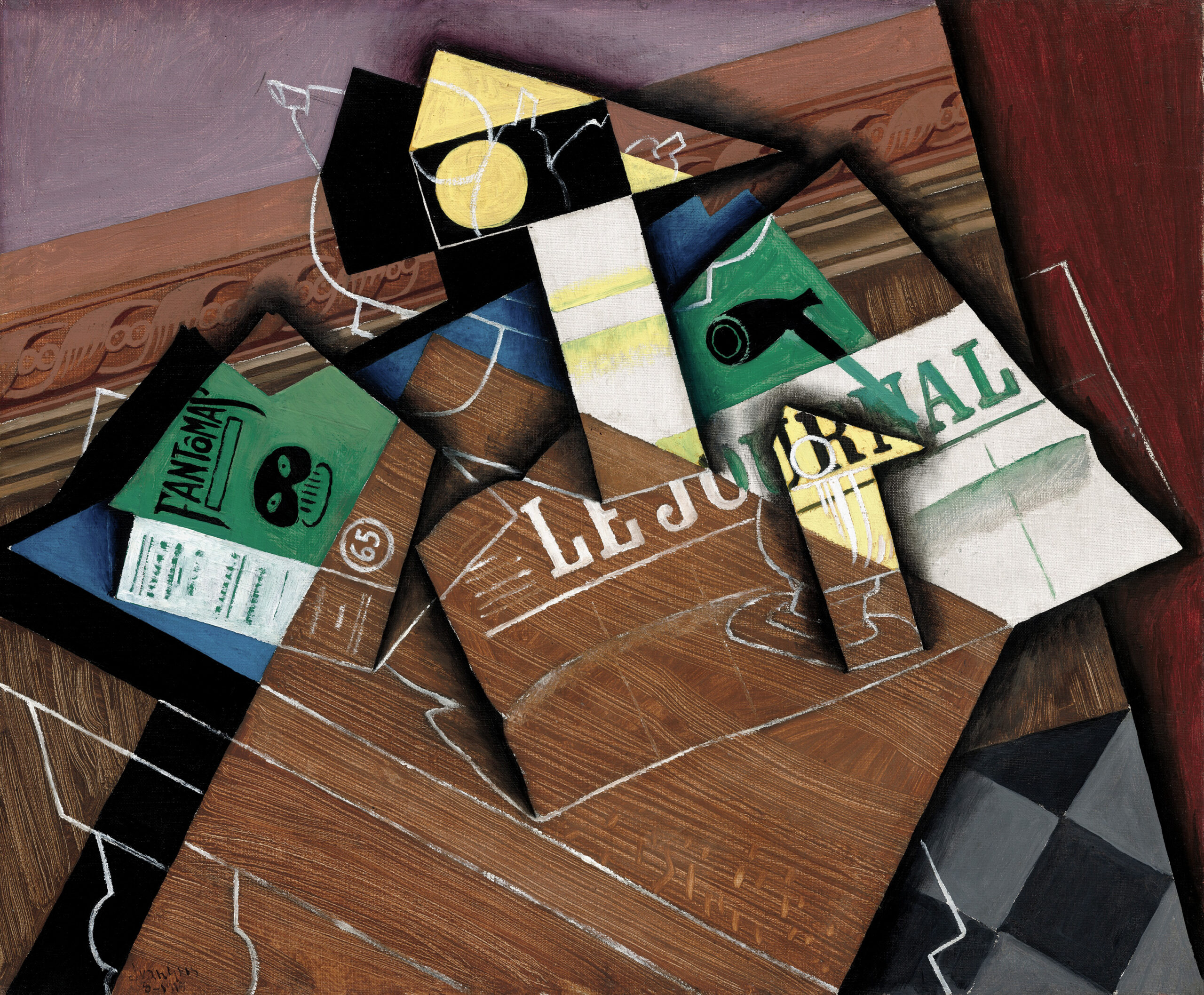
Paris, August 1915. War is tearing Europe apart. Juan Gris, a Spanish exile in Montmartre, does not paint violence. He sets a newspaper, a pipe and a theatre programme on a table. He transforms the everyday into a visual enigma.
A table as chessboard
Look: everything tilts. The table, seen from above, leans towards you, its brown planes streaked like real oak. A newspaper, LE JOURNAL, occupies the centre, its white lettering shifting to green depending on the background behind it. To the left, a green programme displays FANTÔMAS in black letters, topped by a mask with empty eyes. A circle bears the number 65. A glass and a fruit bowl emerge in white outlines, ghostly, layered over the wood. In the lower right corner, a black-and-white chessboard pattern surfaces beneath the papers.
Fantômas in Cubism
In 1915, Fantômas was a popular phenomenon. This masked criminal, the hero of a series of pulp novels by Souvestre and Allain, captivated the avant-garde, Apollinaire, Picasso and Max Jacob all revered him. Juan Gris slips his name into an analytical Cubist still life: an ironic and knowing gesture. The work belongs to a pivotal aesthetic moment: rather than fragmenting reality, Gris reconstructs it through coloured planes, simulated collage and typography. The result? An image that simultaneously reveals and conceals, just like Fantômas himself.
Juan Gris, the architect of Cubism
Born in Madrid in 1887, José Victoriano González arrived in Paris in 1906 and became Juan Gris. A neighbour of Picasso at the Bateau-Lavoir, he developed a more rigorous, more colourful, almost musical brand of Cubism. Fantômas perfectly illustrates his method: constructing a new reality from fragments of the real world.
A question for you
💭 Picasso fragmented reality, Braque decomposed it. Look at this painting, in what way is Juan Gris playing a different game?
About this work
- Fantômas
- Juan Gris
- 1915
- Oil on canvas
- 59.8 × 73.3 cm
- National Gallery of Art, Washington
- https://www.nga.gov/artworks/56101-fantomas
Fantômas: Crime on the Cover
Fantômas (1915) by Juan Gris depicts not a painting but an object: the cover of a popular novel. Fantômas is the masked criminal protagonist of a serial fiction series created by Marcel Allain and Pierre Souvestre from 1911 onward, published by Éditions Fayard with instantly recognizable illustrated covers, a black silhouette dominating Paris, dagger in hand. These covers circulated widely at Parisian newsstands and entered Gris’s studio as raw visual material, alongside the musical scores, tobacco packets, and newspapers that Cubism systematically incorporated into its compositions. The choice of Fantômas was not incidental: the character fascinated avant-garde circles, Apollinaire, Blaise Cendrars, and Max Jacob were among his enthusiastic readers. Popular crime fiction thus became a shared cultural reference between the street and the studio.
Synthetic Cubism: Reconstructing Rather than Fragmenting
Fantômas exemplifies the phase known as Synthetic Cubism, which Gris developed from 1913 onward, distinguishing his approach from the analytical Cubism of Picasso and Braque. Where analytical Cubism decomposes an object into multiple simultaneous facets, Gris begins from geometric coloured planes that he assembles to reconstruct a recognizable form. The novel’s cover remains identifiable, the title, the silhouette, the primary colours are all legible, but each element is governed by its own plastic logic, independent of illusionistic representation. The canvas (59.8 × 73.3 cm), signed lower left “Juan Gris / 8-1915” and held at the National Gallery of Art in Washington, was featured in the Gris retrospective organized by that museum in 1983, and again exhibited in Dallas in 2021.
Gris Among the Cubists: A Singular Voice
José Victoriano González-Pérez, known as Juan Gris (1887-1927), arrived in Paris in 1906 and settled at the Bateau-Lavoir, sharing the building with Picasso. Self-taught as a painter, he began with press illustration before committing to canvas from 1911 onward. His relationship to Cubism was that of a theorist as much as a practitioner: he articulated its principles in lectures and texts, arguing for a painting that moves from the abstract toward the concrete, “I begin with a cylinder to make a bottle,” he summarized. This conceptual rigour gives his work a formal consistency that his contemporaries recognized and that secures his central place in the history of Cubism.