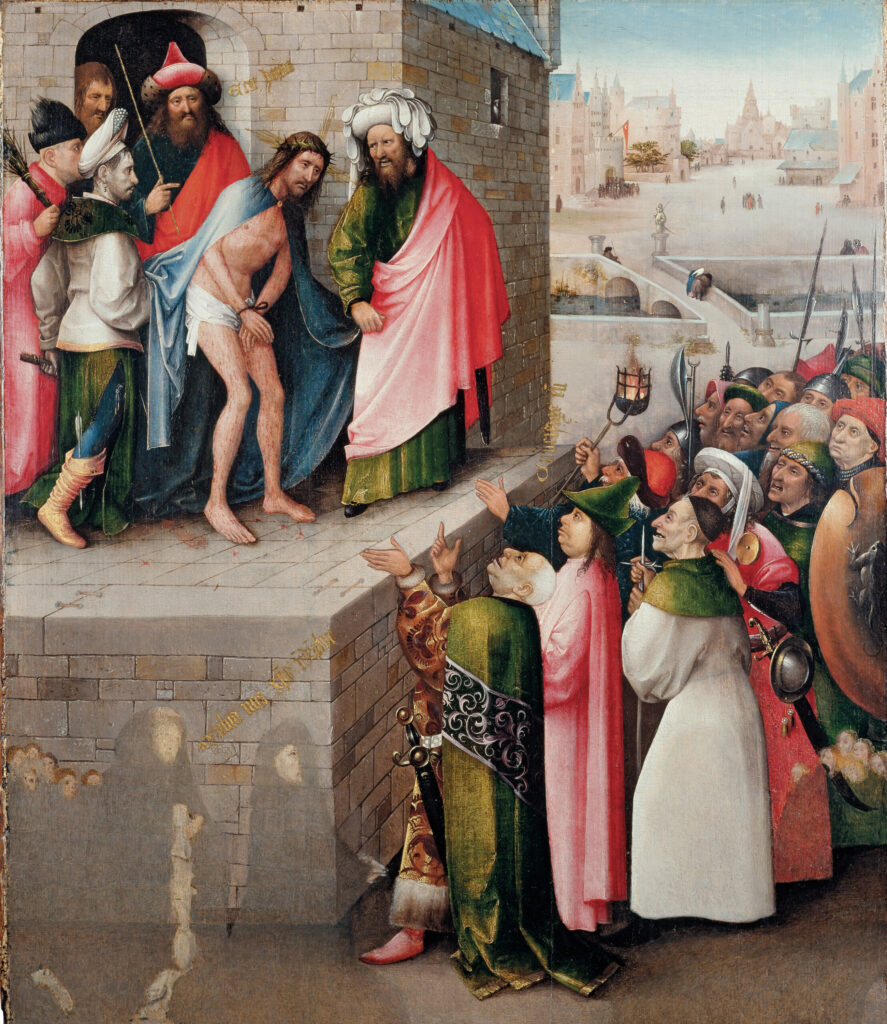
‘s-Hertogenbosch, c. 1490. Hieronymus Bosch paints a crowd scene where violence mingles with devotion. A half-naked man confronts hatred. The painter transforms a biblical episode into a mirror of humanity.
The Crowd and the Condemned
On a stone balcony, Christ appears, crowned with thorns, clad in a simple white loincloth and a blue mantle. Pilate, draped in pink and green, presents him to the people. His white turban contrasts with the fragility of the condemned man. To the left, tormentors sneer. Below, the crowd roars. Bosch paints each face with merciless precision. Mouths twist. Eyes widen. Hands thrust upward, menacing. The saturated colours vibrate with tension. To the right, a Flemish town stretches peacefully beneath a blue sky.
Secrets Beneath the Paint
This work conceals layers of hidden history. A donor family was once depicted in the lower corners of the panel. Painted over at some point in the distant past, they were only rediscovered in 1983 through X-ray examination. The size of the figures reflected their social standing: a father, smaller children, a tonsured son — a monk. A Latin inscription pleaded: “Redeem us, Christ, Saviour.” Christ himself had been re-clothed in a long robe by a prudish overpainting. The restoration carried out at the Städel Museum has reinstated the original loincloth.
Hieronymus Bosch
Hieronymus Bosch (c. 1450–1516), master of the Duchy of Brabant, is one of the most singular painters of the Northern Renaissance. His fantastical visions and social critique permeate every panel. Here, his razor-sharp gaze upon human cruelty reaches a rare intensity.
Think about it
💭 Look at these grimacing faces: what do they tell us about our own relationship to collective violence?
About this work
- Ecce Homo
- Hieronymus Bosch
- c. 1490
- Mixed media on oak
- 71.1 × 60.5 cm
- Städel Museum, Frankfurt am Main
- https://sammlung.staedelmuseum.de/en/work/ecce-homo