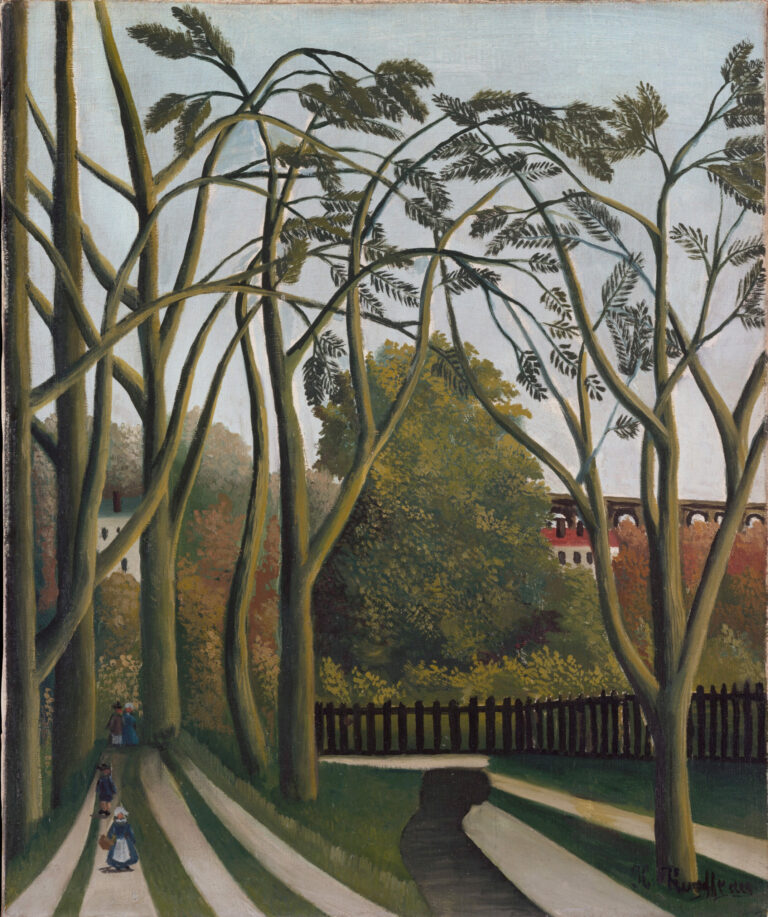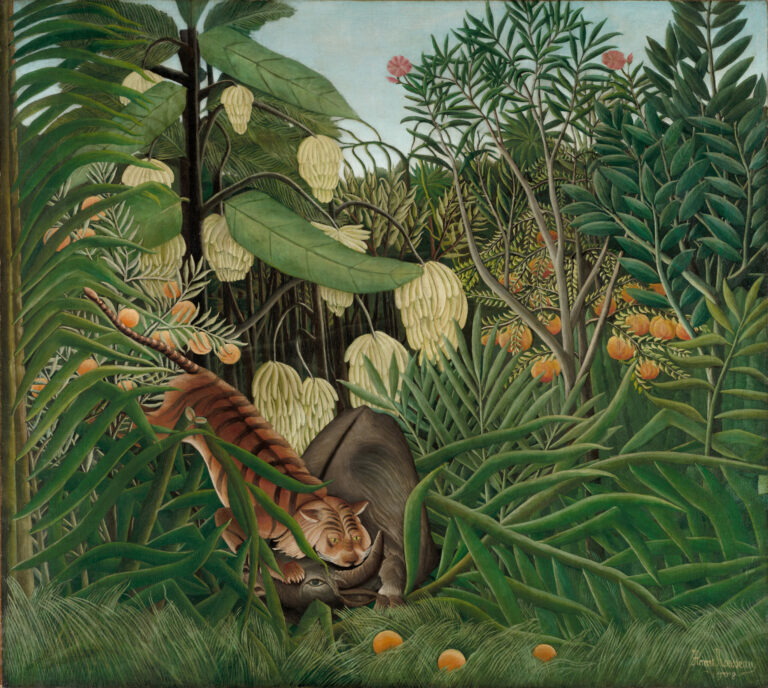
Paris, 1910. A retired customs officer sets down his brush for the last time. Henri Rousseau has just completed his most spellbinding jungle, without ever having left France.
A Jungle of Paper and Dream
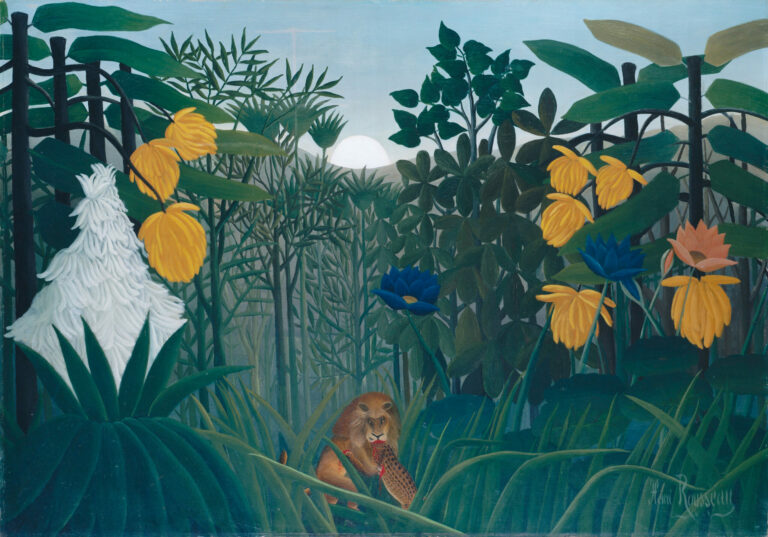
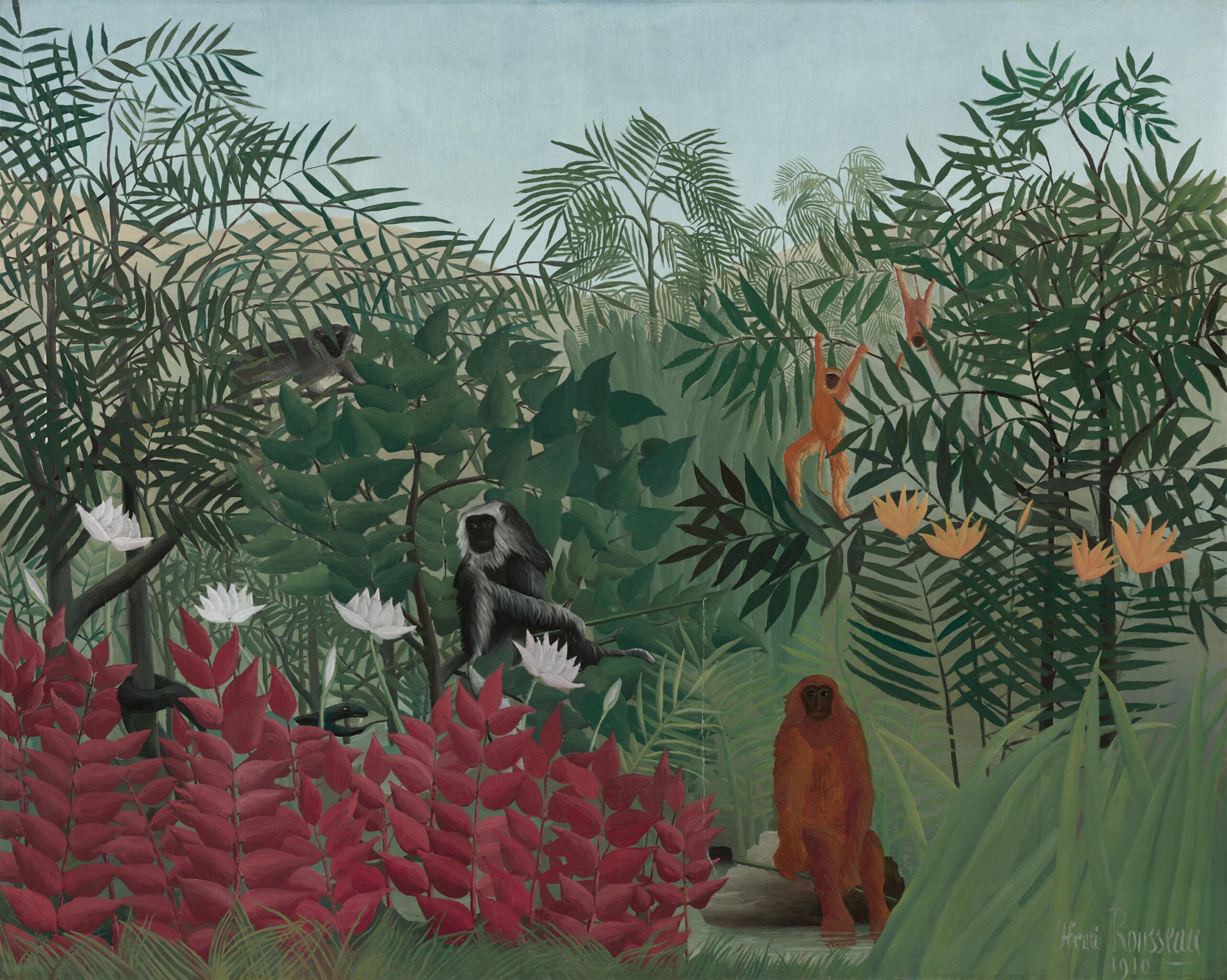
Look at this canvas: a profusion of deep greens, scarlet reds, suspended white flowers. Giant leaves cut out in flat, clean shapes, like layered theatre silhouettes. Rousseau works with a naïve and hypnotic precision. No cast shadows, no conventional depth. The monkeys seem to float between the branches. One holds what appears to be a fishing rod. That almost human gesture stops the eye. This jungle does not roar, it dreams.
The Naïf Who Conquered the Avant-Garde
Rousseau never set foot in the tropics. His virgin forest is born from the Jardin des Plantes, the Paris zoo, and the lithograph albums sold at the Galeries Lafayette. In 1910, colonial expansion fascinated the Western imagination. The press overflowed with smiling explorers posed in the bush. Rousseau absorbed that collective fantasy and transformed it. His anthropomorphised monkeys are not wild beasts: they embody an escape from the Parisian jungle, a gentle and silent utopia. This canvas is one of his last, painted just months before his death.
Henri Rousseau, le Douanier
Born in Laval, entirely self-taught, Henri Rousseau (1844-1910) was long ridiculed by the official academy. Yet Picasso, Apollinaire and the Surrealists admired him deeply. His style made him an unwitting forerunner of modernity.
A Question for You
💭 Look at these flat planes, these clean outlines, this absence of classical perspective: is it clumsiness or deliberate choice? The boundary between outsider art and modern art has rarely been so porous.
About this work
- Tropical Forest with Monkeys
- Henri Rousseau
- 1910
- Oil on canvas
- 129.5 × 162.5 cm
- National Gallery of Art, Washington
- https://www.nga.gov/artworks/61253-tropical-forest-monkeys
The Jardin des Plantes as Source of an Imaginary World
Henri Rousseau never set foot in a tropical jungle. He never travelled beyond France. His forests, and he painted dozens of them, are entirely constructed from indirect sources: the exotic greenhouses and menagerie of the Jardin des Plantes in Paris, albums of colonial lithographs circulating through bazaars and department stores, and his own visual memory of vegetation in Parisian parks. Tropical Forest with Monkeys (1910) is one of the last paintings he completed before his death in September of that year. The large canvas (129.5 × 162.5 cm) is characteristic of Rousseau at his peak: planes of foliage stacked like theatrical backdrops, red flowers suspended in space, monkeys arranged among the plant masses with a strange dignity. One of them holds a fishing rod — an absurd detail that transforms the naturalistic representation into a fable.
The John Hay Whitney Collection and the National Gallery of Washington
Tropical Forest with Monkeys is part of the John Hay Whitney Collection, donated to the National Gallery of Art in Washington, where the work is held under number 61253. John Hay Whitney (1904-1982) was one of the great American collectors of the 20th century, diplomat, publisher, and passionate advocate for modern art. His collection, assembled from the 1930s onward, brings together many French Impressionist and Post-Impressionist works. The presence of this late Rousseau in that ensemble is significant: by the end of his life, the “Douanier” was recognised and defended by the Parisian avant-garde, Picasso, Apollinaire, and the future Surrealists, but also collected by international enthusiasts who saw in him a precursor of modern painting. This canvas, completed just weeks before his death, is one of the most accomplished expressions of a wholly autonomous pictorial vision.
The Surrealist Legacy
The critic Louis Vauxcelles had mocked Rousseau’s work as “silliness.” The irony is that the very qualities Vauxcelles refused to recognise, frontality, the absence of atmospheric depth, vegetation as a curtain rather than a space, were precisely what fascinated the Surrealists and influenced Yves Tanguy, Joan Miró, and Max Ernst. Rousseau’s forest is not a real forest: it is a space of projection, an interior stage dressed in green, which the 20th century learned to read as a precedent for the representation of the unconscious.